Louisiana Buck-to-Doe Ratio by Region
It's a common frustration for many deer hunters: you spend hours in the stand, seeing plenty of does and fawns, but those elusive bucks seem to be ghosts. You might wonder if your property is just "doe-heavy," or if there are simply no big bucks around. The truth is, the ratio of bucks to does in a deer herd can vary wildly, not just from state to state, but even from one region of Louisiana to another. Understanding these regional buck-to-doe ratios is absolutely crucial for dialing in your hunting strategy and increasing your odds of tagging a quality whitetail. This guide will dive deep into why these numbers fluctuate, how they impact deer behavior, and what you can do to adapt your approach based on where you're hunting in our great state.
Understanding the Buck-to-Doe Ratio and Why it Matters
When we talk about the buck-to-doe ratio, we're essentially looking at how many does there are for every mature buck in a given area. It's a key metric in deer herd management, and it paints a vivid picture of the health and balance of a local deer population. For hunters, knowing this ratio, or at least understanding its general trend in your hunting zone, can be a game-changer.
What Exactly is the Ratio?
At its simplest, a buck-to-doe ratio might be expressed as 1:2, meaning one buck for every two does. A ratio like 1:5 means one buck for every five does. Generally, wildlife biologists strive for a more balanced ratio, ideally closer to 1:1 or 1:2, especially in areas managed for quality deer. A highly skewed ratio, say 1:10 or worse, suggests a heavily female-dominated herd. This usually means bucks are being harvested at a much higher rate, or there's simply less buck habitat.
In many parts of Louisiana, particularly on public lands or heavily hunted private tracts that prioritize quantity over quality, ratios can often lean heavily towards does. This isn't inherently bad for the herd's survival, as fewer bucks are needed to breed all the does. However, it can significantly impact hunting dynamics, especially during the breeding season, or "rut."
Why Hunters Care About It
Why should a hunter spend time thinking about these numbers? Because the buck-to-doe ratio directly influences deer behavior, especially the intensity and predictability of the rut. In an area with a very high doe-to-buck ratio, a handful of bucks have a lot more does to breed. This means they don't have to work as hard to find receptive does, and the rut tends to be more drawn out and less intense, with bucks spreading their breeding efforts over a longer period. You might not see those classic "chasing" behaviors or intense buck fights as often.
Conversely, in areas with a more balanced ratio, bucks face more competition. They have to actively seek out and compete for fewer receptive does, leading to a more defined, intense rut with more daylight activity. This competition can make bucks more responsive to calls like rattling and grunting, and generally more predictable in their movements as they search for does. Knowing your local ratio helps you set expectations and fine-tune your tactics. It's a fundamental piece of the puzzle, alongside understanding Louisiana Deer Hunting Area by Area and local food sources.
Impact on Deer Behavior and Rutting Activity
The buck-to-doe ratio plays a huge role in how bucks behave throughout the hunting season. When the ratio is heavily skewed towards does, younger bucks often have a greater chance to participate in breeding because the few mature bucks can't cover all the receptive does. This can result in a rut that feels a bit "meager" or drawn out, without the explosive activity many hunters dream of. Bucks might breed does as they come into estrus, without a concentrated period of intense chasing.
On the other hand, a more balanced ratio can lead to a more condensed and intense rut. More bucks vying for fewer does means more competition, more chasing, more fighting, and more movement. You'll often see bucks covering greater distances, checking scrapes and rubs more frequently, and generally being more active during daylight hours. This is why knowing your specific area's ratio helps you time your hunts. For instance, if you're in an area with a balanced ratio, focusing your efforts during the peak of the rut, as discussed in Hunting the Rut in the Early-Start Areas, can be incredibly productive. If it's heavily skewed, you might need to adjust for a longer, less defined breeding window.
Regional Differences in Louisiana's Buck-to-Doe Ratios
Louisiana is a diverse state, from the piney woods of the north to the sprawling marshes and the rich agricultural lands of the delta. It stands to reason that deer populations, and thus buck-to-doe ratios, will reflect these different habitats, hunting pressures, and management strategies. What works in one area might be totally off-base in another.
North Louisiana's Piney Hills and Farm Country
In the rolling piney hills and adjacent farm country of North Louisiana, you often find a mix of private timberland, smaller agricultural fields, and some public hunting opportunities within Kisatchie National Forest Hunting. Historically, these areas have seen consistent hunting pressure, leading to buck-to-doe ratios that can be quite varied. On intensely managed private lands with strict harvest criteria and supplemental feeding, you might find ratios closer to 1:2 or 1:3. These landowners are actively trying to balance the herd for trophy potential.
However, on smaller, less managed private tracts or much of the public land, the ratio can easily be 1:4 or 1:5. This is due to a higher harvest rate of antlered bucks, often young ones, combined with less pressure on the doe population. Hunters might see a lot of deer, but mature bucks can be sparse. Hunting here often means focusing on careful scouting and understanding Scouting Louisiana Public Land Before Season to find those pockets where bucks might grow older.
The Florida Parishes – A Different Dynamic
The Florida Parishes, encompassing the southeastern part of the state, present a unique scenario. Areas like East and West Feliciana, and parts of St. Helena and Tangipahoa parishes, are renowned for producing some of Louisiana's biggest bucks. This isn't just luck; it's often due to excellent habitat, fertile soils, and a strong culture of quality deer management on large private landholdings. Many of these properties actively manage for older age-class bucks, often implementing antler restrictions and focusing doe harvest to maintain healthy populations.
Because of this intensive management, the Florida Parishes often boast more balanced buck-to-doe ratios, sometimes as low as 1:2 or even 1:1 in prime areas. This increased competition among bucks leads to more active rutting behavior and the opportunity for bucks to reach older age classes, resulting in larger antlers. If you're hunting these areas, you're likely in a situation where understanding buck behavior during the rut, perhaps through methods like Rattling Volume in Thick Cover, can be incredibly effective.
The Mississippi River Delta and Tensas Basin
The rich, alluvial soils of the Mississippi River Delta and the Tensas Basin have historically supported incredibly dense deer populations. Areas like the Richard K. Yancey Wildlife Management Area within the Tensas Basin are famous for their sheer numbers of deer. However, high deer density doesn't always equate to balanced buck-to-doe ratios, especially in public hunting scenarios or on lands not specifically managed for quality.
In many parts of the delta, the ratio can still be skewed towards does, potentially 1:4 or 1:5. This is often because the sheer abundance of deer means less pressure is needed to maintain herd numbers. While there are certainly mature bucks here, their density relative to does might be lower than in more intensely managed areas. Recent concerns about Louisiana's Chronic Wasting Disease Zones in this region are also influencing management strategies, which could impact future ratios as managers adjust harvest guidelines. When hunting here, focusing on known travel corridors and food sources can be more productive than relying solely on rut activity.
The Atchafalaya Basin and Swamp Lands
The vast, intricate wetlands of the Atchafalaya Basin and other swamp lands across South Louisiana offer a truly unique deer hunting experience. Access is often difficult, requiring boats and a deep understanding of the waterways. This natural barrier to entry can lead to different buck-to-doe dynamics compared to more accessible uplands. In many deep swamp areas, bucks might have a better chance of reaching maturity simply because they are harder to hunt consistently.
While overall deer density might be lower in the deepest parts of the Basin compared to agricultural lands, the buck-to-doe ratio can sometimes be more balanced, or at least less skewed, simply because hunting pressure is spread out and difficult to maintain. However, on accessible edges or higher ground within the swamp, pressure can quickly skew the ratio. Where Atchafalaya Basin Bucks Bed can offer clues for finding these less-pressured bucks, which may contribute to a more balanced local ratio due to less harvest.
How Ratios Are Monitored and Interpreted
Understanding the buck-to-doe ratio isn't just about hunter anecdotes; it's a science. Wildlife agencies, like the Louisiana Department of Wildlife and Fisheries (LDWF), invest significant resources into monitoring deer populations. Hunters also play a critical role, consciously or unconsciously, in providing data that helps build a clearer picture.
LDWF's Role in Herd Management
The LDWF is constantly working to monitor the health and dynamics of Louisiana's deer herd. They gather data through various means, including mandatory deer harvest reporting, hunter surveys, and biological sampling at check stations. This data, when aggregated across regions, helps them estimate deer populations and trends, including buck-to-doe ratios. They also conduct aerial surveys, spotlight counts, and track fawn recruitment to get a more complete picture. The goal is to set season dates and bag limits that promote healthy, sustainable deer populations.
It's a complex task, especially in a state with such diverse habitats and hunting traditions. The LDWF uses these ratios, along with other metrics, to inform decisions about either-sex days, antler restrictions, and even special youth hunts like Louisiana Youth and Veterans Weekend Rules, all aimed at maintaining a balanced herd that provides ample hunting opportunities.
Hunter Observation and Trail Camera Data
While the LDWF provides statewide and regional data, individual hunters can gain invaluable insights into the buck-to-doe ratio on their specific hunting grounds. Your own observations from the stand are a primary source of information. Are you consistently seeing five does for every buck? Or is it closer to a one-to-one encounter rate? Keep a log, if you're serious about your property.
Trail cameras are another powerful tool. By running cameras year-round or consistently through a season, you can collect a wealth of data. Many modern trail cameras and associated apps, including platforms like GoHunt, allow you to categorize and count deer by sex and age class. Over time, this builds a localized buck-to-doe ratio estimate for your property. This real-world, ground-level data is incredibly helpful for fine-tuning your personal hunting strategy, as it often provides a more granular view than broad regional averages. It gives you direct insight into the specific conditions affecting Louisiana Buck Age Structure on your land.
Challenges in Estimating Accurate Ratios
Despite all the efforts by wildlife agencies and individual hunters, arriving at truly precise buck-to-doe ratios across an entire state like Louisiana is incredibly challenging. Deer are elusive, their movements can be localized, and their populations fluctuate with habitat changes, weather patterns, and hunting pressure. Harvest data, while valuable, only tells you about the deer that were actually killed, not the full population that exists.
For example, a low buck harvest in a certain area might mean fewer bucks exist, or it might mean bucks are simply harder to hunt there due to dense cover. Similarly, sighting data can be biased. Does and fawns are often more visible and less wary than mature bucks, leading to an overestimation of the doe population if observations are the only metric. This is why a combination of methods, including scientific surveys and long-term hunter data, is crucial for LDWF to make informed decisions. GoHunt users often combine their individual camera data with broader regional trends to get a more comprehensive picture.
Adjusting Your Hunting Strategy Based on Regional Ratios
Once you have a better understanding of the general buck-to-doe ratio in your hunting area, you can make smarter decisions about how and where you hunt. Your approach to food plots, calling, and even stand placement should ideally shift to match the herd dynamics you're likely to encounter.
High Doe-to-Buck Ratios (More Does)
If you're hunting an area with a significantly high doe-to-buck ratio (say, 1:5 or more), your strategy during the rut might need to shift. Since bucks have less competition, they often don't have to cruise as widely or aggressively to find receptive does. This can mean less visible rutting activity, and bucks might be less responsive to aggressive calling like rattling.
In these situations, focusing on food sources and natural funnels becomes even more critical. Does will consistently be drawn to prime food plots, acorn flats, or agricultural fields. Bucks, even if fewer in number, will eventually show up to check these doe groups for receptive females. Hunting the travel corridors leading to and from these food sources, or establishing stands overlooking them, can be very effective. Patience is key. You might see many does before that lone buck finally makes an appearance, and he might move more cautiously. In these environments, understanding Entry Routes Through Standing Soybeans or Hunting a Green Field Planted for Deer becomes paramount.
Balanced or Buck-Heavy Ratios (More Bucks)
When you're fortunate enough to hunt an area with a more balanced buck-to-doe ratio (closer to 1:1 or 1:2), the rut can be an entirely different ballgame. With more bucks competing for fewer available does, the intensity of the breeding season escalates. Bucks will be more aggressive, more vocal, and more prone to chasing and fighting. This is when calling strategies really shine.
Aggressive rattling and grunting can often provoke a response from bucks actively seeking out rivals or does. Focus your scouting on fresh rub lines and scrape lines – these are calling cards from bucks establishing dominance and marking territory. Hunting pinch points and funnels that direct deer movement, especially between bedding and feeding areas, can be incredibly productive during the rut. Using apps like GoHunt can help you identify these natural travel routes and potential ambush spots. This is a great time to implement tactics like Rattling and Grunting in Louisiana or Scrape Lines Along a Logging Road which become much more effective when bucks are actively competing.
The Impact of Pressure on Ratios
Hunting pressure is a massive factor that can influence local buck-to-doe ratios, especially on public lands. When an area sees heavy hunting pressure, particularly during the firearms season, young bucks are often the first to be harvested. This can rapidly skew the ratio, leaving fewer bucks to breed the doe population and potentially impacting the quality of future hunting seasons.
Heavily pressured areas often develop a population of highly nocturnal, wary bucks that are incredibly difficult to hunt. Even if the overall buck population is decent, their daylight visibility might be extremely low. To counter this, hunters need to get creative. This might mean walking further than others, finding obscure access points, or focusing on midweek hunts when pressure is lower. It's about Finding Ground Others Walk Past or getting into those hidden pockets where bucks can feel safe enough to move during the day, despite a skewed ratio caused by heavy overall pressure. Understanding Why Louisiana's Gun Opener Draws the Biggest Crowds and planning to avoid them can be a huge advantage.
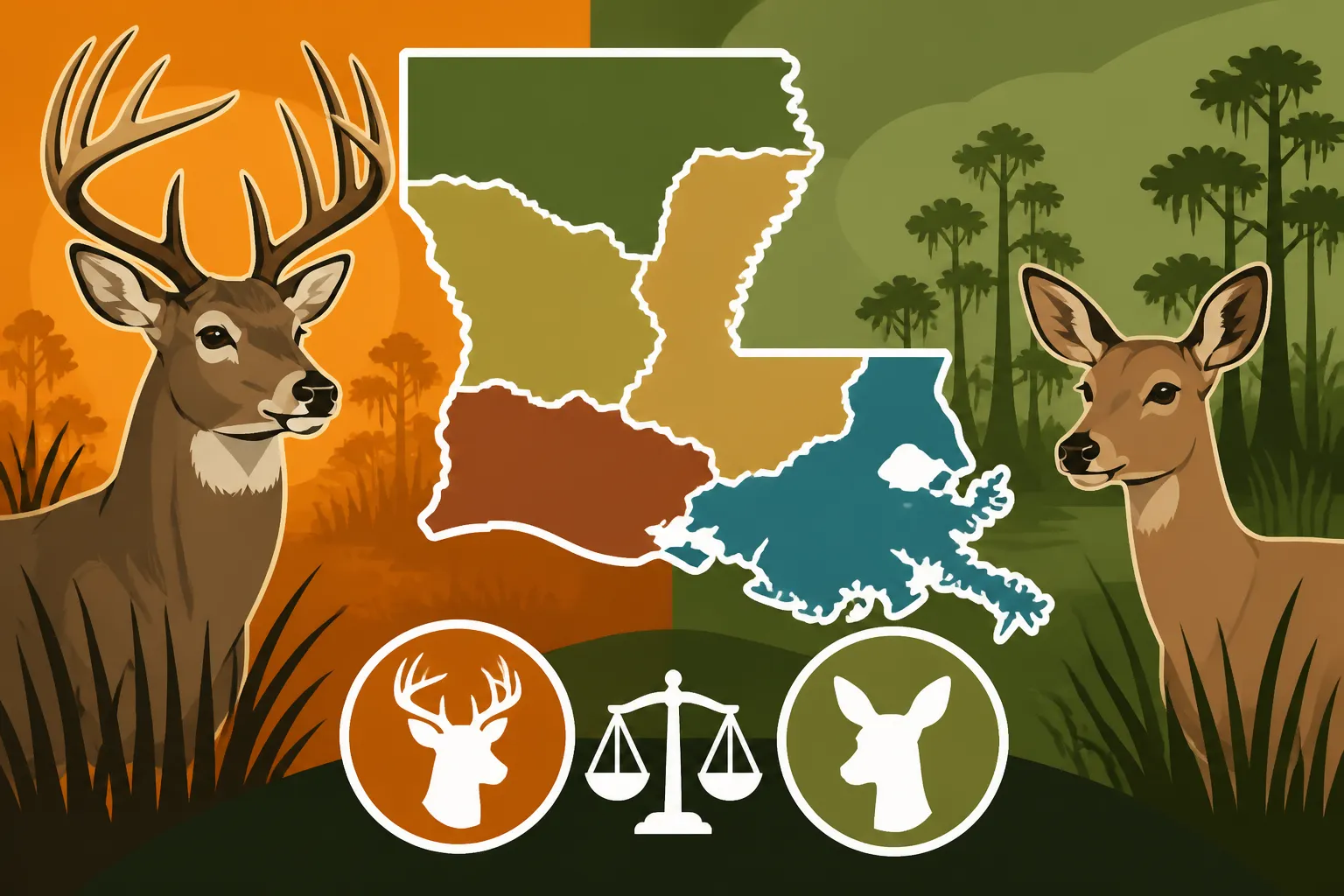
Here's a quick overview of how buck-to-doe ratios might broadly differ across Louisiana:
| Region | Typical Buck-to-Doe Ratio (Approx.) | Rut Intensity | Hunting Strategy Focus |
|---|---|---|---|
| North Louisiana Piney Hills | 1:4 to 1:6 | Moderate to Low | Food sources, travel corridors, long sits, careful scouting for pockets of less-pressured bucks. |
| Florida Parishes | 1:1 to 1:3 | High | Aggressive calling, focusing on buck sign (rubs/scrapes), pinch points, peak rut timing. |
| Mississippi River Delta/Tensas Basin | 1:3 to 1:5 | Moderate | Food sources, primary trails, observation stands in high-density areas. |
| Atchafalaya Basin/Swamp Lands | 1:2 to 1:4 (variable) | Moderate to High | Access challenges, isolated high ground, understanding water levels, less-pressured areas. |
Remember, these are general trends, and specific properties or even small sections of public land can have micro-climates of deer populations that differ significantly. The best way to understand your specific hunting spot is through diligent scouting, consistent observation, and leveraging tools like trail cameras and mapping apps.
Disclaimer
This article is for general informational purposes only and does not constitute professional advice. Laws, prices and regulations vary by location and change over time. Consult a qualified professional for guidance on your specific situation.