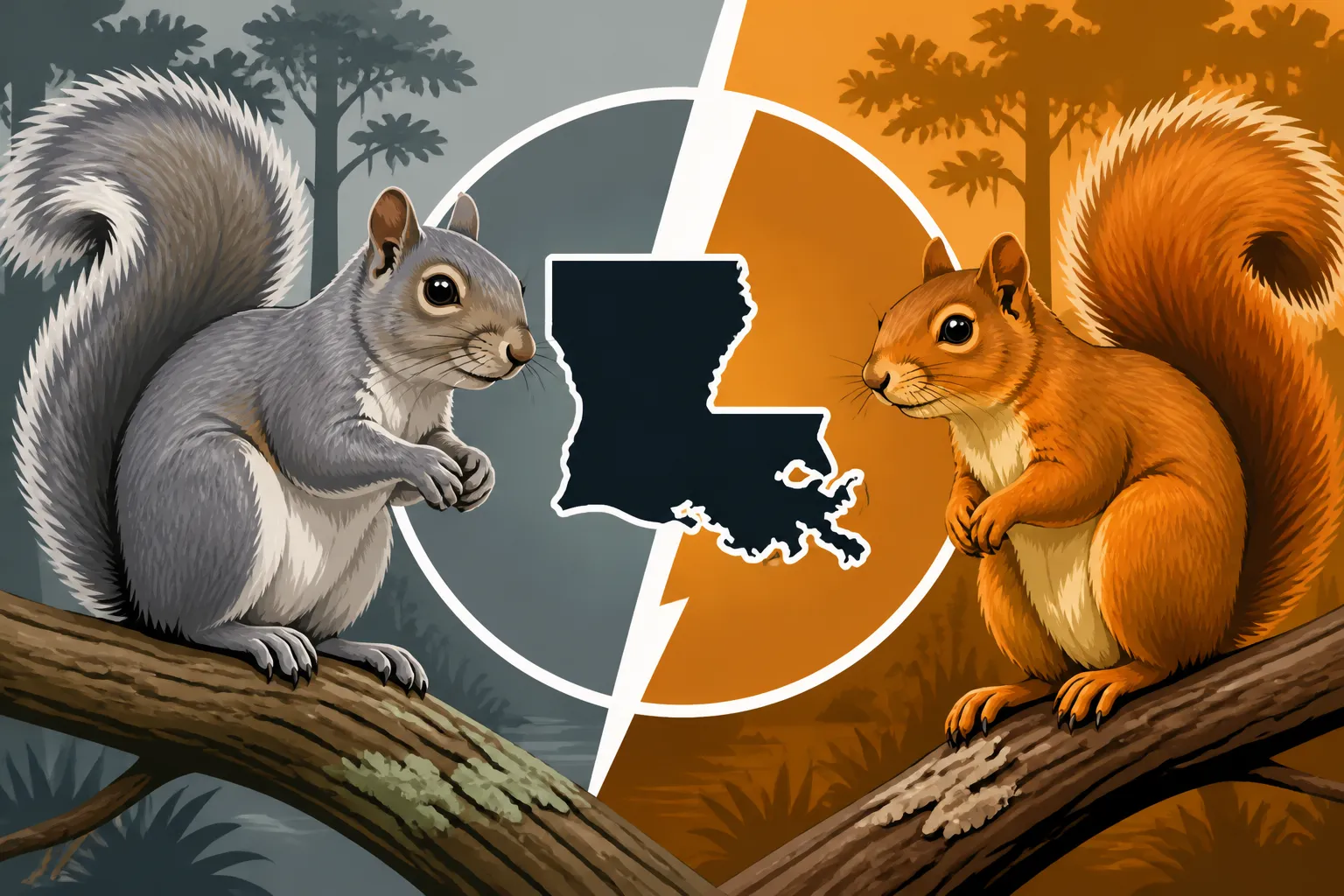
Gray Versus Fox Squirrels in Louisiana
For many of us who grew up chasing game through the bayous and pine forests of Louisiana, the rustle of leaves high in an oak or the scolding bark from a dense thicket immediately brings to mind one thing: squirrels. But if you’ve spent any real time in the field, you've probably noticed that not all squirrels are created equal. This guide will help you understand the distinct differences between the common gray squirrel and the often-larger, more elusive fox squirrel, offering insights into their behaviors, preferred habitats, and specific hunting strategies that will make your time afield more productive and enjoyable.
Understanding the Two Main Species
When you're out in the Louisiana woods, whether it's the bottomland hardwoods or the rolling piney hills, you're primarily going to encounter two species of squirrels: the Eastern gray squirrel and the fox squirrel. While both are tree squirrels and share some general characteristics, they are quite distinct, and knowing these differences can profoundly impact your hunting success and overall appreciation for these fascinating critters. It's not just about size; it's about their entire approach to life in the trees.
Key Physical Distinctions
Let's start with what you can see. The most obvious difference between gray and fox squirrels is their size. Eastern gray squirrels ( Sciurus carolinensis) are generally smaller and more slender. Think of them as the acrobats of the canopy, darting with incredible speed and agility. Their fur is predominantly gray, often with a brownish tint on their back and sides, and they sport a bright white belly. Their tails are full and bushy, a characteristic gray with white-tipped hairs that give it a frosted appearance. They tend to weigh in the range of a pound to a pound and a half.
Fox squirrels ( Sciurus niger), on the other hand, are the heavyweights of the squirrel world. These are robust, chunky squirrels, often twice the size of their gray counterparts, easily weighing two to three pounds, sometimes even more. Their coloration is far more variable and striking. While some fox squirrels can have a reddish-brown or yellowish-brown coat, many in Louisiana exhibit beautiful patterns of gray, black, and rust, often with a darker head and face. Their bellies can be orange, rusty, or even black. Their tails are also full and bushy, but often appear darker and more consistently colored, lacking the frosted look of a gray squirrel's tail. If you spot a squirrel that makes you do a double-take because of its sheer size and vibrant coloring, it's almost certainly a fox squirrel. Louisiana Squirrel Harvest Numbers can give you an idea of how many of each species are typically taken.
Behavioral Differences You'll Notice
Beyond their looks, these two species behave quite differently, which is crucial for hunters to understand. Gray squirrels are social creatures, often seen in groups, especially where food is plentiful. They are incredibly active, constantly foraging, chasing each other, and generally moving at a breakneck pace. Their high-energy antics make them somewhat easier to spot, but their speed and agility also make them challenging targets. When spooked, a gray squirrel will often "bark" vociferously, a rapid series of chattering calls that can alert every other squirrel in the vicinity. They’ll also often run up a tree and then quickly circle to the opposite side of the trunk, using the tree itself as a shield, peeking around to see if the threat has passed.
Fox squirrels, by contrast, are more solitary and deliberate. They move at a slower, more methodical pace, often foraging on the ground or leisurely climbing a tree. They're less prone to the frenetic bursts of energy that characterize gray squirrels. When alarmed, a fox squirrel typically won't bark or chatter as much as a gray. Instead, they often freeze in place, sometimes flattening themselves against a tree limb or a patch of bark, relying on their camouflage to evade detection. If they do move, they might slowly creep around the far side of a tree and stay put, hoping you'll pass them by. This more cautious, less vocal behavior makes them inherently more difficult to locate and get a shot at, especially in dense cover. A good understanding of their habits is key to successful Squirrel and Small Game Hunting in Louisiana.
Habitat Preferences and Where to Find Them
Knowing where to find each species is perhaps the most critical piece of the puzzle for a successful squirrel hunt. While there can be some overlap, gray and fox squirrels generally prefer different types of forest environments. Understanding these preferences will help you narrow down your search and focus your efforts on the areas most likely to hold your target species. Think of it like a roadmap to their homes.
Gray Squirrels: The Forest Dwellers
Gray squirrels are classic forest inhabitants. They thrive in dense, mature hardwood forests, particularly those with a strong mast crop like oaks and hickories. They love continuity in the canopy, allowing them to travel extensively from tree to tree without touching the ground. You’ll find them in abundance in bottomland hardwoods, river swamps, and extensive mixed pine-hardwood forests where hardwoods dominate the understory and mid-story. Large tracts of timber with a diverse age class are ideal. If you're hunting in the Kisatchie National Forest, for example, look for the mature oak flats or the dense creek bottoms.
These areas provide not only a consistent food source but also ample den trees. Gray squirrels often utilize tree cavities for nesting and shelter, although they will also construct large leaf nests (dreys) high in the branches. The dense canopy cover and numerous escape routes among the intertwined branches are perfect for their fast-paced, arboreal lifestyle. When you're scouting with a tool like GoHunt, look for expansive areas of mature hardwoods, especially those along waterways or in rich river bottoms. These are the places where you'll hear the incessant chattering and see the blur of gray movement. Many hunters find success in Squirrel Hunting Louisiana Bottomland Hardwoods, which are prime gray squirrel territory.
Fox Squirrels: More Open Woods and Edges
Fox squirrels, in contrast to their gray cousins, prefer more open, park-like woodlands, often with a strong pine component, or even agricultural edges. They're less dependent on a continuous canopy and spend a significant amount of time on the ground foraging for nuts, seeds, and even fungi. You’ll frequently find them in pine stands, mixed pine-hardwood forests with more widely spaced trees, open oak savannahs, and along the edges of agricultural fields or pastures. They don't mind fragmented woodlands as much as grays. In areas like the Florida Parishes, where pine plantations are common, or along farm country roads, fox squirrels are often the dominant species.
Their larger size and more deliberate movements mean they're better adapted to spending time on the ground. When they do climb a tree, it's often a single, larger tree in a more open setting. Fox squirrels also rely heavily on tree cavities for denning but may make drey nests in more isolated trees. When using your GoHunt maps to scout, target those areas with open pine stands, mature scattered hardwoods, or forest edges bordering fields. You might even find them in urban parks or large residential areas where there are mature nut-bearing trees but less dense canopy cover. These environments provide the ground-level foraging opportunities they favor, as well as the larger, more isolated trees where they might feel secure.
| Feature | Eastern Gray Squirrel ( Sciurus carolinensis) | Fox Squirrel (Sciurus niger) |
|---|---|---|
| Size | Smaller, slender (1-1.5 lbs) | Larger, robust (2-3+ lbs) |
| Coloration | Predominantly gray, white belly, white-tipped tail hairs | Highly variable: reddish, brownish, gray, black, rust, orange belly |
| Tail | Bushy, frosted gray with white tips | Bushy, darker, often reddish-brown or black without white tips |
| Sociality | More social, often seen in groups | More solitary |
| Activity | Very active, fast-moving, agile, arboreal | More deliberate, slower, spends more time on the ground |
| Vocalization | Frequent, loud chattering and barking when alarmed | Less vocal, typically freezes or quietly slips away when alarmed |
| Preferred Habitat | Dense, mature hardwood forests, bottomlands, river swamps | Open woodlands, pine stands, mixed pine-hardwood, agricultural edges, isolated trees |
| Escape Tactic | Runs around tree, darts through canopy | Freezes, flattens, quietly moves to far side of tree |
Hunting Strategies Tailored for Each Species
Successfully hunting gray and fox squirrels requires different approaches. What works for one might be less effective for the other due to their inherent behavioral differences. It’s all about adapting your tactics to the specific animal you’re pursuing, just like you would for different deer species. Getting to know the nuances of Louisiana Squirrel and Rabbit Season Rules is also a good first step before hitting the woods.
Stalking the Stealthy Gray
When hunting gray squirrels, speed and quiet movement are your allies. Because they are so active and often travel in groups, a "still-hunting" or "stalking" method can be very effective. This involves moving slowly and deliberately through the woods, pausing frequently to scan the trees and listen for their characteristic barks and rustles. Focus on areas with abundant mast, especially oak or hickory flats. As you move, keep your eyes peeled for any movement in the canopy or on the ground. When you spot one, try to get a shot before it dashes off.
If you spook a gray, don't give up immediately. They'll often run up a tree and then quickly pivot to the opposite side of the trunk. Position yourself so the wind is blowing towards you, and slowly circle the tree, peeking around the trunk until you spot it again. Sometimes, if you stay still and quiet, a gray squirrel will eventually peek its head around or resume movement, offering a shot. Another effective method is to find a good spot near a productive feeding tree or a travel corridor between den trees, sit quietly, and wait for them to appear. This "sit-and-wait" approach is especially good for early mornings or late evenings when squirrels are most active. Carrying a pair of lightweight binoculars can also help you scan the high canopy for subtle movements. Scouting Louisiana Public Land Before Season is always a great idea for finding these productive spots.
Ambushing the Bolder Fox Squirrel
Hunting fox squirrels often requires a more patient and deliberate approach, much like deer hunting. Given their solitary nature and tendency to freeze, traditional still-hunting can be challenging if you're solely relying on movement. Instead, identifying prime fox squirrel habitat – those more open, park-like woods or field edges – and then setting up in a spot with good visibility can be highly productive. Look for larger, isolated trees, particularly those bearing nuts, and position yourself to intercept them as they move or feed.
Since they spend more time on the ground, paying close attention to the base of trees and open areas is crucial. If you spot a fox squirrel and it freezes, use your knowledge of their behavior. Rather than trying to circle immediately, which might spook it into a full dash, try to remain perfectly still yourself. Wait them out. Often, after a few minutes, they’ll slowly start to move, presenting a shot. Their larger size means they're a more substantial target, but their cautious nature means getting that first shot is paramount. If you're using a tool like GoHunt to mark potential feeding areas or travel routes in these more open habitats, you can often predict where a fox squirrel might appear. Just remember, patience is truly a virtue when it comes to these bigger, bolder but warier squirrels.
Equipment Considerations
For both species, a .22 caliber rimfire rifle is a classic and effective choice. It's accurate, relatively quiet, and offers plenty of punch for squirrels while being economical. Headshots are always preferred to preserve meat. Many hunters also opt for a small-gauge shotgun, such as a .410 or 20-gauge, especially in denser cover where quick shots are necessary or for younger hunters. Load up with smaller shot sizes like #6 or #7.5.
Consider your clothing as well. Camouflage is certainly helpful, but more important is quiet material that won't rustle as you move. Comfortable walking boots are essential, as squirrel hunting often involves a lot of walking. A game vest or small backpack for carrying your harvested squirrels, water, and perhaps a snack will also make your hunt more enjoyable. Don't forget bug spray, especially in the early season, as Louisiana's insects are no joke! For those hunting in the cooler months, dressing in layers is always smart, as mornings can be chilly and afternoons quite warm. Always remember to check Louisiana Squirrel Season Opening Day and Louisiana Squirrel Daily Bag Limit before you head out.
Beyond the Hunt: Conservation and Management
While hunting squirrels is a cherished tradition in Louisiana, understanding their broader ecological role and conservation status is important. As ethical hunters, we play a part in managing these populations and ensuring their health for future generations.
Population Status and Trends
Both gray and fox squirrel populations are generally robust across Louisiana. They are adaptable animals and, as long as suitable habitat and food sources are available, tend to thrive. Gray squirrels, with their preference for widespread mature hardwood forests, enjoy stable populations in many parts of the state. Their prolific breeding habits also help them bounce back quickly from localized disturbances.
Fox squirrels, while perhaps less numerous in certain highly fragmented or urbanized areas, also maintain healthy populations, particularly in the piney woods and agricultural regions where their preferred habitat exists. Like any wildlife, their numbers can fluctuate based on factors such as mast crop failures, severe weather events (like hurricanes impacting den trees), or localized habitat loss. However, neither species is currently considered at risk in Louisiana. Regular monitoring by the Louisiana Department of Wildlife and Fisheries helps ensure these populations remain healthy and sustainable for both hunting and ecological balance. Understanding these dynamics is part of being a responsible steward of the land and its wildlife.
The Role of Habitat in Their Survival
The long-term health of both gray and fox squirrel populations is directly tied to habitat quality and availability. For gray squirrels, this means the preservation and regeneration of mature hardwood forests. Large, connected tracts of timber are vital, offering consistent food, denning sites, and protection from predators. Sustainable forestry practices that ensure a continuous supply of mast-producing trees are beneficial.
For fox squirrels, maintaining diverse forest structures, including open pine stands and mixed woodlands with a healthy understory, is key. Their reliance on ground foraging means that areas with a good litter layer and varied vegetation are important. Prescribed burns, when managed carefully, can also create the more open, park-like conditions that fox squirrels favor by reducing dense undergrowth while promoting new forage. As hunters, supporting land management initiatives that focus on diverse forest health benefits not only squirrels but also a wide array of other wildlife, creating richer ecosystems for all. When we look at a place on GoHunt, we're not just looking for a spot to hunt; we're looking at an ecosystem.
Disclaimer
This article is for general informational purposes only and does not constitute professional advice. Laws, prices and regulations vary by location and change over time. Consult a qualified professional for guidance on your specific situation.