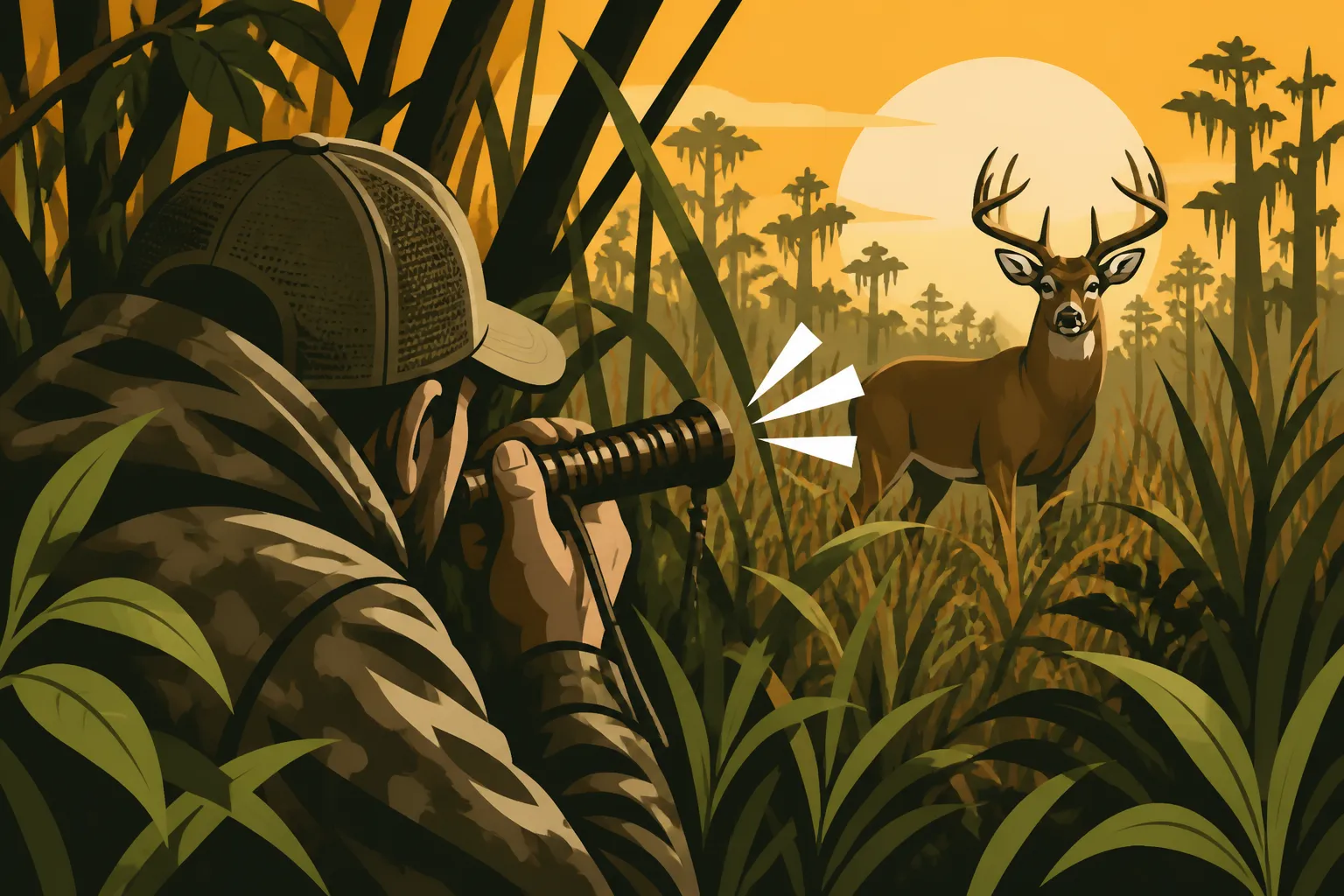
Rattling Volume in Thick Cover
If you've ever tried rattling for deer in Louisiana's dense woods, you know the frustration. You clash those antlers together, put your heart into it, and then… crickets. It's easy to feel like your efforts are just swallowed by the thick palmetto, tangled briars, or expansive cypress swamps, leaving you wondering if any deer even heard you. This guide is all about cutting through that noise (or lack thereof) to help you master rattling volume in our state's challenging, thick cover, ensuring your calls are heard and bring those bucks in.
The Unique Challenges of Rattling in Louisiana's Thick Cover
Hunting deer in Louisiana is an experience unlike many other places. Our landscape, while incredibly rich and diverse, presents specific hurdles, especially when it comes to calling techniques like rattling. The sheer density of our forests and swamps can make even the most aggressive rattling sequence seem like a whisper.
Why Traditional Rattling Strategies Fall Short Here
When you watch hunting shows or read articles about rattling, a lot of the advice often comes from folks hunting more open terrain – think big midwestern ag fields or western sagebrush country. In those environments, sound carries for hundreds of yards, and deer can often see the "fight" from a distance. But down here in Louisiana, that traditional wisdom just doesn't cut it. Our terrain is a tapestry of thick bottomland hardwoods, dense regenerating clear-cuts, suffocating river cane breaks, and marshy cypress-tupelo swamps. These environments are designed to absorb and scatter sound, making it incredibly difficult for your rattling to reach deer that are more than a few dozen yards away.
Imagine a buck cruising through a palmetto flat in the Kisatchie National Forest, where visibility might only be 20 yards. A soft rattle in that scenario is likely to be completely missed. You're not just trying to make noise; you're trying to create a sonic footprint that demands attention and can penetrate the layers of vegetation. The deer here are accustomed to a different acoustic landscape, and we, as hunters, need to adapt our calling volume and technique to match it. This often means being more assertive than you might be elsewhere, just to get noticed.
Understanding How Sound Travels (or Doesn't) in Dense Woods
The way sound behaves in our dense Louisiana woods is fascinating, and understanding it is key to effective rattling. Sound waves, by nature, travel best in open, unobstructed spaces. When they encounter obstacles like tree trunks, dense canopies, thick undergrowth, and even heavy humidity, they don't just pass through cleanly. Instead, they get reflected, refracted, scattered, and absorbed. Think of it like trying to shout across a crowded, noisy room versus an empty field – the energy of your voice is constantly being dampened and redirected.
In a humid Louisiana swamp, the air itself can play a role, sometimes muffling sounds further. Wind, too, can be a double-edged sword; a strong breeze might carry your rattling sound further in one direction, but it will also make it harder for deer to pinpoint the source, and can completely drown it out if they're upwind. This complex acoustic environment means that a rattle that sounds perfectly convincing to you might barely register as a faint, indistinguishable noise to a deer just 75 yards away, especially if there's a thick stand of yaupon or thorny briars between you. Knowing these limitations is the first step in overcoming them, pushing you to consider higher volume or different strategies to truly grab a buck's attention.
Mastering Rattling Volume for Maximum Effectiveness
Getting the right volume for your rattling in Louisiana isn't a one-size-fits-all approach. It's about knowing when to be subtle and when to really lay into those antlers, depending on the situation. The key is to project sound effectively without sounding unnatural or overdoing it for the specific conditions.
When to Go Loud: Aggressive Tactics in Heavy Brush
There are definitely times in Louisiana when you need to be assertive with your rattling, especially if you're trying to call a buck from deep within heavy cover. The peak of the rut, for instance, is a prime example. During this time, bucks are testosterone-fueled, constantly seeking out does, and highly competitive. They're more likely to investigate a perceived fight, even if it sounds quite aggressive. If you're hunting during the rut in areas known for good buck activity, like certain sections within Louisiana Deer Hunting Area by Area, don't be afraid to go for a loud, crashing sequence.
This aggressive approach is particularly effective in extremely dense areas where you need to project sound as far as possible. Think about those impenetrable palmetto thickets or tracts of young, regenerating timber that are almost impossible to walk through. Your goal isn't just to make noise, but to create the convincing illusion of a full-blown, knock-down-drag-out buck fight. This means not just clashing antlers, but incorporating sounds like breaking branches, scuffing leaves, and deep grunts. Really get into it, hold the antlers firmly, and hit them together with authority, simulating the bone-jarring impact of two mature deer. This kind of sound can cut through more vegetation and is more likely to pique the interest of a dominant buck looking to assert his territory or steal a hot doe. Using heavier, larger synthetic antlers or robust real deer antlers will help you generate the necessary volume and depth of sound to carry in these conditions.
When to Keep it Subtle: Finesse Rattling for Close Encounters
While there are times for aggressive rattling, there are equally important situations where a more subtle, finesse approach is the ticket. This is often the case during the early season, when bucks are still in their bachelor groups and less inclined to fight, or in the late season when they're worn out and wary. It's also critical when you suspect deer are already nearby, perhaps just out of sight in some moderately thick cover. The goal here isn't to draw a buck from a quarter-mile away, but rather to gently pique the curiosity of a deer that's already within, say, 75-100 yards.
In these instances, a softer, less intense rattling sequence can be far more effective. You want to mimic the sound of light sparring, a buck just rubbing his antlers on a bush, or perhaps a younger, less aggressive interaction. Use lighter rattling bags or smaller shed antlers to create soft clicks, gentle scrapes, and subtle rubs. These sounds don't scream "challenge" but rather suggest a natural, non-threatening deer presence. This can be particularly useful when you're set up in a Treestand Setups in Kisatchie National Forest and want to draw in a buck that's already in the general vicinity without alerting him to your exact location with overly aggressive sounds.
Integrating soft grunts with your subtle rattling can add another layer of realism. A short, quiet grunt immediately after a few light antler clashes can make the scene incredibly convincing, suggesting a buck that's just finished a mild interaction and is now asserting himself softly. Remember, the idea is to invite investigation, not to sound like an alarm. Often, a gentle, curious approach can be far more persuasive to a wary Louisiana buck than a full-on brawl.
Practical Techniques and Gear for Louisiana's Terrain
Successfully rattling in Louisiana's diverse and often dense terrain requires more than just clashing antlers. It's about having the right tools, knowing how to use them, and understanding how to combine different elements to create the most convincing illusion.
Choosing the Right Rattling Equipment
The equipment you choose for rattling can significantly impact the volume and realism of your calls, especially in thick cover. There are three main categories: real antlers, synthetic antlers, and rattling bags. Each has its pros and cons in the Louisiana environment.
- Real Antlers: These are often considered the gold standard for realism. They produce a very natural, sharp crack and hollow resonance that's hard to replicate. Heavier, larger real antlers from mature bucks will create the most volume and deep tones, which can be essential for cutting through dense vegetation. The downside is they can be bulky, heavy, and sometimes awkward to carry, especially when trying to navigate thick briar patches or swampy ground. They're also prone to absorbing moisture, which can dampen their sound over time if not dried properly. For aggressive, high-volume calls, real antlers are tough to beat.
- Synthetic Antlers: Brands like Rattling Forks or Knight & Hale offer synthetic versions. These are designed to mimic the sound of real antlers but come with the advantage of being lighter, more durable, and completely weatherproof. They won't get waterlogged, making them ideal for our humid, often wet conditions. While some might argue they lack the exact "ring" of bone, modern synthetics have come a long way. Some models are specifically designed with larger, hollow sections to maximize sound projection, which is a huge benefit when you need to make noise in a thicket. They are often less expensive than a good set of real sheds, too.
- Rattling Bags: These are the most compact and quietest option. Typically, a rattling bag contains wooden dowels or synthetic sticks that create a gentler, more subtle clashing sound when shaken. They're fantastic for simulating light sparring, a buck rubbing a tree, or when you want to avoid startling close-range deer. They excel in situations where you need minimal noise or are trying to coax a buck the last few yards into an open shooting lane. However, they lack the sheer volume and impact necessary for aggressive rattling in very dense cover. If your hunting app like GoHunt shows particularly thick, unbroken stands of timber in your scouting area, you might opt for heavier synthetic antlers over a bag for better reach.
The best approach for a Louisiana hunter is often to have a selection. A robust set of real or high-quality synthetic antlers for loud, aggressive sequences and a rattling bag for those subtle, close-range finesse calls.
Integrating Other Calls and Scents with Rattling
Rattling in isolation can be effective, but its power is dramatically amplified when you combine it with other calling techniques and even scents. Think of it as creating a multi-sensory experience for the deer, painting a more complete picture of what's happening in their woods.
The most natural pairing with rattling is a grunt call. Bucks grunt for various reasons – asserting dominance, calling to does, or communicating during a fight. By incorporating grunts immediately before, during, or after your rattling sequence, you add realism. A deep, guttural grunt during a loud rattling session makes it sound like a full-blown altercation, while a softer, inquisitive grunt after a subtle rattle can make a nearby buck think another deer is just passing through. Learning to produce different types of Grunt Calls in Mature Louisiana Timber can significantly enhance your setup.
Doe bleats are another excellent addition. If you can make a doe bleat a few seconds into your rattling sequence, it simulates a doe that might be caught in the middle of two fighting bucks, or a buck that's just won a skirmish and is now looking for the doe. This can be an irresistible draw for a rutting buck. Finally, don't underestimate the power of visual and olfactory cues. Creating a mock scrape nearby, especially if you add some deer urine or a synthetic buck lure, can ground your rattling in a specific spot. Bucks often circle downwind of a call to scent-check the area, so placing a mock scrape where they'll naturally encounter it on their approach can be incredibly effective. Always be mindful of the Wind and Thermals in Swamp Bottomland and position your setup so the scent travels into the approach path of the deer you're trying to call.
Positioning and Presentation in Dense Thickets
Your rattling setup isn't just about the sounds you make; it's crucially about where you make them and how you present yourself. In Louisiana's thick cover, thoughtful positioning can mean the difference between success and a deer slipping by undetected.
First, elevation is almost always your friend. Whether you're in a climber, lock-on, or ladder stand, getting 15-20 feet up helps your rattling sound travel further above the dense undergrowth. It also gives you a better vantage point to spot deer approaching through the thick stuff, which is critical since they often come in quickly and quietly. When hanging your stand, always try to create a few shooting lanes, even narrow ones, into the thickest cover around you. You might not get a wide-open shot, but a 10-yard window is all you need sometimes.
When it comes to the act of rattling, don't just sit there silently and clash your antlers. Make it sound like a real deer. Scuff your boots on the leaves, break a small branch underfoot, or even stomp the ground softly to mimic a buck pawing the earth. These subtle additions create an even more authentic scene. After a rattling sequence, remain absolutely motionless for at least 5-10 minutes. Bucks will often approach cautiously, stop, and listen intently before moving again. They might even try to circle downwind to get a whiff of the "fighters." Being hidden and ready is paramount, especially since a buck coming to a rattle in thick cover often appears like a ghost, suddenly materializing within easy bow range. Consider utilizing natural cover or even a Using a Ground Blind on Louisiana Public Land to ensure you're completely concealed while calling.
Reading Deer Reaction and Adjusting Your Strategy
Calling deer in thick Louisiana cover is a dynamic process. It's not just about making noise; it's about listening, watching, and reacting to how the deer respond. Each encounter is a lesson, and adapting on the fly can turn a slow morning into an unforgettable hunt.
Deciphering Deer Behavior After Rattling
Once you've finished your rattling sequence, the real hunting begins. Louisiana bucks are notoriously cagey, and their reactions can range from an immediate charge to a cautious, almost imperceptible approach. Knowing what to look for and how to interpret their behavior is key.
Often, the first sign you've been heard might not be a deer crashing through the brush. It could be a subtle ear flick, a head snapping up in the distance, or even a soft stomp of a hoof. Watch for any unusual movement in the vegetation. Bucks that come to a rattle often try to circle downwind to get a scent of the "fight." This classic "circle downwind" maneuver is why your wind direction is so critical and why you need to be prepared to pivot or have multiple shooting lanes. If a buck starts to circle, try to anticipate his path and be ready. Don't be surprised if he hangs up just out of sight, trying to visually locate the source of the sound before committing. They might stand there for several minutes, evaluating the scene.
Patience is your best friend after rattling. Deer won't always charge in like a locomotive. Many will approach slowly, stopping frequently to scan and listen. If you don't see anything after a few minutes, resist the urge to rattle again immediately. Give it a good 5-10 minutes of intense scanning. Sometimes a soft doe bleat after this pause can be the trigger that brings in a hesitant buck who's been lurking just out of sight. A good understanding of Hunting the Rut in the Early-Start Areas and Hunting the Rut in the Long-Window Areas will also inform how aggressive or cautious a buck might be in his approach.
Adapting Your Rattling to Current Conditions
Successful rattling isn't just about a single technique; it's about being a chameleon, adapting your strategy to the ever-changing conditions in the Louisiana woods. What works perfectly one day might fall flat the next.
Weather plays a huge role. On a calm, clear, crisp morning, sound will carry much better than on a humid, windy, or rainy day. If it's windy, you might need to increase your volume and duration to ensure the sound isn't completely washed out. Rain can dampen sounds significantly, but it can also make deer less wary, as their own sounds are masked. During periods of high humidity, sound can often be muffled, requiring a more forceful approach to project your rattling effectively.
The time of day also matters. Early mornings and late afternoons, when deer are most active, are typically the best times for rattling. Mid-day, when deer are often bedded down, might require a longer, more drawn-out sequence to stir them from their beds. The phase of the rut is perhaps the most critical factor. During the pre-rut, subtle, inquisitive rattling might be more effective as bucks are still establishing dominance. During the peak rut, aggressive, high-volume rattling can be incredibly effective, as bucks are actively seeking and challenging rivals. Post-rut, when bucks are exhausted, a softer, less threatening approach might be best to catch the attention of a weary animal.
Finally, consider the hunting pressure. On heavily pressured public lands, like those you might find described in Hunting Pressure on Louisiana Public Land, deer are much warier. They've likely heard rattling before, and too much noise can send them running. In these areas, a more subtle, less frequent rattling sequence, combined with long periods of silence, might be more productive. On private land with less pressure, you might get away with more aggressive and frequent calling. Always take a moment to assess the specific situation before you even pick up your antlers.
| Condition / Rut Phase | Cover Density | Recommended Volume | Rationale |
|---|---|---|---|
| Peak Rut | Extremely Thick | Loud & Aggressive | Cut through cover, capitalize on high buck aggression. Mimic real fight. |
| Peak Rut | Moderately Thick | Moderate to Loud | Still aggressive, but fine-tune to avoid overdoing it if deer are closer. |
| Peak Rut | Moderate | Moderate | Realistic fight simulation, but allows for observation before commitment. |
| Pre-Rut / Post-Rut | Extremely Thick | Moderate to Loud | Still need to project sound, but less aggressive to avoid spooking. |
| Pre-Rut / Post-Rut | Moderately Thick | Subtle to Moderate | Pique curiosity, less about challenge. Mimic light sparring. |
| Early Season | Any | Subtle | Bucks less aggressive, focus on curiosity. Avoid startling. |
| Wary / Pressured Deer | Any | Very Subtle | Minimal noise to avoid educating or alarming sensitive deer. |
| High Wind / Rain | Any | Increase Volume | Compensate for sound dampening by atmospheric conditions. |
Disclaimer
The information provided in this guide is for educational and entertainment purposes only. Hunting regulations and best practices can change, and it is the hunter's responsibility to stay informed about all current Louisiana Department of Wildlife and Fisheries (LDWF) rules and local ordinances. Always prioritize safety, respect wildlife, and obtain all necessary licenses and permits before hunting.