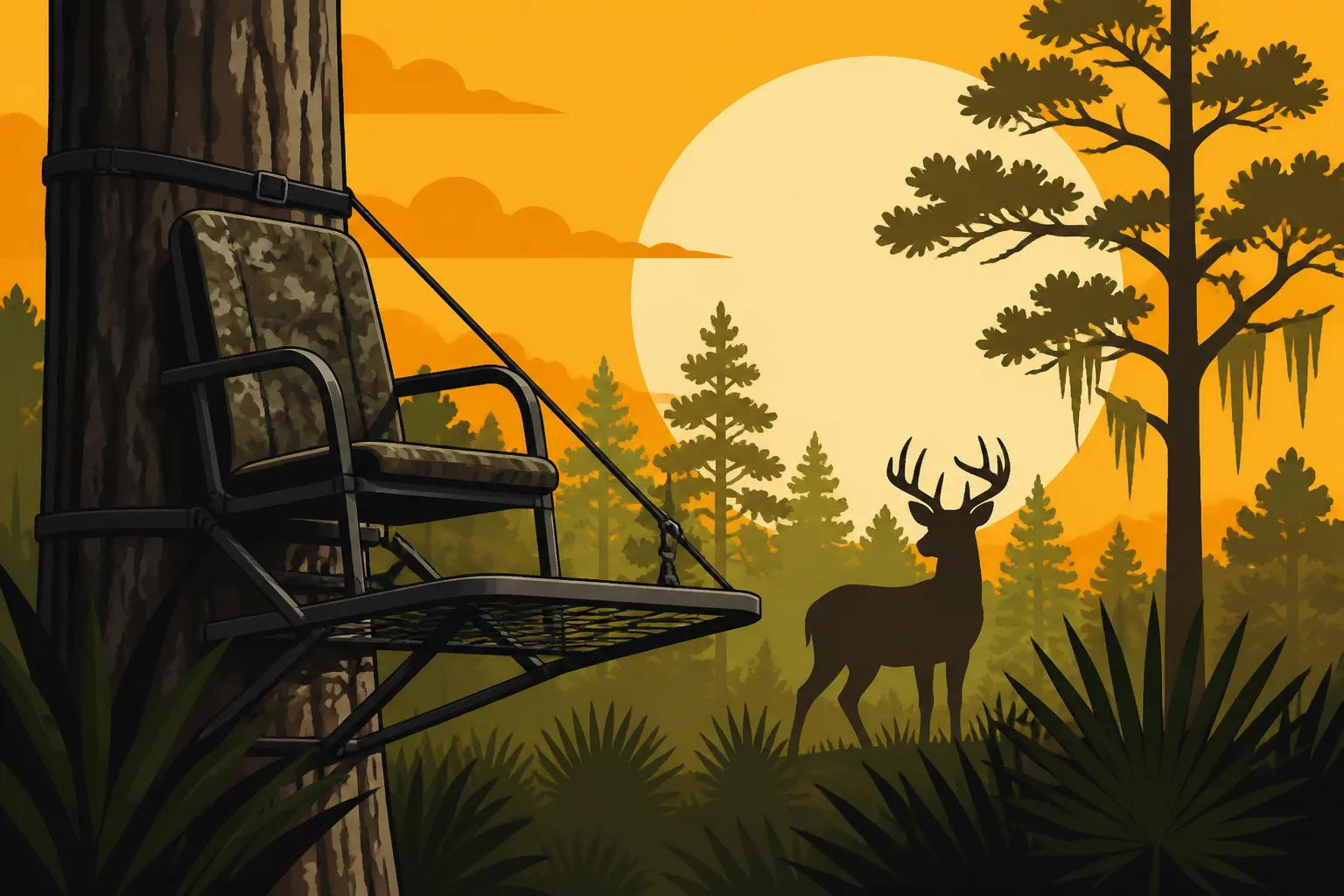
Treestand Setups in Kisatchie National Forest
Hunting in a vast, sprawling public land like Kisatchie National Forest can feel overwhelming. You've got thousands of acres, dense timber, and deer that are often more wary than their private-land cousins. One of the biggest hurdles hunters face is figuring out where and how to effectively set up a treestand to consistently encounter deer. This guide is here to walk you through the nuances of treestand placement in Kisatchie, helping you turn those daunting woods into a productive hunting ground.
Understanding Kisatchie's Unique Terrain and Challenges
Kisatchie National Forest, spread across various ranger districts in central and north-central Louisiana, isn't your typical flatland hunting experience. It presents a diverse landscape that requires a thoughtful approach to treestand hunting. Ignoring these characteristics will lead to unproductive sits and missed opportunities.
The Dense Forests and Varied Topography
Unlike some open timber tracts, Kisatchie is often characterized by very dense pine and mixed hardwood forests, especially in areas that haven't seen recent thinning or burns. This thick cover can make visibility a real challenge, but it also provides excellent sanctuary for deer. You'll encounter everything from rolling piney hills and ridges to swampy bottoms and creek drains, sometimes within a relatively small area. Understanding how deer utilize this varied topography is paramount. For instance, deer might bed on a high, dry ridge for security, but they'll often travel through the thicker creek bottoms to access water and food sources. The subtle elevation changes, even just a few feet, can create natural travel corridors that are easily overlooked if you're not paying close attention. It’s a completely different game than, say, hunting an open agricultural field.
Hunting Pressure and Deer Behavior
Let's be real, Kisatchie National Forest is public land, and it sees hunting pressure. Especially during the opening weekends of deer season and any special primitive firearms weekends, you'll encounter other hunters. This pressure directly impacts deer behavior. Mature bucks, in particular, become incredibly nocturnal and will quickly learn to avoid areas with heavy human scent and activity. They'll often seek out the densest cover, the hardest-to-reach pockets, and move during the darkest hours. This means your treestand placement can't just be about finding a food source; it has to factor in security. You're trying to intercept deer that are actively trying to avoid you and everyone else out there. This often means hunting deeper, off the beaten path, and being extremely mindful of your entry and exit routes. It's not uncommon to find deer bedded within a few hundred yards of a busy road if the cover is thick enough and they feel secure.
Scouting for Success Before Hanging Your Stand
You wouldn't build a house without a blueprint, and you shouldn't hang a treestand without thorough scouting. This is especially true in the vastness of Kisatchie, where blind luck is a rare commodity. Pre-season work is the backbone of any successful hunt here.
Interpreting Topographic Maps and Aerial Imagery
Before you ever set foot in the woods, your best friend will be a good mapping application. Tools like GoHunt offer incredibly detailed topographic maps and aerial imagery that can reveal secrets the forest floor might hide. Look for features that create natural funnels or pinch points: the inside corners of clearcuts, saddles between ridges, creek crossings, and changes in timber type. A small strip of hardwoods winding through a pine plantation, for example, can be a major travel corridor. Pay close attention to subtle elevation changes; even a rise of 10-15 feet can be enough for deer to prefer as a travel route or a bedding area if it offers good visibility and cover. You're looking for areas that concentrate deer movement, whether it's because of terrain features or adjacent cover. Understanding Reading a Ridge for Central Louisiana Deer can give you a significant advantage in these varied landscapes.
Once you identify these potential hotspots on the map, mark them. This gives you a starting point for your on-the-ground scouting. Don't be afraid to zoom in and out, looking at the bigger picture of how deer might move between large blocks of cover or food sources, then narrowing down to the exact points where you think they'd pass. The digital age has truly changed how we approach public land, and leveraging these tools is no longer an option but a necessity.
On-the-Ground Sign Recognition
Mapping gets you close, but nothing beats boots on the ground. Once you've identified promising areas from your armchair scouting, it's time to walk the terrain. Look for fresh deer sign: rubs, scrapes, fresh tracks, and droppings. During the early season, pay attention to food sources like acorns, persimmons, or green browse in creek bottoms. Later in the season, deer might shift to different mast crops or browse. Look for well-worn trails, especially those connecting bedding areas to feeding areas or water. These trails might not be obvious, often winding through thickets, but they are gold. If you find a funnel identified on your map, verify it with physical sign. Is there a faint trail running through it? Are there rubs leading into it? Confirming your digital observations with real-world evidence is critical.
Don't just look for sign; interpret it. Are the tracks large, indicating a mature buck? Is there a fresh rub line indicating active rutting behavior in the area? Are the scrapes consistently worked? The more current and concentrated the sign, the better your chances. This is also where you determine the direction of deer travel, which is essential for placing your stand for the right shot angle. Remember, deer leave clues, and your job is to become a detective. Learning Finding Sign in Big Kisatchie Timber will drastically improve your success rate.
Strategic Treestand Placement: Key Considerations
You've done your homework; now it's time to get down to the business of hanging a stand. This isn't just about picking a tree; it's about making a series of calculated decisions that will determine whether your hunt is successful or ends with a "close call."
Maximizing Visibility and Shooting Lanes
When you select a tree, climb up to your intended hunting height and evaluate your shooting lanes. What looks open from the ground can be surprisingly obstructed from 20 feet up. You want clear lanes to any likely deer trails or pinch points you've identified, but without over-trimming. Over-trimming creates an obvious "hunter's nest" that deer will quickly avoid. Think about what a deer would see looking up. Minimal trimming for maximum visibility is the goal. Remember that a deer's vitals are a relatively small target, and a small twig can deflect an arrow or bullet enough to cause a miss or, worse, a wound.
Consider the angle of your shot. If a trail passes directly under your stand, a straight-down shot can be difficult for archery hunters. Ideally, you want deer to pass slightly to your side, offering a broadside or quartering-away shot. Also, think about background. Can you effectively blend in with the tree, or will you silhouette against the sky? Look for trees with a busy canopy or other trees behind you to break up your outline. The less you stand out, the better.
Playing the Wind and Thermals
This is arguably the most critical factor in treestand placement, especially on pressured public land like Kisatchie. Deer have an incredible sense of smell, and if they catch your scent, your hunt is over before it begins. You must position your stand so that your scent cone blows away from where you expect deer to approach or travel. This means constantly checking wind direction and having multiple stand locations for different winds. It's not enough to check the wind at ground level; thermals can pull your scent up or down depending on the time of day and temperature, especially in hilly or swampy terrain.
In the morning, as the sun rises, thermals typically rise, carrying your scent upward. In the evening, as the air cools, thermals fall, carrying your scent downward into low-lying areas. In Kisatchie's varied landscape, this can be complex. A stand overlooking a creek bottom might be perfect in the morning with a rising thermal but deadly in the evening as your scent sinks into the very area you're hunting. Conversely, a ridge-top stand might work better in the evening. Always have a plan for how to access and exit your stand without blowing your cover, considering both wind and thermals. This is where a good mapping app like GoHunt with real-time weather overlays can be incredibly useful for planning your specific hunt.
Identifying Natural Funnels and Travel Corridors
Deer are creatures of habit and efficiency. They'll use the path of least resistance or the path of most security. Your job is to find these routes and set up along them. Natural funnels can be subtle, like a narrow strip of timber between two clearcuts, or more obvious, like a low saddle in a ridge line that deer use to cross from one side to another. Creek bottoms, drainage ditches, and old logging roads that have grown over can also serve as major travel corridors. When you're Hunting a Ridge-Top Saddle for Rutting Bucks, you're specifically targeting one of these funnels.
Look for pinch points where deer are forced into a smaller area. This could be where dense thickets meet more open timber, or where a waterway becomes too wide to easily cross, forcing deer to use a specific crossing point. These are prime locations for a treestand. During the rut, these funnels become even more critical, as bucks will cruise them looking for does. Consider terrain features that influence deer movement even subtly. A slight bench on a hillside might be preferred over a steeper incline. Focus on areas that provide cover for deer while they travel, offering them security as they move from bedding to feeding areas.
Types of Treestands and When to Use Them
Choosing the right tool for the job is essential, and treestands are no exception. The type of stand you choose for Kisatchie will largely depend on the specific terrain, your hunting style, and how much mobility you need.
Climbers, Hang-Ons, and Ladders
- Climber Stands: These are incredibly popular for public land hunting due to their portability and versatility. If you're hunting timber with relatively straight, limbless trees, a climber allows you to quickly move and adapt to changing conditions or deer patterns. They're excellent for run-and-gun tactics or when you need to cover a lot of ground and set up quickly. However, they're limited to trees that are relatively straight and don't have low limbs, which can sometimes be a challenge in Kisatchie's diverse forest types. Brands like Summit and Lone Wolf make excellent lightweight climbers. When you're constantly adapting to Hunting Pressure on Louisiana Public Land, a mobile climber can be a game-changer.
- Hang-On Stands: These offer more flexibility in tree choice, as they can be used in trees with limbs or unusual shapes. You'll need climbing sticks or steps to get up the tree. Hang-ons are great for setting up semi-permanent sets in specific, proven locations. You might have several sets pre-hung on public land (where allowed) and rotate between them based on wind direction or recent sign. They often provide a more stable and comfortable platform for longer sits. The downside is they require more effort to set up initially, and moving them can be time-consuming. Hawk and Millennium stands are well-regarded for their comfort and stability.
- Ladder Stands: While less common for deep public land penetration due to their bulk, ladder stands have their place in areas where you can easily access them, perhaps along a remote forest road or near a food plot edge. They offer maximum comfort and stability, making them ideal for all-day sits. They're usually a more permanent fixture once erected. For hunting Entry Routes Through Standing Soybeans on the edge of the forest, a ladder stand could be a viable option if access is easy and disturbance is minimal. However, their visibility makes them less suitable for highly pressured areas deep in the woods.
Essential Treestand Accessories for Public Land
Beyond the stand itself, a few key accessories can make your Kisatchie treestand experience safer and more effective:
- Safety Harness: This isn't an accessory; it's non-negotiable. Always wear a full-body safety harness and stay tethered from the moment your feet leave the ground until they return. Treestand falls are a leading cause of hunting accidents. No deer is worth a serious injury or worse.
- Haul Rope: Essential for raising and lowering your bow, rifle, or backpack. Never climb with gear in your hands. This keeps you safe and allows you to move quietly.
- Lineman's Belt/Rope: For hang-on stands, a lineman's belt allows you to safely secure yourself to the tree while ascending with climbing sticks and installing your stand.
- Lightweight Backpack: Choose a pack that can carry your essentials without being bulky. Consider one with external straps to secure extra layers or your bow.
- Pruning Shears/Folding Saw: For clearing minimal shooting lanes once you're at height. Be judicious; less is more.
- Rangefinder: Critical for accurately judging distances in the woods, especially with archery equipment.
- Wind Checker: A small bottle of powder or a milkweed pod is invaluable for constantly monitoring wind direction and thermals.
Access and Entry/Exit Strategies
Setting up the perfect treestand means nothing if you spook deer on your way in or out. This is a common pitfall on public land, where minimizing your footprint is paramount.
Minimizing Disturbance on Public Land
Deer on Kisatchie are acutely aware of human intrusion. Your goal is to be a ghost. This means choosing entry and exit routes that avoid known bedding areas and food sources as much as possible, especially in the dark. Use natural features like creek beds (if dry), logging roads (if not too noisy or visible), or thick brush lines to hide your approach. Try to walk into the wind if possible, even if it means a slightly longer route, to prevent your scent from drifting into sensitive areas. If you plan to be Camping Rules on Kisatchie Forest Land, consider how your camp setup affects deer movement near your hunting areas.
Avoid breaking branches, talking loudly, or making unnecessary noise. Move slowly and deliberately. If you're walking in before dawn, a quiet headlamp with a red light option can illuminate your path without alerting game as much as a bright white beam. Remember, your hunt starts the moment you leave your vehicle. Any disturbance you create on the way in can ruin your hunt before you even climb into your stand.
Planning Routes to and From Your Stand
Always have a detailed plan for getting to and from your stand, and ideally, have backup routes for different wind directions. Think about how deer will react to your presence. If you walk directly through a feeding area to get to your stand, you've likely just spooked any deer already there. Instead, loop around, using the densest cover or the most challenging terrain to keep your presence undetected.
When it comes to exiting, the same rules apply. If you shoot a deer late in the evening, you might need to exit quickly to recover it. If you don't, and you plan to return the next morning, ensure your exit doesn't disturb the area so much that other deer are gone by dawn. Sometimes, staying in your stand until well after legal shooting light is the best strategy to allow deer to clear out naturally before you descend. Using mapping apps like GoHunt can help you plot these routes meticulously, marking quiet paths and potential obstacles.
Year-Round Stand Management and Maintenance
A treestand isn't a "set it and forget it" item, especially on public land. Regular attention ensures safety and effectiveness year after year.
Post-Season Adjustments and Relocation
Once the season wraps up, don't just abandon your stands. The off-season is the perfect time to evaluate their effectiveness. Did a stand consistently produce sightings? Did deer avoid it? Did the wind swirl unexpectedly? Use this information to make adjustments. Perhaps a stand needs to be moved 20 yards to catch a slightly different trail, or maybe it needs to be repositioned for a better wind advantage. The landscape itself changes with the seasons – undergrowth grows thick, logging might occur, or natural events like storms could alter travel routes.
This is also a great time for Scouting Louisiana Public Land Before Season for next year. While you're out there checking existing stands, look for new sign, new food sources, or new funnels that might have developed. Consider taking down stands that weren't productive and relocating them to new, more promising areas. Kisatchie is dynamic, and your strategy needs to be, too.
Safety Checks and Equipment Longevity
Safety should always be paramount. Before each season, and ideally before each hunt, give your treestand a thorough inspection. Check all straps, cables, bolts, and welds for wear, fraying, rust, or damage. Rodents love to chew on straps, and prolonged sun exposure can degrade materials. Replace any worn or damaged components immediately. If a component looks questionable, it's better to replace it than risk a fall.
Regular cleaning and lubrication can extend the life of your stand, especially in Louisiana's humid environment. Store your stands in a dry place during the off-season if you remove them from the woods. If you leave hang-on stands up year-round (ensure this is allowed by Kisatchie's specific WMA rules), plan for more frequent and thorough inspections. This preventative maintenance not only ensures your safety but also protects your investment in quality hunting gear.
| Treestand Type | Ideal Kisatchie Terrain | Mobility | Comfort | Tree Suitability | Key Advantages |
|---|---|---|---|---|---|
| Climber | Straight, limbless trees in pine/mixed forests | High | Medium | Straight, limbless, 8-20 inch diameter | Portable, quick setup, adaptable |
| Hang-On | Varied timber, trees with limbs/irregular shapes | Medium | High | Wide range of tree types | Versatile, stable, can be left in place |
| Ladder | Easy access points, field edges, minimal thickets | Low | Very High | Large, sturdy trees with easy ground access | Very comfortable, secure, good for long sits |
Disclaimer
Hunting on public land like Kisatchie National Forest carries inherent risks. Always prioritize safety, understand and adhere to all Louisiana Department of Wildlife and Fisheries (LDWF) regulations, and never take unnecessary chances. The information provided here is for educational purposes and should be combined with your own extensive scouting and safety practices.