Wind and Thermals in Swamp Bottomland
Hunting the dense, humid swamp bottomland of Louisiana presents a unique challenge: the wind seems to have a mind of its own, swirling and shifting unexpectedly. Just when you think you've got it figured out, thermals kick in, making your scent a highway for every deer in the parish. This guide is all about dissecting those frustrating air currents, giving you the knowledge to confidently predict and use wind and thermals to your advantage, rather than constantly battling them.
The Invisible Dance: Understanding True Wind Versus Thermals
When you're out in the open, "wind" feels pretty straightforward. It blows from one direction, and you generally know where your scent is going. But step into the thick, low-lying world of a Louisiana swamp bottomland, and suddenly that simple understanding goes out the window. Here, we're dealing with two distinct, often conflicting, forces: true wind and thermals. Learning to differentiate them and understand their behavior is the first step to becoming a more effective swamp hunter.
Defining True Wind in a Canopy
True wind is the larger-scale air movement, the one predicted by weather forecasts. It's driven by high and low-pressure systems, and it generally moves in a consistent direction at higher altitudes. However, once that true wind hits the dense, multi-layered canopy of swamp timber – the cypress, tupelo, oaks, and undergrowth – it gets broken up, deflected, and often channeled. What you feel on your face at ground level might be a fraction of the true wind, or it might be a completely localized swirl. This makes relying solely on a wind checker at your stand height incredibly deceptive. You might be smelling clean at your perch, but twenty feet below, your scent is swirling around, getting picked up by deer moving through the thickets. The taller and denser the canopy, the more fractured and unpredictable the true wind becomes at deer level.
Think about a river. The main current flows consistently, but eddies and backwashes form around obstacles like logs or bends. The swamp canopy acts like those obstacles, creating miniature "eddies" in the air currents. This is why you need to pay attention to how leaves are moving at different heights, not just what your wind checker is telling you right next to you. A consistent breeze at 20 feet might be completely absent or reversed at 5 feet, especially when the forest floor is sheltered by dense palmettos or brush. Understanding these dynamics is crucial for success, whether you're setting up a ground blind or a more traditional treestand.
The Role of Thermals: Rising and Falling Air
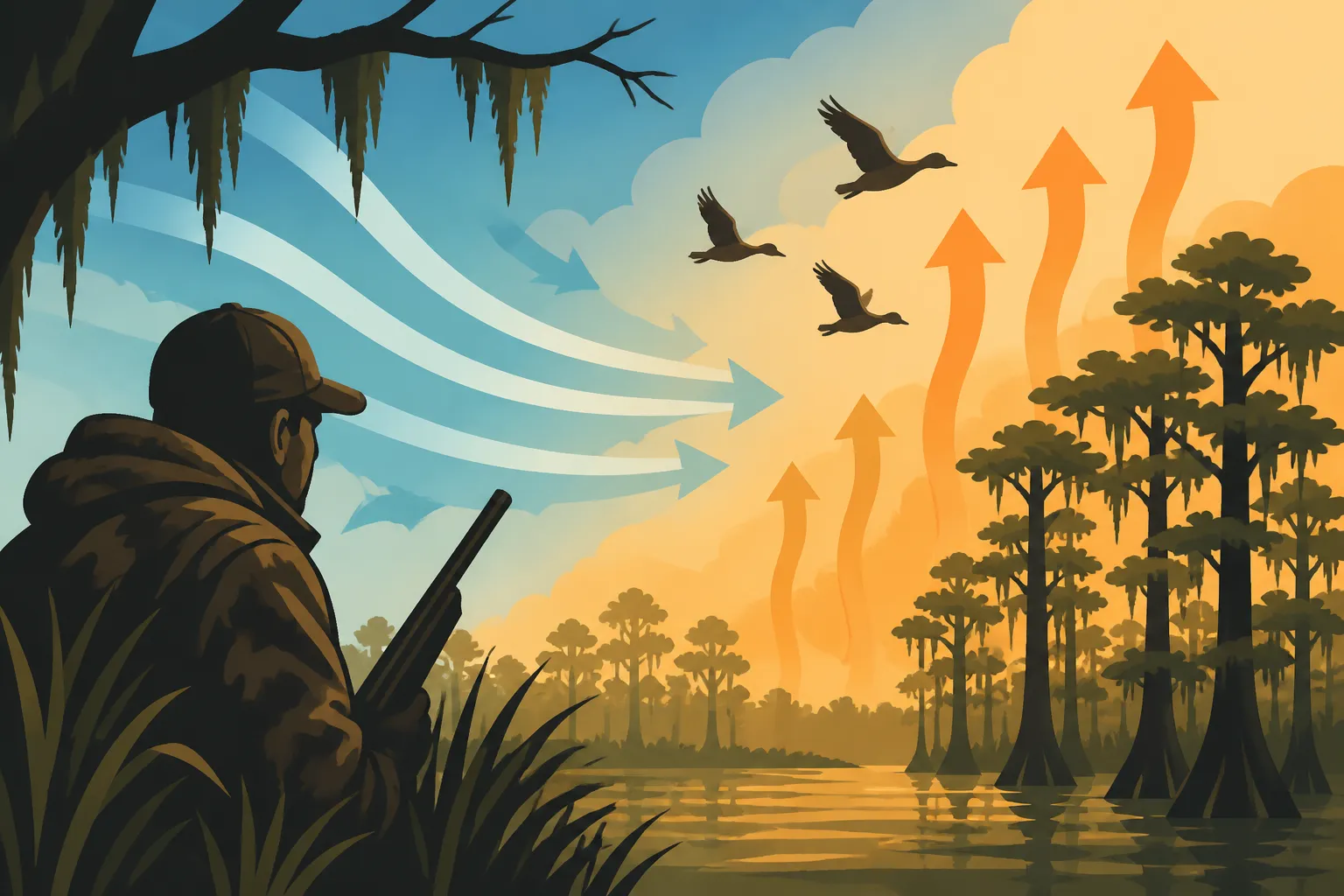
Thermals are an entirely different beast, driven by temperature differences in the air, not large-scale pressure systems. They are essentially convection currents, and they play a massive role in swamp bottomland, especially during those warm, still Louisiana days. As the sun heats the ground, the air directly above it warms up and becomes less dense. This warm air then begins to rise, creating an "updraft" or rising thermal. Conversely, as the sun sets and the ground cools, the air near the surface cools down, becomes denser, and begins to sink, creating a "downdraft" or falling thermal.
In the swamp, these thermals are often more dominant than light true winds, especially in the early morning and late evening. The air will literally flow uphill as it warms in the morning, and drain downhill as it cools in the evening. This means that if you're on a slight rise in the swamp – even a barely perceptible one – your scent will travel up that rise in the morning and down it in the evening, regardless of the gentle true wind. It's a critical concept, because if you set up on the wrong side of a thermal, your carefully planned entry and exit routes, and even your stand location, could be broadcasting your presence to every deer in the area. These thermals also dictate much of the deer movement and how they use the terrain to their advantage, often bedding in spots where they can rely on rising thermals to carry their scent up and away from danger during the day.
Swamp Specifics: How Water and Land Influence Air Movement
Louisiana's swamp bottomland is a unique mosaic of waterways, varying elevations, and dense vegetation. Each of these elements profoundly impacts how wind and thermals behave, creating a complex, dynamic environment for hunters. Ignoring these nuances is a surefire way to get busted by a mature buck.
Water's Influence: Bayous, Sloughs, and Standing Water
Water is a huge thermal regulator in the swamp. It heats up and cools down much slower than dry land. This difference in thermal retention creates predictable air currents around water bodies like bayous, sloughs, and areas of standing water. In the morning, as the land warms faster than the water, air over the land will rise, pulling cooler air from over the water towards the land. This often creates a subtle breeze towards the bank from the water. Conversely, in the evening, as the land cools faster, the air over the water remains warmer and rises, pulling cooler air from the land towards the water.
This "land-sea breeze" effect, even on a micro-scale within the swamp, is incredibly important. If you're hunting a bayou bank in the morning, positioning yourself on the far side of where you expect deer to approach, with your scent blowing towards the water, can be highly effective. The reverse is true in the evening. Understanding these localized air movements can make the difference between a successful hunt and a frustrated one. Always observe the smallest clues: how a mosquito repellent plume drifts, or how dew on the leaves disappears. This is especially true when you're focusing on specific areas like Cypress-Tupelo Swamp Edges or setting up near a major waterway.
Bottomland Topography: Ridges, Drains, and Flats
Even in seemingly flat swamp country, subtle changes in elevation – a slight ridge, an old levee, a natural drain, or a slight depression – act as highways for thermals. In the morning, as the sun rises and warms the landscape, air will flow uphill along these contours. A deer bedded on the side of a slight rise will often have the thermal carrying its scent up and over its back, while it can visually detect danger below.
In the evening, as the air cools, it becomes heavier and sinks, flowing downhill into drains and depressions. This "thermal drain" effect means that low-lying areas, which might seem like great travel corridors, can be death traps if you're positioned incorrectly. If your stand is above a drain in the evening, your scent will likely funnel right down that drain. Before you head out, use detailed topographical maps on a platform like GoHunt to identify these subtle elevation changes. Even a two-foot difference can mean a consistent thermal path. This is vital when you're considering Reading a Basin Chute for Deer Movement or trying to pinpoint Where Atchafalaya Basin Bucks Bed. The smallest topographical features are magnified in their importance when it comes to air movement.
Vegetation Density and Obstruction
The sheer density of vegetation in Louisiana's bottomland also dictates how air moves. Thick canopies, dense palmetto patches, vine tangles, and areas of heavy brush don't just block sightlines; they physically disrupt and channel air currents. A gentle true wind that might be consistent over open water can become completely still or even reverse course within a dense block of timber.
Areas of very thick cover, like a vast cane brake or a regenerating clear-cut, can create "dead air" pockets where thermals dominate, or they can act as windbreaks, pushing air currents around them. Conversely, more open timber, like mature oak bottoms, might allow more consistent true wind penetration, but still be influenced by thermals moving over the broader landscape. Hunters need to visualize not just where deer might walk, but how the air will flow through those routes. A small opening or funnel in thick vegetation can become a perfect ambush point if the wind and thermals are channeling deer through it, but it's a terrible spot if it acts as a chimney for your scent. Think about how the air might be forced to flow around a thick stand of evergreens versus blowing through deciduous timber in winter.
Strategic Hunting: Mastering the Air Currents
Now that we understand the intricate dance of wind and thermals in the swamp, let's talk about how to apply this knowledge directly to your hunting strategy. It's not just about knowing where your scent goes; it's about anticipating it and using it to your advantage.
Morning Ascent: Hunting the Thermal Lift
As the sun begins to warm the swamp in the morning, thermals start to lift. Air will typically rise, moving uphill and out of low-lying areas. This means your scent will generally be carried upwards and away from the deer on the ground, especially if you position yourself effectively. The key here is to get to your stand well before daylight, allowing the air to settle around you before the thermal lift really kicks in.
A classic strategy for morning hunts in bottomland is to set up on the lee side of a subtle ridge or high ground, or slightly below a known travel corridor, allowing your scent to be carried up and over the deer as they move back towards bedding areas from nocturnal feeding. You want to be at a lower elevation than where you expect the deer to be at first light, or on the downwind side of their approach. For instance, if deer are moving along an old logging road that runs parallel to a slight ridge, set your stand a bit down the slope from the road, letting the rising thermal carry your scent up and away. Be mindful of how you enter; if your entry path crosses low ground that deer might be in at first light, you risk busting them before you even get settled. When you’re Scouting Louisiana Public Land Before Season, look for these subtle elevation changes and plan your approach accordingly.
Evening Descent: Playing the Falling Air
As the sun dips below the horizon and the swamp begins to cool, the thermals reverse. Air cools, becomes heavier, and starts to sink, flowing downhill into drains, sloughs, and depressions. This is your cue to adjust your strategy. For evening hunts, you typically want to be above the deer's anticipated travel route or on the upwind side of their approach to bedding from feeding.
A common tactic is to set up on the downhill side of a funnel or travel corridor, or perched on a slight rise overlooking a low-lying feeding area. Your scent will be carried downwards, away from the deer that are moving into those lower areas to feed. For example, if you're hunting an old creek bed that deer use as a travel route, set up on a high bank or knoll overlooking it. The falling thermal will carry your scent into the creek bed and beyond, but after the deer have already moved through that exact spot or are approaching from the direction the thermal is draining. Just like with mornings, your exit strategy is paramount. Don't walk directly through an evening feeding or bedding area where deer will soon be gathering, as you'll leave a scent cone that will alert them.
Midday Challenges and Solutions
Midday in the Louisiana swamp, especially during the warmer months, can be particularly tricky for wind and thermals. This is often when true wind, if any, can become most inconsistent, and thermals might be at their strongest, creating significant vertical and horizontal air movement. With the sun high, warming everything evenly, you might experience more turbulent, swirling air currents as various micro-thermals interact.
During midday, deer activity often slows down, with animals bedding in thick cover. This is a time when Warm-Weather Sitting Strategy in Louisiana truly comes into play. If you're going to hunt midday, look for areas with more consistent airflow, perhaps near a larger body of water that can temper the thermals, or in areas with consistent true wind channeling. Often, still-hunting through very thick cover can be effective, relying on sight and sound more than perfect scent control, but this is a high-risk, high-reward strategy. Many hunters choose to either sit in a spot that offers the most consistent wind for the entire day, or they retreat and reposition for the evening hunt, taking into account the thermal changes.
Using Technology and Tools for Better Understanding
In today's hunting world, we have incredible tools at our fingertips that can drastically improve our understanding of wind and thermals. Don't hesitate to use them.
One of the most valuable resources is a mapping application like GoHunt. Before you even set foot in the timber, pull up your GoHunt app and study the contours. Identify those subtle ridges, drains, and sloughs we talked about. Look for features that might channel wind or thermals. Many of these apps also offer excellent satellite imagery that can help you visualize vegetation density – thick palmetto flats versus more open timber.
Furthermore, many advanced hunting apps provide predictive wind and thermal overlays, which can give you a general idea of how air might behave at different times of day. While these are not foolproof in the micro-environment of a dense swamp, they offer a powerful starting point for planning your stand locations and approach routes. Pairing your personal observations with the detailed wind and thermal overlays often available on tools like GoHunt can paint a much clearer picture, helping you choose the perfect spot, whether it's a treestand or Using a Ground Blind on Louisiana Public Land. It’s a dynamic process of combining technology with on-the-ground intuition.
Real-World Scenarios and Troubleshooting
The theory is one thing, but applying it in the constantly changing environment of a Louisiana swamp is another. Let's look at a couple of common scenarios and how to troubleshoot those tricky air currents.
Hunting a Bayou Bank
Imagine you're hunting a deer trail running parallel to a medium-sized bayou in the morning.
- The Challenge: The water is cooler than the land at first light, potentially creating a thermal pull from the water towards the land, while the true wind might be quartering across the bayou.
- Morning Strategy: You want your scent to blow either over the water or along the bank in a direction deer won't be approaching from. Set your stand slightly back from the bank, on the land side, but angled so your scent blows towards the water or directly parallel to the bank and away from the deer's likely approach path. The rising thermal over the warming land will help lift your scent. A classic spot would be on a slight bend in the bayou, where you can cover a longer stretch of bank with your eyes, and the wind/thermal combo pushes your scent away. This is crucial for success, especially if you're trying to intercept deer moving from feeding areas to deeper bedding cover in the morning, which might be found near Hunting a Funnel Between Two Sloughs.
- Evening Strategy: As evening cools, the thermal pull will reverse, drawing air from the land towards the water. Your stand should be positioned to take advantage of this. You might choose to sit closer to the bank, with your scent blowing over the water. This allows deer to approach along the land-side trail without getting winded. Always be aware of the exact direction of the subtle currents.
Working a Cypress-Tupelo Slough
Picture a long, narrow cypress-tupelo slough, perhaps with some standing water, serving as a travel corridor between two blocks of higher ground.
- The Challenge: These sloughs are notorious thermal drains. In the evening, cool, heavy air will funnel right down them. In the morning, they will draw rising thermals upwards.
- Morning Strategy: For a morning hunt, you could set up on a slight rise above the slough, or on the downwind side of where deer might cross it. The rising thermal will help carry your scent up and away from the slough itself. This is a great place to catch deer moving out of the slough onto higher ground. Be sure your entry doesn't blow scent into the slough.
- Evening Strategy: In the evening, this slough becomes a thermal highway for your scent if you're not careful. Your best bet is to set up on the upwind side of the slough or further downstream of where deer will be entering it, allowing your scent to be carried down the slough, away from approaching deer. If you're on a slight rise to the side of the slough, the falling thermal will pull your scent down into the slough and carry it away. This is a great scenario for Hunting Cypress-Tupelo Swamp Edges.
Dealing with Post-Front Conditions
A cold front sweeping through Louisiana can dramatically change wind and thermal patterns.
- The Challenge: Immediately after a strong cold front, winds can be higher and more consistent, often from the north or northwest. Thermals are less dominant because temperature differences are less extreme.
- Strategy: This is when true wind becomes your primary concern. With consistent wind, you can be more predictable. Position yourself strictly downwind of known travel routes and feeding areas. The advantage here is that deer often become very active after a cold front, moving to feed. Focus on food sources like acorn flats or green fields on private land, using the strong, steady wind to your advantage. This scenario contrasts sharply with Warm-Weather Sitting Strategy in Louisiana where thermals play a much larger role.
Here's a quick reference for typical swamp thermal and wind patterns:
| Time of Day | Condition | Air Movement | Hunting Strategy Tip |
|---|---|---|---|
| Morning | Land warming faster | Thermals rise from land, pulling air from water/low areas. | Position slightly lower than deer, allow scent to lift over them. Avoid low, damp spots. |
| Evening | Land cooling faster | Thermals sink from land, drawing air towards water/low areas. | Position slightly higher than deer, allow scent to drain into low areas ahead of them. |
| Midday | High sun, no strong wind | Swirling, turbulent air, mixed thermals and light wind. | High risk, best avoided if possible. Stick to strong true wind or very specific micro-thermals. |
| After Cold Front | Strong, consistent wind | True wind dominates, thermals less active. | Rely on true wind. Hunt strictly downwind of travel routes and food sources. |
| Calm, Humid | No true wind | Thermals are primary. Minor topography dictates flow. | Extreme caution. GoHunt topo maps are vital. Any slight rise or drain is a scent channel. |
Remember, consistency is key. Always use a reliable wind indicator, like milkweed seeds or a powder bottle, constantly. Observe how your indicator behaves at different heights and at different distances. Your own senses are your most important tool, but they need to be trained to interpret the subtle cues the swamp gives you about its invisible air currents.
Disclaimer
Hunting is an inherently dangerous activity. Always prioritize safety, understand and adhere to all local, state, and federal hunting regulations, and obtain appropriate licenses. The information provided here is for educational purposes and general guidance only, and should not replace professional instruction or personal judgment.