How LDWF Counts the Louisiana Deer Herd
It’s a question every Louisiana deer hunter has pondered while sitting in a stand: just how many deer are really out there? We often hear about population estimates or management goals, but the process of actually counting wild whitetails feels like trying to count raindrops in a thunderstorm – impossible! This guide is here to pull back the curtain and explain the methods and challenges the Louisiana Department of Wildlife and Fisheries (LDWF) employs to understand, track, and ultimately manage our state's incredible deer herd, shedding light on how those season structures and bag limits come to be.
Why Counting Deer is Such a Challenge, and Why It Matters So Much
You might think that with all the technology we have today, getting a precise count of deer in Louisiana would be a straightforward task. But anyone who’s spent more than a few hours in the cypress breaks, the piney hills, or the thick bottomland hardwoods knows just how elusive our whitetails can be. They’re masters of camouflage, they move constantly, and they certainly don’t line up to be tallied. Yet, despite these incredible difficulties, understanding deer population trends is absolutely vital for the future of hunting and the health of our natural environment.
The Elusive Nature of Whitetails
Let’s be honest, trying to get an exact number of deer across an entire state like Louisiana is an exercise in futility. Deer aren't like cattle in a pasture; they're constantly on the move, utilizing diverse habitats from dense swamps to open agricultural fields. Their natural instincts keep them hidden, especially mature bucks who are notoriously wary. Factors like terrain, vegetation density, and even the time of day make direct observation incredibly difficult and prone to significant undercounting. You could walk the same patch of woods five times in a day and get a different count each time, simply because deer are bedded down, or just moved through. This inherent elusiveness means that wildlife managers can't simply conduct a statewide census and call it a day.
Despite this challenge, having a solid grasp on whether the population is growing, shrinking, or stable in various regions is paramount. Without this information, LDWF would be flying blind when it comes to setting regulations, which could have serious consequences. If numbers are declining, and we continue to harvest too many, we could deplete the herd. Conversely, if numbers are soaring unchecked in certain areas, we could face overpopulation issues that devastate habitat and lead to widespread disease outbreaks. It's a delicate balance, and the challenge of counting deer makes achieving it all the more impressive.
The Stakes of a Good Estimate
The importance of accurate deer population estimates cannot be overstated. When LDWF sets the hunting seasons and bag limits, they're not just pulling numbers out of a hat. These decisions are directly informed by the data they collect and the trends they observe. Imagine a scenario where the deer population is actually declining in a particular area, but the harvest limits are kept high because of outdated or inaccurate estimates. Hunters might continue to take deer at an unsustainable rate, leading to a long-term decrease in the herd, fewer hunting opportunities down the line, and potential genetic bottlenecks. Nobody wants to see fewer deer in the woods.
On the flip side, if deer numbers are booming in an area, but conservative limits are maintained due to underestimated populations, the herd can quickly outgrow its habitat's carrying capacity. This leads to overbrowsing, where deer consume available forage faster than it can regenerate, effectively destroying their own food source. An overpopulated herd also experiences increased stress, making them more susceptible to diseases like EHD, which can cause sudden, localized die-offs. In extreme cases, overpopulation can even impact agricultural crops, leading to more deer-vehicle collisions on our roads, and other issues. So, while an exact number is impossible, a robust, data-driven estimate is absolutely critical for healthy deer, healthy habitats, and a healthy hunting future. This is where tools like GoHunt can come in handy for hunters to understand personal harvest trends relative to broader population insights.
LDWF's Primary Deer Survey Methods
Since counting every individual deer is simply not feasible, the LDWF employs a suite of scientific methods to gather data, piece together the puzzle, and generate reliable population estimates. These methods often complement each other, with the strengths of one technique helping to offset the limitations of another. It’s a bit like being a detective, looking at all the clues to form a comprehensive picture.
Spotlight Surveys: A Glimpse into the Night
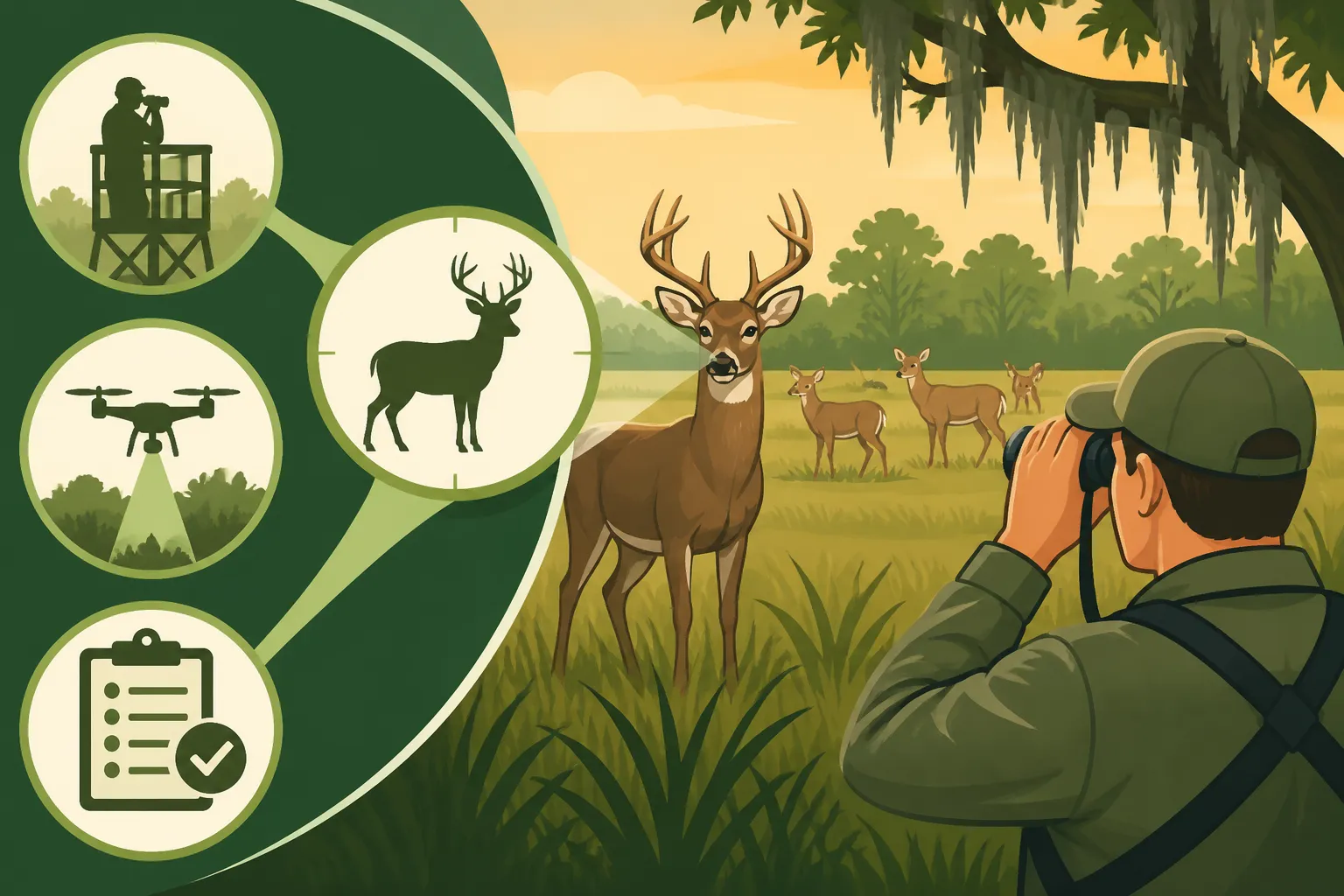
One of the foundational tools in LDWF's deer monitoring arsenal is the spotlight survey. This method involves driving predetermined routes, typically along logging roads or field edges, during the nighttime hours. Biologists use powerful spotlights to scan the surrounding terrain, counting and categorizing any deer they observe by sex and sometimes even age class. The idea isn't to get an exact number of deer in the entire survey area, but rather to establish an index of relative abundance. By running the same routes, under similar conditions, year after year, they can track trends: are we seeing more deer than last year? Fewer? Is the buck-to-doe ratio shifting?
Of course, spotlight surveys have their limitations. Deer in extremely thick cover, like a dense palmetto patch or a cypress-tupelo swamp, are easily missed. Weather conditions, like fog or heavy rain, can significantly impact visibility. The time of year also plays a role, as deer behavior and distribution change throughout the seasons. To account for these variables, LDWF tries to standardize their survey efforts as much as possible, conducting them at consistent times, on similar nights, and using routes that span various habitat types across the state. While a single spotlight count won't give you a precise tally, the accumulated data over many years provides invaluable trend information, helping to gauge population shifts in specific regions.
Harvest Data: The Hunters' Contribution
Perhaps one of the most direct and crucial pieces of information LDWF utilizes comes directly from us, the hunters. Mandatory deer reporting after every harvest is not just a regulatory hurdle; it's a vital data collection effort. When you legally harvest a deer and report it, you’re providing a concrete data point: the number of deer removed from the landscape, its sex, and often its specific location. This real-world, ground-level information is aggregated across thousands of hunters statewide, giving biologists an unparalleled dataset on harvest pressure and distribution. For details on how this process works, check out our guide on Louisiana Deer Reporting Requirements.
Beyond just the count, LDWF also encourages or sometimes requires biological samples from harvested deer, especially in areas of concern like CWD zones. This can include jawbones for aging deer or lymph node samples for disease testing. Analyzing this data provides insights into the herd's age structure, recruitment rates (how many fawns are surviving), and overall health. If a high percentage of harvested bucks are young, it might indicate overharvesting of mature animals. If fawn recruitment is consistently low, it flags a potential problem. While LDWF doesn't directly link hunter data to a specific total number, it's a critical input for their computer models. It's truly a collaborative effort: the better we report, the more accurate the data, and the better informed LDWF's management decisions can be. Hunters using apps like GoHunt can easily log their harvests, making this reporting process more seamless and trackable.
Camera Traps and Remote Sensing
In recent years, the use of technology like remote camera traps (trail cameras) has revolutionized wildlife monitoring, and LDWF is no exception. While hunters primarily use trail cameras for scouting and understanding deer movement, wildlife biologists deploy them in a systematic way to gather population-level data. By setting up cameras on specific grids or transects and leaving them for extended periods, LDWF can capture countless images and videos of deer without human disturbance. This provides a wealth of information, particularly useful for understanding metrics like Louisiana Fawn Survival Rates and Louisiana Buck-to-Doe Ratio by Region.
Camera trap data offers several advantages. It provides continuous, long-term monitoring with minimal human presence, reducing bias caused by deer reacting to people. It's excellent for observing nocturnal activity and can help confirm the presence of deer in areas that are difficult to access via spotlight surveys. Specialized software can even help analyze these images to identify individual deer or estimate population densities based on recapture rates (how often the same deer passes a camera). While it requires significant effort to deploy and maintain cameras and process the vast amount of data, it's becoming an increasingly powerful tool to complement traditional survey methods, giving biologists a less intrusive, more granular look into the daily lives and relative densities of our whitetails.
Population Modeling and Habitat Assessment
So, LDWF gathers all this disparate data – spotlight counts, harvest reports, biological samples, camera trap images. How do they turn all that raw information into a coherent picture of the state's deer population? The answer lies in sophisticated computer modeling and a deep understanding of habitat science. It's less about counting every deer and more about understanding the dynamics that cause populations to grow or shrink.
The Science of Estimation: Computer Models
Since an actual physical count of every single deer is impossible, LDWF relies on advanced population models. Think of these as complex mathematical equations that take all the collected data points – from harvest numbers and spotlight survey trends to fawn survival rates and adult mortality figures – and integrate them into a comprehensive system. These models don't spit out an exact number like "2,345,678 deer in Louisiana." Instead, they generate estimates of population density within different regions and project trends over time. This approach allows biologists to confidently say whether a population is stable, increasing, or decreasing, and by roughly how much, which is far more practical for management purposes. Our article on the Louisiana Deer Population Estimate delves deeper into these figures.
These models are constantly refined with new data, making them more accurate over time. They account for variables like birth rates (recruitment), death rates (natural mortality, harvest, predation, disease), and even movement between areas. It’s a bit like how meteorologists forecast weather; they use multiple data inputs and complex models to give us the most likely scenario, rather than a guaranteed outcome. The goal is to provide the best possible scientific framework for making management decisions that ensure a sustainable deer population for generations to come, taking into account the nuances of How Louisiana's Ten Deer Areas Differ.
Habitat's Role in Carrying Capacity
Deer populations don't exist in a vacuum; they are intrinsically linked to the quality and quantity of their habitat. This concept is known as "carrying capacity" – essentially, how many deer an environment can sustainably support without degrading itself. LDWF biologists spend a lot of time assessing habitat, understanding what resources are available, and how those resources fluctuate year to year. Factors like food availability (acorns, various browse plants, agricultural crops), water sources, and protective cover (thick woods, swamps) directly influence deer health, reproductive success, and ultimately, population density. If a region experiences a significant drought, or a devastating hurricane, it can drastically alter habitat and impact deer numbers.
For example, a banner acorn crop one year can lead to fatter, healthier deer going into winter, potentially increasing fawn survival rates the following spring. Conversely, a poor mast crop, which we discuss in Hunting After a Poor Acorn Year, can put stress on the herd, making them more vulnerable to disease and reducing overall productivity. LDWF considers these habitat variables when interpreting population data. A seemingly stable population might actually be slowly degrading its habitat if it's consistently at the very edge of carrying capacity, which signals a need for increased harvest to bring numbers down to a healthier level for the habitat. This holistic approach ensures that management isn't just about deer numbers, but about the entire ecosystem.
Disease Monitoring and Impact
The health of the deer herd is another critical component in population assessment, and disease monitoring plays an increasingly vital role. Chronic Wasting Disease (CWD) is a prime example of a disease that can have significant impacts on local deer populations, and LDWF's rigorous surveillance efforts are directly integrated into their understanding of herd dynamics. By collecting samples from harvested deer, particularly in designated Louisiana's Chronic Wasting Disease Zones, biologists can track the prevalence and spread of the disease. Every sample submitted by hunters for Louisiana CWD Testing for Hunters contributes to this crucial database.
Beyond CWD, LDWF also monitors for other diseases like Epizootic Hemorrhagic Disease (EHD), which can cause localized die-offs, especially during dry, hot summers. Understanding when and where these diseases occur, and their severity, allows biologists to adjust population models accordingly. For instance, a localized EHD outbreak might lead to a temporary dip in deer numbers in a specific parish, which the models need to reflect. Disease management is often intertwined with population management; sometimes, reducing deer density through increased harvest can help slow the spread of certain pathogens by decreasing deer-to-deer contact. It's a sobering but necessary aspect of modern wildlife management, ensuring the long-term health and sustainability of our deer.
From Data to Decision: How Numbers Shape Your Season
All this scientific effort – the surveys, the samples, the complex computer models – ultimately culminates in the hunting regulations that impact every one of us who enjoys chasing whitetails in Louisiana. Understanding how these numbers translate into your season framework can deepen your appreciation for the management process and highlight the importance of hunter cooperation.
Setting Seasons and Bag Limits
The most tangible outcome of LDWF's extensive deer population monitoring is the annual establishment of hunting seasons and bag limits. When you see different archery, primitive firearms, and gun seasons, or varying either-sex days and antlerless limits across the state's various deer areas, know that these are carefully considered decisions based on collected data. If models indicate a healthy, growing population in, say, Area 1, you might see more liberal either-sex days or higher antlerless limits to manage numbers and prevent overpopulation. Conversely, if an area is struggling, perhaps due to habitat loss or disease, seasons might be more restrictive to allow the herd to recover. Our guide on Louisiana Deer Hunting Area by Area explains these regional differences in detail.
The goal is always to find that sweet spot: maximizing hunter opportunity while ensuring the long-term sustainability of the deer herd. It’s a dynamic process; populations fluctuate, habitats change, and new challenges like CWD emerge. This means regulations aren’t set in stone and can be adjusted year to year to reflect the most current understanding of the herd. LDWF strives for adaptive management, meaning they are constantly evaluating data and making adjustments to keep the herd in balance with its environment. This ensures that when you step into the woods, you're participating in a regulated system designed for abundance.
Hunter Cooperation: The Unsung Hero
It really can't be said enough: hunter cooperation is absolutely foundational to LDWF's ability to manage Louisiana's deer herd effectively. Every time a hunter reports a harvested deer, that data point feeds into the larger picture, strengthening the accuracy of population models and informing management decisions. Failing to report a harvest, or providing inaccurate information, is like a missing piece in a critical puzzle; it weakens the entire system. We covered this in depth in The Louisiana Deer Reporting Deadline.
Beyond reporting, participation in voluntary surveys or submitting biological samples (like lymph nodes for CWD testing) in designated areas provides invaluable insight into herd health and disease prevalence. Hunters are literally on the front lines, acting as the eyes and ears of wildlife management. Our collective actions directly impact the quality of data LDWF has, which in turn dictates the future of our hunting seasons. So, when you follow the regulations and contribute your data, you're not just complying with the law; you're actively participating in the conservation of Louisiana's deer resource. Utilizing digital tools like GoHunt to track your individual success can also help reinforce the habit of accurate reporting and contribute to broader insights.
The Future of Deer Management
The science of deer management is always evolving. As technology advances, so too do the methods available for monitoring and understanding wildlife populations. We might see even more sophisticated remote sensing techniques, drone technology for habitat mapping, or enhanced genetic analysis of deer populations in the future. Citizen science initiatives, where hunters and other outdoor enthusiasts contribute data through user-friendly apps, could also play an increasingly larger role, offering an even broader reach for data collection.
What remains constant, however, is the need for sound scientific principles, adaptive management strategies, and the continued partnership between wildlife agencies like LDWF and the hunting community. Managing a wild, free-ranging species across a diverse landscape like Louisiana is a complex, continuous endeavor. It requires patience, dedication, and a commitment to gathering the best possible information. By understanding how LDWF counts and manages our deer herd, we, as hunters, can better appreciate the regulations we follow and become more informed and responsible stewards of this incredible natural resource.
| Survey Method | Primary Benefit | Key Limitation | What it Tells Biologists |
|---|---|---|---|
| Spotlight Surveys | Excellent for trend data over time and relative abundance. | Misses deer in thick cover; weather dependent. | Population trends (up/down), buck-to-doe ratios, density index. |
| Harvest Data | Direct count of removed deer; detailed biological info. | Relies on hunter compliance; doesn't count unharvested deer. | Age structure, reproductive success, herd health, harvest pressure. |
| Camera Traps | Less intrusive, continuous monitoring, fawn recruitment data. | High data volume to process; limited to specific areas. | Fawn survival, buck-to-doe ratio, relative density, activity patterns. |
| Habitat Surveys | Assesses carrying capacity and resource availability. | Subjective assessment; doesn't directly count deer. | Environmental health, potential for population growth/decline. |
| Population Models | Integrates all data for comprehensive estimates and projections. | Outputs are estimates, not exact counts; model complexity. | Overall population size, growth rate, projected trends. |
Disclaimer
This article is for general informational purposes only and does not constitute professional advice. Laws, prices and regulations vary by location and change over time. Consult a qualified professional for guidance on your specific situation.