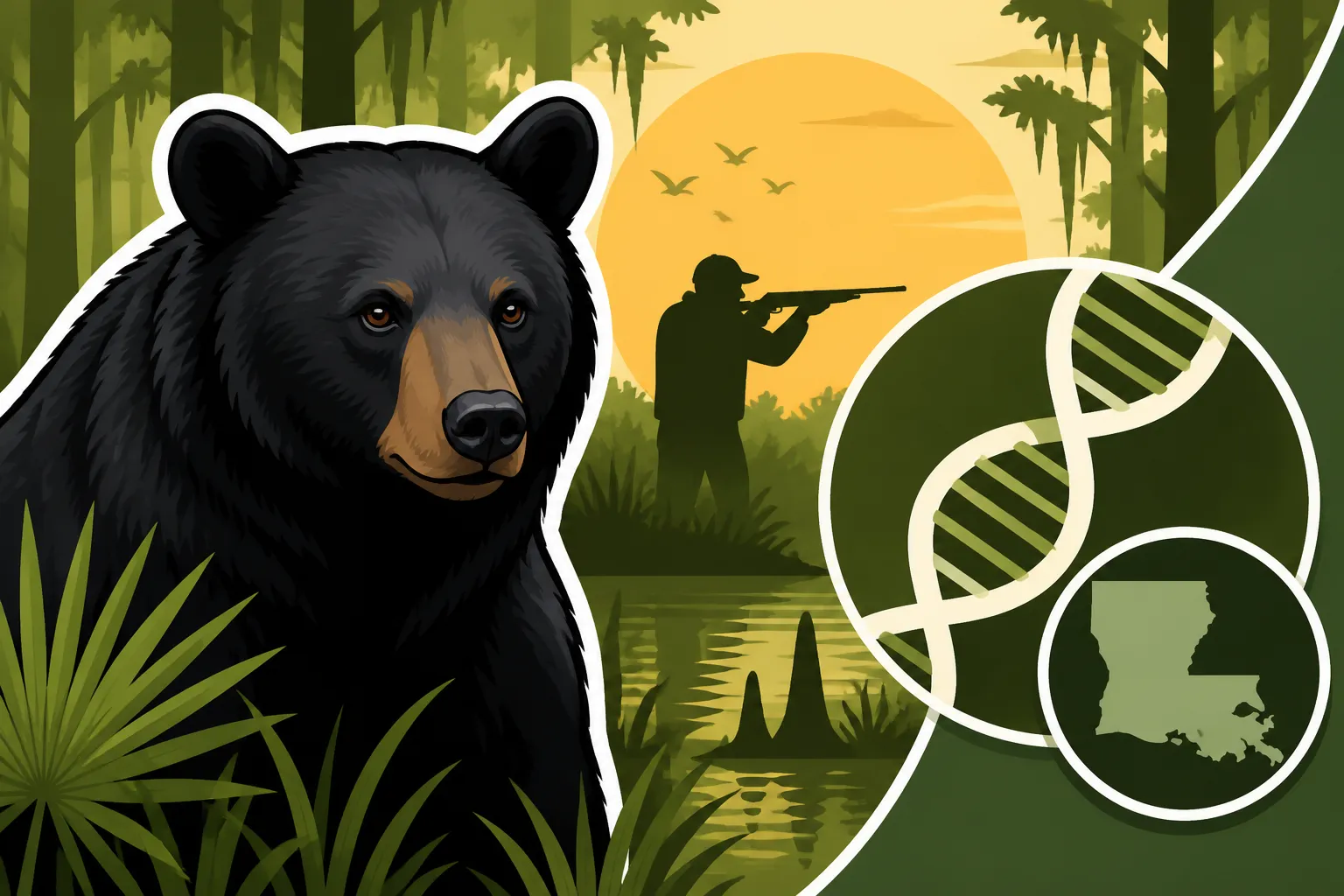
Louisiana Black Bear DNA Tracking Study
It's incredibly challenging to manage a species as elusive and secretive as the Louisiana black bear, especially when they prefer the dense cover of our swamps and bottomlands. Understanding how many bears are out there, where they're moving, and how healthy their populations are is crucial for their long-term survival and for making smart management decisions. This guide will dive deep into the fascinating world of Louisiana's black bear DNA tracking studies, explaining the methods, what we've learned, and why this science is so important for the future of these magnificent animals in our state.
The Elusive Nature of Louisiana Black Bears
Tracking black bears in Louisiana isn't like counting deer in an open field. These animals are masters of stealth, preferring the thickest, most inaccessible parts of our unique ecosystems. Their habitat choices, often deep within the Atchafalaya Basin or the remote reaches of the Tensas River bottomlands, make direct observation incredibly difficult. You might spend days in the woods and never catch a glimpse, even if bears are present.
Why Traditional Tracking Methods Fall Short
In the past, wildlife biologists relied heavily on methods like trap-and-tag programs, scat analysis, or even aerial surveys in areas with less canopy cover. While these methods provided some valuable data, they often fell short of giving a comprehensive picture. Trapping bears is labor-intensive, costly, and can be stressful for the animals. Scat analysis can tell you what they're eating and where they've been, but it's hard to reliably identify individual bears from their droppings. Aerial surveys are great for open country, but under the dense canopy of a Louisiana swamp, it's virtually impossible to spot a black bear from above. The sheer scale of their habitat and their cautious nature mean that traditional techniques, while still useful in combination with other methods, just can't provide the level of detail needed for robust population modeling and genetic health assessments. We needed something more precise, something that could identify individuals without ever laying hands on them.
The Importance of Accurate Population Data
Why go to such lengths for accurate bear numbers? Well, managing any wildlife species effectively hinges on knowing its population status. For a species like the Louisiana black bear, which was once nearly extirpated from our state and is now making a comeback, this data is even more critical. Accurate population estimates help biologists understand if conservation efforts are working, if habitat protection is sufficient, and where the population is growing or struggling. Without solid numbers, it's impossible to set sustainable hunting seasons, if and when they occur, or to gauge the impact of human encroachment or environmental changes. This data helps us answer big questions: Is the population healthy? Is it expanding into new territories? Are there enough bears to sustain a small, controlled harvest in the future, as has been seen with Louisiana's Reinstated Black Bear Lottery? Getting these answers right means the difference between informed stewardship and shooting in the dark.
How DNA Tracking Works for Black Bears
The real game-changer in bear management has been the advent of DNA tracking studies. This modern approach allows wildlife managers to gather critical genetic information from bears without ever having to capture or even see them. It's truly revolutionized our understanding of these animals and their movements across the landscape.
Non-Invasive Sampling Techniques
The beauty of DNA tracking is its non-invasive nature. Instead of traps and tranquilizers, biologists primarily use strategically placed "hair snares." Imagine a barbed wire fence or a strand of regular wire wrapped around a tree, often baited with something irresistible like a pungent fish oil or a sweet-smelling doughnut. Bears, being curious and food-motivated, will rub against these snares as they try to get to the bait, leaving behind precious strands of hair. These hairs, often no more than a few dozen, contain enough follicular cells to provide a DNA sample. These sampling sites are placed throughout known or suspected bear habitats, from the sprawling Atchafalaya Basin Bear Population to the areas holding the Tensas Basin bear population.
Researchers also collect other biological samples found in the field, such as scat or even saliva from partially eaten prey, though hair snares are the most common and reliable method for consistent sampling. These samples are meticulously cataloged with GPS coordinates and then sent to a specialized lab for analysis. This approach minimizes disturbance to the bears and provides a wide geographic spread of data points, giving a much more accurate picture of their range and density.
From Hair to Data: The Lab Process
Once those tiny hair samples arrive at the lab, the real magic of genetic science begins. Each sample is carefully processed to extract DNA from the root bulb of the hair. Think of it like a biological fingerprint. Scientists then use specific genetic markers to identify individual bears. Because each bear has a unique DNA profile, much like humans do, researchers can determine exactly how many individual bears are present in a given study area.
But it doesn't stop there. The DNA also reveals information about sex, kinship (who's related to whom), and even potential health indicators. By analyzing multiple samples collected over time and across different locations, biologists can track individual bear movements, estimate population sizes, and assess genetic diversity within different sub-populations, like those in Louisiana's Three Bear Subpopulations. This intricate lab work transforms a handful of bear hairs into a rich database of ecological information, providing insights that were previously impossible to obtain. It's a testament to how far wildlife science has come, giving us powerful tools to protect our natural heritage.
What the DNA Studies Reveal
The insights gleaned from Louisiana's black bear DNA tracking studies are nothing short of profound. They've peeled back layers of mystery surrounding these once-imperiled animals, giving wildlife managers and conservationists a much clearer roadmap for their future.
Population Estimates and Distribution
One of the most critical pieces of information these studies provide is a robust estimate of the total black bear population in Louisiana. Before DNA analysis, population figures were often based on broader habitat models and anecdotal sightings, leading to educated guesses at best. With DNA, scientists can use capture-recapture statistical models, where "captures" are simply DNA identifications, to generate much more precise numbers. These studies have confirmed that the Louisiana black bear population is indeed recovering, showing a positive trend in growth and expansion since its low point.
Beyond a simple number, the DNA data paints a detailed picture of bear distribution. It shows where the major populations are concentrated, such as The Atchafalaya Basin Bear Population and the Tensas Basin bear population, and how these groups might be interacting. We can see evidence of bears moving into new territories, pushing the boundaries of their traditional ranges. This kind of detailed mapping is invaluable for understanding habitat connectivity and identifying potential corridors that bears might use to travel between different areas, which is vital for maintaining genetic health.
Genetic Health and Connectivity
Perhaps even more important than population size is the genetic health of the species. A small, isolated population can suffer from inbreeding and a lack of genetic diversity, making it more susceptible to diseases and less able to adapt to environmental changes. Louisiana's black bear population has faced this challenge due to historical fragmentation and low numbers. The DNA studies allow scientists to assess genetic diversity within and between the various bear sub-populations.
For example, by looking at genetic markers, researchers can tell if bears from the Coastal Bear Population Near Terrebonne are interbreeding with those in the Atchafalaya Basin, or if they are largely isolated. Strong genetic connectivity means a healthier, more resilient population. The good news is that these studies have generally shown encouraging signs of genetic health, indicating that bears are moving across the landscape and exchanging genes, which is a key factor in their long-term recovery. This information directly informs decisions about protecting critical habitat corridors and minimizing barriers to bear movement, ensuring a diverse gene pool for generations to come. Understanding these intricate details helps agencies like the Louisiana Department of Wildlife and Fisheries (LDWF) make informed choices, and tools like those found on GoHunt can offer maps and data that hunters can use to stay informed on these sensitive areas.
Implications for Louisiana Black Bear Management
The wealth of data gathered through black bear DNA tracking studies isn't just for academic curiosity; it directly impacts how we manage and protect this iconic Louisiana species. These findings guide critical decisions that affect the future of the bears and the landscapes they inhabit.
Informing Conservation Strategies
Knowing precisely where bears live, how many there are, and how connected their populations are allows conservationists to develop highly targeted strategies. For instance, if DNA analysis shows a particular sub-population has low genetic diversity, it might signal a need for enhanced habitat protection or the creation of wildlife corridors to allow bears to move more freely and breed with other groups. If a new population is observed establishing itself in an area previously thought to be bear-free, that area might be prioritized for conservation efforts or for educating local communities about coexisting with bears.
The studies also help pinpoint critical habitats that are essential for denning, foraging, and breeding, ensuring these areas receive adequate protection from development or other disturbances. This scientific backing helps secure funding for conservation initiatives and allows land managers to focus resources where they will have the greatest positive impact on the overall Louisiana's Recovering Black Bear population. It’s all about working smarter, not just harder, to ensure these bears thrive.
Supporting Sustainable Hunting Decisions
The success of black bear recovery in Louisiana has, in part, led to the consideration and implementation of limited hunting seasons, such as those covered by Louisiana's Reinstated Black Bear Lottery. This is where accurate DNA data becomes absolutely indispensable. Before any hunting season can be considered truly sustainable, wildlife managers must have an undeniable grasp on population numbers, growth rates, and the health of the gene pool. The DNA studies provide that foundational knowledge.
By knowing How Many Black Bears Louisiana Has and how many can be harvested without jeopardizing the population's long-term viability, state agencies can set very conservative quotas. This ensures that hunting remains a tool for population management rather than a threat to recovery. For hunters, understanding the science behind these decisions helps foster compliance with rules like Passing on a Cub or Sow With Cubs, which are critical for protecting the future breeding stock. The data essentially serves as a scientific safety net, allowing for careful, controlled hunting opportunities that are continuously re-evaluated based on the most current biological information. It's a balance, but one that is managed with the best available science.
Challenges and Future of DNA Tracking
While DNA tracking has been a monumental leap forward for black bear management in Louisiana, it's not without its hurdles. However, the future holds exciting possibilities, especially with advancements in technology and the increasing involvement of citizen scientists.
Overcoming Logistical Hurdles
One of the primary challenges in conducting large-scale DNA tracking studies is the sheer logistics involved. Louisiana's bear habitat is often remote, swampy, and difficult to access, making the deployment and maintenance of hair snares a significant undertaking. Imagine setting up hundreds of bait stations deep in the Atchafalaya Basin, then trekking back in weeks later to collect samples, all while battling heat, humidity, and mosquitoes. It requires substantial manpower, resources, and time.
Another challenge lies in the lab processing itself. While highly effective, DNA extraction and analysis can be expensive, and results aren't immediate. There's also the occasional issue of sample degradation, especially in a humid environment, or contamination. Ensuring consistency in sample collection and handling across vast, diverse landscapes is paramount to obtaining reliable data. Despite these challenges, the commitment to these studies reflects the importance placed on the long-term health of our black bear population.
The Role of Citizen Scientists and Technology
The future of black bear DNA tracking in Louisiana, and indeed across the nation, looks bright, largely due to two powerful forces: technology and citizen science. Technological advancements are continuously making DNA analysis faster, more affordable, and more accessible. Think portable genetic sequencing devices that could one day allow for quicker field assessments, or sophisticated software that can process massive amounts of data with greater efficiency.
More importantly, the involvement of citizen scientists is poised to play an increasingly vital role. Local hunters, landowners, and outdoor enthusiasts often have intimate knowledge of their local areas and can be invaluable eyes and ears on the ground. By training volunteers to identify and properly collect non-invasive samples, such as hair or scat, the reach and frequency of sampling efforts could dramatically increase. These dedicated individuals could help expand the geographical scope of studies, fill in data gaps, and contribute significantly to our understanding of Where Louisiana Black Bears Range Today. Imagine a network of informed citizens contributing to a real-time database, feeding into tools like GoHunt, which could then display up-to-date habitat maps or areas of recent bear activity based on these community contributions. This collaborative approach would not only empower locals but also provide an unprecedented level of data for conservation, ultimately securing a more robust future for the Louisiana black bear.
| Aspect of DNA Tracking | Description | Benefits | Challenges |
|---|---|---|---|
| Method | Non-invasive collection of hair (primarily), scat, or saliva using bait stations (hair snares) in bear habitat. | Minimizes disturbance to bears; allows for broad spatial sampling; can be conducted over long periods. | Labor-intensive deployment/maintenance in remote areas; potential for sample degradation or contamination in humid climates; reliance on bear curiosity/behavior. |
| Lab Process | DNA extraction from hair follicles; genetic markers used to identify individuals, sex, kinship, and genetic diversity. | Provides unique identification for individual bears; accurate population estimates (capture-recapture); reveals genetic health, inbreeding, and connectivity between sub-populations. | Costly specialized lab equipment and personnel; results are not immediate; precision required to avoid cross-contamination. |
| Key Findings | Precise population estimates; detailed distribution maps; assessment of genetic diversity and population connectivity. | Informs conservation priorities; guides habitat protection/corridor creation; supports sustainable management decisions (e.g., hunting quotas); tracks recovery progress. | Data interpretation requires expertise; ongoing monitoring needed to detect changes; can be slow to reflect immediate population shifts. |
| Future Outlook | Advances in portable technology for quicker analysis; increased reliance on citizen scientists for data collection. | Faster, more affordable processing; expanded geographical coverage; greater community engagement and awareness; real-time data integration with mapping tools. | Ensuring data quality and consistency from volunteers; funding for technology development and citizen science programs; maintaining scientific rigor in data analysis. |
Disclaimer
This article is for general informational purposes only and does not constitute professional advice. Laws, prices and regulations vary by location and change over time. Consult a qualified professional for guidance on your specific situation.