Nest Predation and Louisiana Turkey Hatches
It's incredibly frustrating when you dedicate time and effort to understanding the wild turkeys in our beautiful state, only to see population numbers struggle. Many of us have witnessed fewer poults scratching around our fields and pine forests, leading to concerns about the future of spring gobbler season. This guide dives deep into the complex issue of nest predation and its significant impact on turkey hatches across Louisiana, offering insights into why it happens and what measures can be taken to help.
Understanding the Vulnerability of Turkey Nests in Louisiana
Wild turkeys, despite their robust appearance as adults, are incredibly vulnerable during their nesting and early poult stages. It’s a make-or-break time that dictates the health and future of the entire population.
The Critical Role of a Successful Hatch
For any game species, especially one like the wild turkey that relies on a consistent annual recruitment of young birds, a successful hatch is everything. It's the lifeblood of the flock, ensuring that new genetics are introduced and that enough individuals survive to replace those lost to natural mortality, hunting pressure, or disease. When hens successfully bring off a brood of poults, those young birds are the foundation of next year's breeding stock and hunting opportunities. Without a good hatch, you're looking at a shrinking pool of birds, which inevitably means fewer gobblers strutting in the spring and fewer hens to continue the cycle.
Think about it: a hen might lay a dozen or more eggs, but if predators wipe out that nest, all those potential birds are gone in an instant. This isn't just a bad season; it's a gap in the age structure of the population that can take years to recover from. We saw how crucial successful hatches were when Louisiana was working to restore its turkey populations decades ago, as detailed in How Turkeys Were Restored to Louisiana. Every successful nest contributed directly to building the robust flocks we once enjoyed.
Nesting Habitat Challenges and Their Impact
Turkey hens are incredibly particular about where they choose to lay their eggs, and for good reason. They're looking for dense, protective cover that offers concealment from the watchful eyes and keen noses of predators, yet is still accessible for them to come and go for feeding and watering. In Louisiana, this often means areas with thick native grasses, low-lying shrubs, and a good mix of saplings and mature timber that create a mosaic of protective pockets. However, the ideal nesting habitat is becoming increasingly scarce in many parts of the state.
Habitat degradation, whether it's from aggressive clear-cutting that removes ground cover, the spread of invasive species that don't provide good concealment, or simply a lack of management that leads to overly dense, uniform undergrowth, makes nests significantly more vulnerable. A hen nesting in sparse cover or on a field edge with little transition is practically ringing a dinner bell for anything passing by. Even seemingly small changes to the landscape, like alterations in agricultural practices or unchecked growth of specific plant species that don't offer structural diversity, can force hens into less secure nesting sites, directly increasing the chances of predation. It's a constant struggle to find that balance, and tools like GoHunt can help landowners assess their property for optimal nesting cover.
Identifying the Primary Nest Predators of Wild Turkeys
When it comes to nest predation, Louisiana's diverse ecosystems are unfortunately home to a long list of culprits. These animals are simply following their natural instincts, but their combined impact on turkey hatches can be devastating.
Mammalian Marauders
Our Louisiana woods and swamps are teeming with mammalian predators, many of whom are opportunistic feeders who won't pass up a turkey nest if they stumble upon it. These animals often rely on their keen sense of smell, tracking hens to their nests or simply scenting the eggs directly.
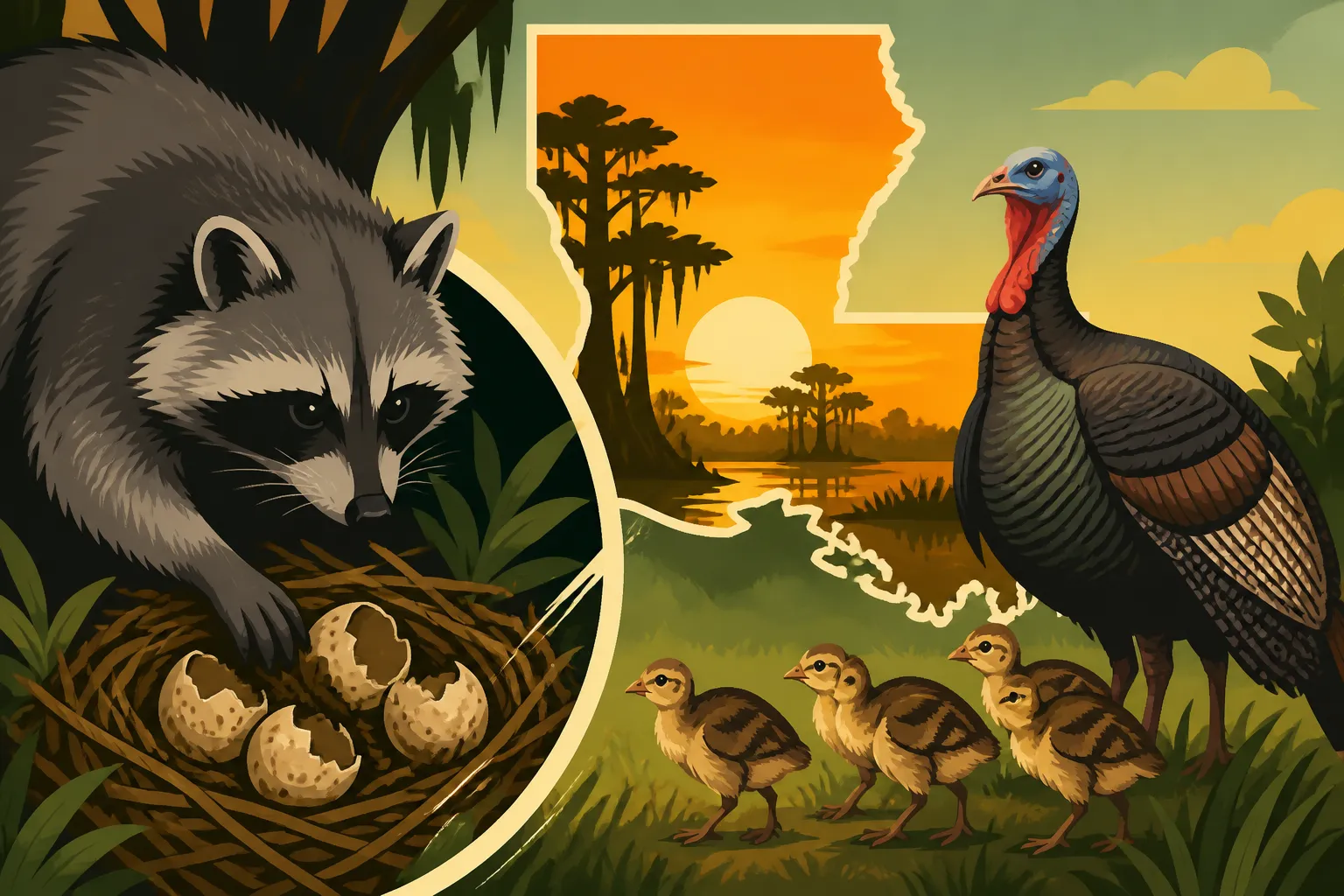
- Raccoons and Opossums: These masked bandits and slow-moving marsupials are notorious egg-eaters. They are abundant in nearly every corner of Louisiana, from suburban fringes to deep cypress swamps, and their omnivorous diet makes turkey eggs a welcome treat. They're masters at finding nests, often leaving tell-tale signs like broken eggshells with jagged edges or scattered nest material.
- Skunks: While less agile, skunks are also highly effective nest predators. Their digging abilities allow them to unearth eggs, and their strong scent makes their presence obvious, even if you don't catch them in the act.
- Coyotes: The coyote population in Louisiana has exploded over the decades, and they are highly adaptable predators. They'll actively hunt for nests, especially during the spring when easy protein is a bonus. Their impact can be significant, not just on nests but on poults and even adult birds. Understanding the wider impact of Coyotes and Predators in Louisiana is crucial for overall wildlife management.
- Feral Hogs: Perhaps one of the most destructive forces against ground-nesting birds, feral hogs are a nightmare for turkey hens. They're intelligent, voracious, and travel in destructive sounders. A group of hogs can root up an entire area, consuming everything in their path, including turkey eggs and even young poults. Their numbers are staggering, and even with extensive efforts like Trapping Louisiana Feral Hogs, their impact remains immense. The sheer volume of these animals, as highlighted in Louisiana Feral Hog Regulations, means they exert constant pressure on turkey populations.
Avian and Reptilian Threats
While mammals often get the most attention, our feathered and scaled residents also play a significant role in nest predation.
- Crows and Jays: These intelligent birds are notorious for locating and consuming eggs. They often perch high above, observing hen movements, and once the hen leaves the nest, they swoop in for a quick meal. The visual clues they pick up make turkey nests easy targets.
- Raptors: Hawks and owls, while more typically targeting poults or adult birds, can occasionally raid nests if given the opportunity, especially if the hen is flushed off the nest.
- Snakes: Louisiana is home to a vast array of snake species, and many of them are perfectly happy to consume bird eggs. Their ability to move silently and penetrate dense cover makes them particularly effective nest predators. While it's nearly impossible to quantify their exact impact, given the sheer number of snakes in our environment, they are undoubtedly a contributing factor to nest losses, particularly in marshy or heavily wooded areas.
The Impact of Predation on Louisiana Turkey Populations
The relentless pressure from nest predators has tangible and often severe consequences for the wild turkey populations we cherish in Louisiana. It’s a dynamic that biologists and hunters alike monitor closely to gauge the health of our flocks.
Declining Poult-to-Hen Ratios
One of the most critical metrics for assessing turkey population health is the poult-to-hen ratio. This simply measures how many poults (young turkeys) survive to a certain age per hen. A healthy ratio indicates strong reproductive success and a promising outlook for future generations. When this ratio consistently declines, it's a flashing red light for wildlife managers. Nest predation directly attacks this ratio at its most vulnerable point: the eggs and newly hatched poults. If nests are destroyed before hatching, or if poults are taken shortly after emerging, fewer young birds ever make it to the "poult" count.
Think of it like this: a hen might successfully lay 12 eggs, but if only 3 hatch and survive past the first few weeks because of predators, her contribution to the population that year is severely diminished. Over large areas and multiple seasons, this cumulative loss can prevent the overall population from growing or even maintaining stable numbers. Our annual Louisiana Turkey Brood Survey Results often reflect the harsh realities of this predation pressure, showing where the greatest challenges lie. When the numbers are low, it's a direct indicator that the challenges of successful nesting and brood rearing are significant, often pointing back to predation as a major factor.
Implications for Hunting Seasons and Management
The long-term consequence of widespread nest predation is a direct impact on our cherished hunting traditions. Fewer successful hatches today inevitably mean fewer adult birds tomorrow, which translates to fewer gobblers available during the spring season. This isn't just about anecdotal observations; it's about sustainable wildlife management. When population models show insufficient recruitment, wildlife agencies like the Louisiana Department of Wildlife and Fisheries (LDWF) may need to consider adjusting season lengths, bag limits, or even hunting areas to ensure the long-term viability of the species.
For hunters, this means seasons might feel tougher, and success rates could drop. It might mean fewer opportunities to take a bird, or perhaps even stricter regulations on hens. Managing a turkey population isn't just about managing hunters; it's fundamentally about managing the habitat and mitigating threats to the turkeys themselves. The data from Louisiana Turkey Population Estimate and Louisiana Turkey Harvest Numbers are directly influenced by how well hens can successfully raise their young without constant threat from predators. It's a cycle, and when a vital link like nest success is weakened, the entire chain suffers.
Mitigation Strategies for Protecting Turkey Nests
While eliminating all predators is impossible and undesirable, there are proactive steps that can be taken to lessen their impact on turkey nests and give our wild turkey populations a better fighting chance. It’s about creating an environment where hens have the best possible opportunity to hatch and raise their broods.
Habitat Improvement and Management
Hands down, the most effective long-term strategy for mitigating nest predation is through robust habitat improvement. Turkeys, like all wildlife, thrive when their environment provides ample food, water, and cover – especially nesting cover.
- Creating Dense Nesting Cover: Hens need thick, low-lying vegetation to conceal their nests. This means managing for native grasses, sedges, and forbs that offer good concealment but also allow the hen to move through easily. Think about small pockets of dense cover along field edges, within timber stands, or near water sources. Planting warm-season grasses can be incredibly beneficial. These areas provide the perfect blend of security and accessibility.
- Timber Management: Thoughtful timber management, such as thinning pine plantations to allow sunlight to reach the forest floor and encourage understory growth, can create fantastic turkey habitat. Selective cutting that promotes diverse age classes of timber and creates openings for herbaceous growth is key. Overly dense, shaded forests offer little in the way of nesting cover.
- Prescribed Burning: Fire, when used correctly, is a powerful habitat management tool in Louisiana. Prescribed burns can reduce excessive woody undergrowth, control invasive species, and stimulate the growth of beneficial native plants that provide excellent nesting and brood-rearing cover. However, timing is everything; burns must be conducted outside of nesting season to avoid destroying active nests. Understanding the impact of Prescribed Burns and Louisiana Hunting Closures is vital for effective implementation.
- Creating Brood-Rearing Habitat: Beyond nesting, poults need open areas with abundant insects for food and protective overhead cover from raptors. This often means managing for open woodlands with a healthy understory of legumes and other forbs. Investing in Habitat Work on Louisiana WMAs often focuses on creating this varied habitat to benefit turkeys.
Landowners and land managers have a huge role to play here. By strategically implementing these practices, often with guidance from LDWF biologists or using resources from organizations, you can transform your property into a turkey haven.
Predator Control and Exclusion Methods
While habitat is the foundation, targeted predator control can offer a more immediate, albeit temporary, relief in specific areas. It’s a tactic that needs to be approached thoughtfully and ethically.
- Targeted Trapping Programs: For mammalian nest predators like raccoons, opossums, and skunks, strategic trapping can reduce local populations and provide a "breathing room" for nesting hens. This isn't about eradication, but rather reducing predator density during critical nesting and brooding periods. Trapping, especially for feral hogs, is an ongoing battle, and effective programs for Trapping Louisiana Feral Hogs can certainly have a positive side effect for turkeys.
- Challenges of Large-Scale Control: It's important to understand that broad-scale predator control over vast landscapes is rarely feasible or effective. Predator populations are resilient and can quickly rebound. The focus should be on creating high-quality habitat that naturally allows turkeys to evade predators and on targeted, localized efforts where specific predator issues are acute.
- Limited Exclusion Methods: For wild turkeys, physical exclusion methods like fencing around nests are generally impractical and can even lead to increased predation by drawing attention to the nest site. Hens need to be able to access and leave their nests discreetly. Instead, focusing on dense, natural cover is the best form of "exclusion." However, for certain small, confined areas, very specific and temporary measures might be explored by some private landowners. This is less about a widespread strategy and more about very localized, experimental efforts.
Ultimately, the goal is to create a landscape where wild turkeys can thrive naturally, with enough high-quality cover to successfully nest and raise their young, even in the presence of natural predators. It's a continuous effort that combines wise land management with a deep understanding of the turkey's lifecycle and the challenges it faces.
Common Turkey Nest Predators and Their Impact
Here's a quick overview of some of the most common threats to Louisiana turkey nests and the signs they often leave behind.
| Predator Type | Common Species in Louisiana | Method of Predation | Typical Signs Left at Nest Site |
|---|---|---|---|
| Mammals | Raccoon, Opossum, Skunk, Coyote, Feral Hog | Scent-tracking, opportunistic foraging, active searching, rooting | Scattered, crushed, or eaten eggshells; disturbed nest material; paw prints; hog rooting |
| Birds | Crow, Blue Jay, Owl, Hawk | Visual detection from above, opportunistic raids, targeting unprotected nests | Eggshell fragments with clean breaks; nest material undisturbed but eggs gone |
| Reptiles | Various snake species (e.g., Rat Snake, King Snake) | Silent approach, consuming eggs whole or leaving collapsed shells | Eggs missing or collapsed shells; no obvious disturbance to nest material |
Understanding these patterns can help hunters and landowners identify what pressures their local turkey populations are facing. It’s a vital piece of the puzzle when we're trying to figure out why the numbers aren't what we hope for, and why the Louisiana Turkey Population Estimate might fluctuate.
Addressing nest predation is a long-term commitment, blending smart habitat management with an understanding of the natural world. It’s not just about getting ready for next spring's hunt, but about ensuring that future generations will also have the privilege of hearing a gobbler sound off from its roost in a Louisiana bottomland hardwood. By focusing on creating and maintaining prime nesting and brood-rearing habitat, and understanding the role predators play, we can all contribute to healthier, more robust wild turkey populations across our state. For more detailed information, keep an eye on official Louisiana Turkey Brood Survey Results which can offer regional insights into population trends.
Disclaimer
This article is for general informational purposes only and does not constitute professional advice. Laws, prices and regulations vary by location and change over time. Consult a qualified professional for guidance on your specific situation.