Night Hog Hunting Light Rules in Louisiana
Hunting feral hogs in Louisiana can often feel like an unending battle, especially when these destructive animals are most active under the cloak of darkness. Many hunters are eager to pursue hogs at night to reduce their impact on crops and habitat, but the specific rules around using artificial lights can be confusing and lead to unintentional violations. This comprehensive guide aims to untangle the complexities of Louisiana's night hog hunting light regulations, ensuring you can participate effectively and legally in controlling these prolific pests.
Understanding Louisiana's Feral Hog Regulations for Night Hunting
Louisiana faces a significant challenge with its booming feral hog population. These animals cause millions of dollars in agricultural damage annually, destroy delicate ecosystems, and compete with native wildlife for food resources. Recognizing the severity of this issue, the Louisiana Department of Wildlife and Fisheries (LDWF) has established very liberal regulations for feral hog hunting, treating them more as an invasive nuisance species than traditional game animals. This distinction is crucial, as it provides hunters with more flexibility, particularly regarding hunting hours and methods, compared to regulated game species like deer or turkey.
Year-Round Opportunity and Methods
One of the most defining aspects of feral hog hunting in Louisiana is that there are generally no closed seasons or bag limits on private land. This means you can pursue hogs literally any day of the year, at any time of day or night, as long as you have the landowner's permission. This year-round approach underscores the state's aggressive stance on population control. For a deeper dive into these general rules, you might find our guide on Louisiana Feral Hog Regulations particularly helpful. This continuous hunting opportunity is a stark contrast to the highly structured seasons for deer or waterfowl, making hogs a consistent target for those looking to get afield.
When it comes to methods, Louisiana also provides considerable leeway. Hunters can use a wide array of firearms, archery equipment, and even some trapping methods. This flexibility extends to the use of modern technologies that aid in nocturnal hunting, which is where the conversation about lights becomes especially relevant. The overarching goal is to facilitate effective hog removal, and allowing various tools, including lights, is a key component of that strategy. If you're looking for more general hunting strategies, consider checking out Hunting Louisiana's Year-Round Feral Hogs.
The General "Night Hunting" Definition in Louisiana
For most regulated game species in Louisiana, "night hunting" is explicitly prohibited, and legal hunting hours are typically defined as one-half hour before sunrise to one-half hour after sunset. These restrictions are in place to ensure fair chase, prevent poaching, and protect hunters from mistaken identity in low-light conditions. However, feral hogs exist in a unique regulatory space. Because they are not classified as a "game animal" under the traditional sense but rather a destructive pest, many of these standard limitations do not apply, particularly on private land.
This exception for feral hogs means that when the sun dips below the horizon, and the woods or fields go dark, the opportunity to hunt hogs legally with certain tools, including artificial lights, can begin. It's a critical difference that empowers landowners and hunters to address hog issues during the peak activity hours of these nocturnal creatures. While general hunting on public lands will still adhere to standard sunrise-to-sunset rules, the private land allowance for hogs offers a powerful tool in management. For context on typical hunting hours for other species, you can read more about Louisiana Public Land Hunting Hours.
Specific Rules for Using Lights When Hunting Hogs at Night
The ability to hunt feral hogs at night with lights is a game-changer for many hunters and landowners in Louisiana, offering a significant advantage in controlling these elusive animals. However, it's crucial to understand the nuances of where and how these lights can be legally employed to avoid any missteps.
Private Land Privileges and Permissions
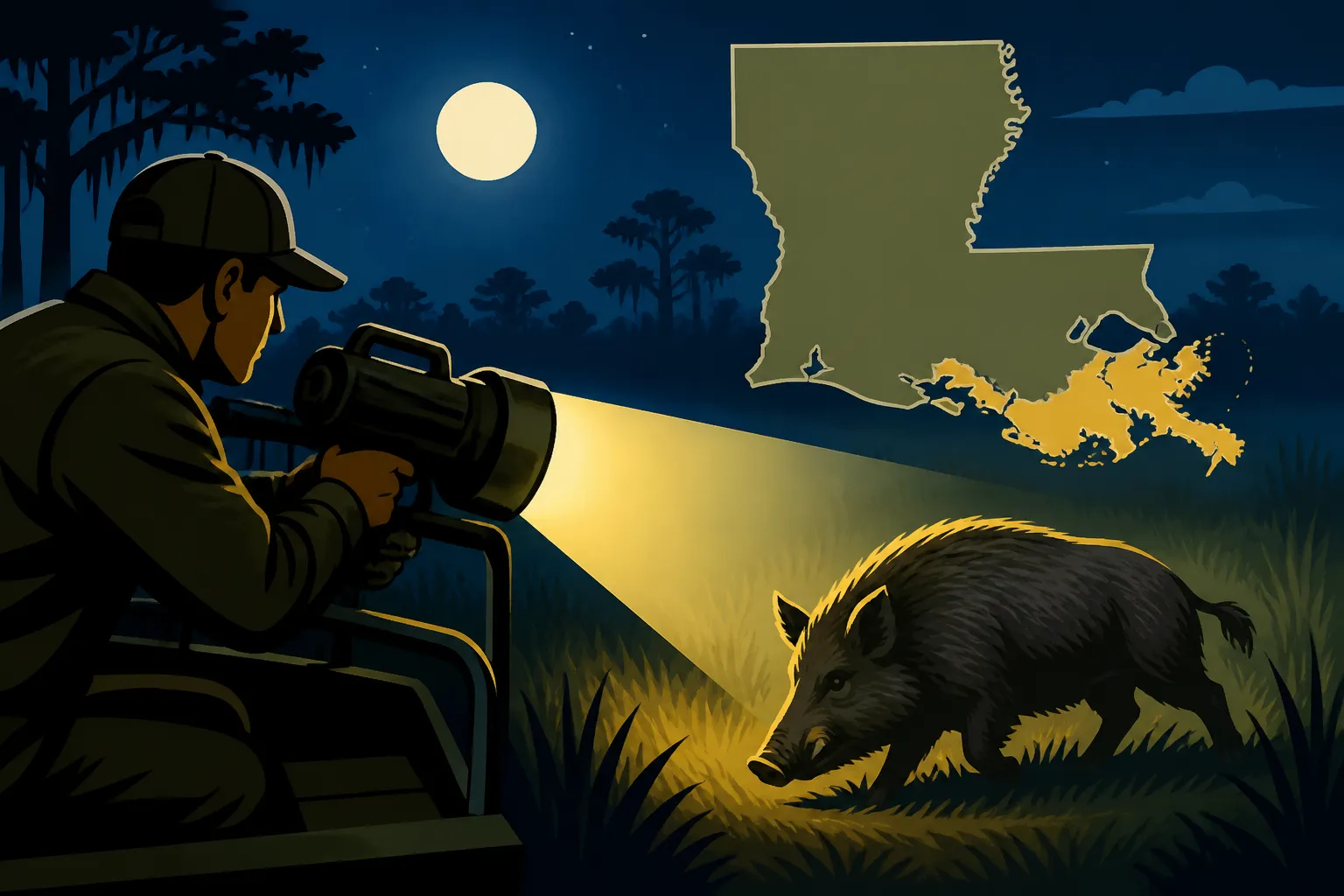
The most important distinction when it comes to night hunting for hogs with lights is the difference between private and public land. On private land, hunters are generally permitted to use artificial lights, including weapon-mounted lights, spotlights, and even advanced thermal or night vision devices, to locate and harvest feral hogs. This broad allowance is a direct response to the severe agricultural damage and ecological disruption caused by these animals. Landowners often find that night hunting is the most effective way to target large groups of hogs that become active once human presence diminishes after sunset.
To exercise this privilege, however, you absolutely must have explicit permission from the landowner. While verbal permission is often accepted, it's always a best practice to obtain written permission, especially when hunting at night or using methods that might draw attention. This written documentation should clearly state that you have permission to hunt feral hogs at night and to use artificial lights. This protects both you and the landowner should any questions arise. Remember, trespassing laws are strictly enforced, so clarifying your access and methods beforehand is paramount. If you need more information on securing access, consider reviewing Getting Private Land Permission in Louisiana.
Public Land Restrictions and Exceptions
In stark contrast to private land, hunting feral hogs at night on public lands in Louisiana, such as Wildlife Management Areas (WMAs) or National Wildlife Refuges, is almost universally prohibited. Public land hunting is governed by much stricter regulations designed to manage diverse wildlife populations, ensure public safety, and maintain a fair chase environment for all hunters. This means that even though hogs are considered nuisance animals, the general rules for hunting hours (one-half hour before sunrise to one-half hour after sunset) apply to them on public property.
There are virtually no exceptions for using artificial lights to hunt hogs at night on public lands. Attempting to do so could result in significant fines, loss of hunting privileges, and confiscation of equipment. Always consult the specific WMA or refuge regulations before planning any hunt, as rules can vary slightly, but assume night hunting with lights is off-limits. The LDWF website and their "Regs" app are invaluable resources for checking the most current rules for any specific public hunting area.
Types of Lights and Devices Permitted on Private Land
When hunting hogs at night on private land, the flexibility in Louisiana's regulations allows for a wide array of lighting and sighting technologies. This has opened up new frontiers for hog control, making hunters far more effective after dark.
- Traditional Flashlights and Spotlights: Simple handheld or head-mounted flashlights are commonly used for scanning fields and woods. More powerful spotlights can also be effective for longer-range illumination, helping to identify targets.
- Weapon-Mounted Lights: These lights attach directly to your firearm, illuminating your target and aligning with your point of aim. They are highly practical for maintaining situational awareness and making quick, accurate shots.
- Thermal Imaging Devices: Thermal scopes and monoculars detect heat signatures, making hogs stand out clearly against cooler backgrounds, even in complete darkness or thick cover. These devices have revolutionized night hunting, as they don't emit any visible light, making hunters nearly undetectable to the animals. Many guided hunts, like those mentioned in Thermal-Assisted Hog Guide Packages, extensively use this technology.
- Night Vision Devices: Night vision scopes and binoculars amplify ambient light (like moonlight or starlight) to create a visible image. While not as effective in absolute darkness as thermal, they provide a more natural, green-tinted view of the environment.
All these tools are generally permissible on private land for feral hog hunting in Louisiana, but it's always wise to ensure your specific device is not mistaken for something illegal (e.g., certain laser sights might have restrictions, though typically not for hogs). The emphasis is on safe, effective, and legal hog removal, and these lighting technologies contribute significantly to that goal.
Navigating Public vs. Private Land for Night Hog Hunts
The distinction between hunting regulations on private versus public land is perhaps the most critical factor for night hog hunters in Louisiana. Understanding these differences and how to operate within them will dictate your success and compliance.
Securing Private Land Access
If you're serious about effective night hog hunting with lights, private land is where you'll find the most opportunities. Obtaining permission, as mentioned, is non-negotiable. Many landowners are actively looking for help with hog control, as these animals devastate crops, pastures, and timberland. Approaching landowners politely, explaining your intentions, and offering to share harvested meat or simply provide a service can open many doors.
When discussing permission, clarify specifically that you intend to hunt at night and use artificial lights. This avoids any misunderstandings down the line. It's also a good idea to discuss safety protocols, such as your shooting lanes and how you'll communicate your presence to others who might be on the property. Establishing a clear, trustworthy relationship with a landowner is key to long-term access. This could also be a good point to review resources like Do Feral Hogs Need Landowner Permission? to understand the legal nuances of access.
Public Land Night Hunting Limitations
To reiterate, night hunting for feral hogs with lights is generally prohibited on public lands managed by the LDWF or other agencies. These areas, including state WMAs and federal refuges, have specific hunting hour regulations that must be followed for all species, including hogs. While you can hunt hogs during daylight hours on public land during established seasons, the ability to use lights for nocturnal pursuits is not extended.
This might be frustrating for hunters who primarily rely on public access, but the rules are in place for valid reasons, including safety and equitable resource use. Therefore, if your goal is to hunt hogs with thermal or night vision, you must focus your efforts on private land where explicit permission has been granted. Always double-check the LDWF regulations pamphlet or website for the specific WMA you intend to hunt, as rules are subject to change, and specific closures or special restrictions might apply.
The Importance of Scouting and Planning
Regardless of whether you're on private land or exploring the limited daylight opportunities on public land, thorough scouting and meticulous planning are the cornerstones of a successful hog hunt, especially at night. Hogs are creatures of habit but can adapt quickly, making pre-hunt reconnaissance vital. Before you even step foot on a property, understanding the lay of the land is paramount. Tools like GoHunt's mapping platform can be incredibly useful for pinpointing property lines, identifying potential travel corridors, and even marking known hog activity zones. These digital scouting tools allow you to analyze topography, water sources, and potential bedding areas without disturbing the animals.
For night hunting, understanding terrain is even more critical for safety and shot placement. You need to know what's beyond your target, and daylight scouting helps immensely with this. Identify natural funnels, common crossings, and areas with fresh rooting or tracks. While LDWF regulations are your ultimate source for rules, platforms like GoHunt can help you visualize land ownership and topography, which is invaluable when planning stand locations or identifying potential safety zones for your shots after dark. This blend of traditional observation and modern mapping technology, like that found in GoHunt's robust system, allows for incredibly precise and effective hunt planning.
Table: Comparison of Light Use for Night Hog Hunting in Louisiana
| Feature | Private Land (with permission) | Public Land (WMAs, Refuges) |
|---|---|---|
| Legal to Hunt Hogs? | Yes, year-round, no bag limit | Yes, but only during specific daylight seasons |
| Legal to Hunt Hogs at Night? | Yes, with landowner permission | No, generally prohibited |
| Use of Artificial Lights (visible)? | Yes, generally permitted | No, generally prohibited |
| Use of Thermal/Night Vision? | Yes, generally permitted | No, generally prohibited |
| Primary Regulatory Source | Landowner permission & general state laws | LDWF WMA/Refuge specific regulations |
| Risk of Violation | Low, if permission and safety adhered to | High, if attempting night/light hunting |
Gear, Safety, and Best Practices for Ethical Night Hunting
Successfully and ethically hunting feral hogs at night with lights requires more than just knowing the rules; it demands proper gear, rigorous safety protocols, and a commitment to responsible hunting practices.
Essential Gear for Night Hunts
When you're out after dark, you're operating in an environment that naturally limits your senses. Having the right equipment is not just about effectiveness; it's about safety.
- Optics: Whether it's a weapon-mounted light, a powerful spotlight, thermal imaging, or night vision, your primary piece of gear for seeing in the dark is paramount. Consider a good quality red or green LED light, as many animals are less disturbed by these colors. Thermal scopes offer the ultimate advantage by detecting heat, making hogs impossible to miss, even in dense cover. If you're new to thermal, many guides offer services that include the use of their high-end gear, as seen in options like Thermal-Assisted Hog Guide Packages.
- A Reliable Firearm: Choose a caliber and bullet combination that provides ample stopping power for hogs, which can be surprisingly tough. Common choices include .223/5.56, .308, 6.5 Creedmoor, or larger.
- Communication Devices: If hunting with a partner, two-way radios are indispensable. Always carry a fully charged cell phone for emergencies, even if you anticipate poor service. Many hunters also rely on mapping apps like GoHunt for real-time location sharing within their group.
- First-Aid Kit: Accidents can happen, especially in low light. A well-stocked first-aid kit is a must.
- Navigation Tools: A GPS device or a reliable mapping app on your phone (download maps for offline use!) can prevent you from getting disoriented in the dark. Again, GoHunt can be a great resource for navigating unfamiliar terrain, even after sunset.
- Proper Attire: Dress in dark, quiet clothing that blends into the night. Consider wearing minimal reflective materials.
Safety First: Backstop, Target ID, and Communication
Night hunting inherently carries increased risks, making safety an even higher priority.
- Identify Your Target Absolutely: In the dark, it's incredibly easy to mistake one animal for another, or even a person. Never, ever, take a shot unless you are 100% positive of your target and what lies beyond it. Use your optics to confirm antlers or other characteristics before pulling the trigger. This is particularly vital in areas where deer or other regulated wildlife might be present.
- Know Your Backstop: Just because it's dark doesn't mean your bullet disappears. Always have a safe and clear backstop for every shot. This means shooting into hillsides, thick earth, or dense cover where you are certain your projectile will not endanger property or people.
- Communicate Constantly: If hunting with others, maintain constant communication. Know each other's positions, intentions, and movements. Use pre-arranged signals or radio calls for movement and when shots are about to be taken.
- Avoid the "Skyline" Shot: Never shoot at an animal silhouetted against the night sky, as you have no idea what might be behind it.
- Treat Every Firearm as Loaded: This basic safety rule is amplified at night. Be extra vigilant with muzzle control and trigger discipline.
Ethical Considerations and Shot Placement
Ethical hunting dictates that we strive for quick, humane kills. This is especially true when hunting hogs, regardless of their nuisance status.
- Shot Placement: Aim for the vitals (heart/lungs) or a head shot if you're confident in your accuracy. The "shoulder" shot on a hog is often lower and more forward than you might expect, especially on larger boars. Proper Shot Placement on a Feral Hog ensures a swift kill and minimizes suffering. Take only shots you are comfortable making consistently.
- Follow-Up: If a hog is hit but doesn't drop, follow up quickly and safely. Hogs can cover ground remarkably fast, even when mortally wounded.
- Baiting for Effectiveness: Many night hunters use bait, such as soured corn, to attract hogs to a specific, safe location. This allows for controlled shooting opportunities. Understand that if you plan on Building and Freshening a Hog Bait Site, you must do so legally and ethically, ensuring the bait is not accessible to other game species where baiting might be prohibited.
- Respect the Resource: Even though hogs are invasive, they are still living creatures. Handle harvested animals respectfully and make use of the meat. Feral hog meat can be delicious when properly prepared.
By combining a thorough understanding of Louisiana's night hunting regulations for hogs, appropriate gear, unwavering safety practices, and an ethical approach, you can contribute effectively to managing these pervasive animals while enjoying a unique and challenging hunting experience.
Disclaimer
The information provided in this guide is for general informational purposes only and does not constitute legal advice. Hunting regulations in Louisiana are subject to change, and specific rules may vary by parish, WMA, or refuge. Always consult the most current Louisiana Department of Wildlife and Fisheries (LDWF) regulations pamphlet or their official website before engaging in any hunting activities. It is the hunter's responsibility to know and obey all applicable laws and regulations.