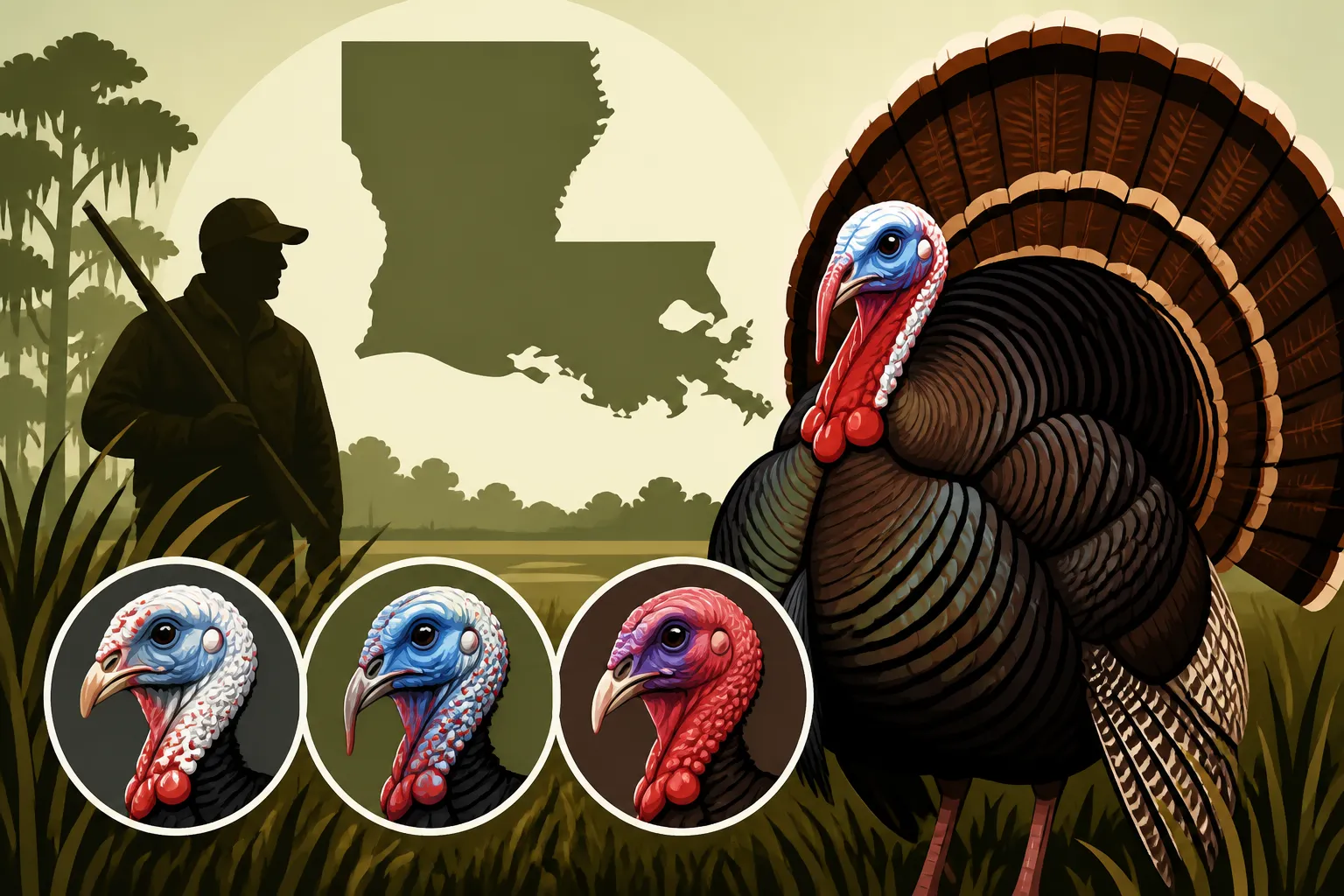
Louisiana Wild Turkey Subspecies
When you're out there, boots on the ground in the Louisiana woods, that first distant gobble is pure magic. For many of us, a turkey is a turkey – a magnificent bird that tests our patience and woodsmanship. But have you ever wondered if there's more to it, if the birds strutting through our cypress breaks or scratching in our pine forests are all the same? This guide will pull back the curtain on the specific wild turkey subspecies that call Louisiana home, giving you a deeper understanding of their traits and how this knowledge can sharpen your focus and boost your success on your next hunt.
The Eastern Wild Turkey: Louisiana's Reigning Monarch
Let's be clear from the outset: Louisiana is Eastern wild turkey country. These are the birds that have painstakingly been restored to our state, and they are the magnificent creatures you're likely pursuing whether you're deep in the Tensas River Basin or working the edges of a pine plantation up north. Understanding the Eastern is paramount to successful turkey hunting in Louisiana. They're resilient, cunning, and perfectly adapted to our diverse landscapes.
Physical Characteristics and Identification
When you picture a classic wild turkey, you're probably envisioning an Eastern. They are typically the largest and most iridescent of the five commonly recognized subspecies. A mature Eastern gobbler is a sight to behold, often tipping the scales from 18 to 25 pounds, though some true giants have certainly been taken in the Pelican State. Their body feathers are a deep, shimmering copper-bronze, catching the sunlight with green and red iridescence that truly stands out against the muted greens and browns of the swamp or forest floor.
Look closely at their tail feathers: they're dark brown or black, banded with a distinct, wide rusty-brown or chestnut band, and finally tipped with black. This is a key identifier. Their wing feathers are generally dark with white barring, which can look striking when they're fanned out in a strut. The legs are typically dark gray to almost black, sturdy and scaled, often bearing sharp, curved spurs on an older gobbler that tell tales of dominance and territorial battles. And of course, the signature beard – a coarse cluster of black bristles growing from the chest – is almost always present on a gobbler, varying in length and thickness with age. Hens sometimes have beards, but it's much less common and typically shorter and thinner.
Preferred Habitat in Louisiana
Eastern wild turkeys are incredibly adaptable, which is part of their success story in Louisiana. They thrive in a mosaic of habitat types, which is why you can find them from the uplands down to the edges of the marsh. Their preference leans heavily towards mature hardwood forests, particularly those with a mix of pine and other mast-producing trees like oaks and hickories. These areas provide crucial food sources in the form of acorns, pecans, and other nuts, especially during the fall and winter months.
You'll often find them in vast river bottomlands, such as those along the Red River, Ouachita River, and, of course, the massive Atchafalaya Basin. These areas offer dense roosting timber, plenty of cover, and rich foraging opportunities. They also do quite well in the extensive pine forests and mixed pine-hardwood stands found across North and Central Louisiana, where they forage for insects, seeds, and fruits. Even agricultural edges, particularly those bordering timber, will attract Easterns looking for spilled grains or fresh greenery. When scouting, think about areas with a good canopy for roosting, an open understory for foraging and strutting, and nearby water sources. Using a tool like GoHunt can help you visualize these different habitat types on public land, identifying potential roosting ridges or creek bottoms where turkeys might travel.
Tracing the Eastern Wild Turkey's Journey in Louisiana
The presence of abundant wild turkeys in Louisiana today is a testament to one of the greatest wildlife conservation success stories in North America. It wasn't always this way, and understanding their journey here gives you an even deeper appreciation for these birds.
Historical Decline and Restoration Efforts
It's hard to imagine now, but by the early 20th century, wild turkeys were nearly extirpated from much of Louisiana. Unregulated hunting, coupled with widespread deforestation and habitat alteration from logging and agriculture, pushed their populations to critically low levels. Many older hunters can still recall a time when seeing a wild turkey was a rare, almost mythical event in our state. The landscape had changed dramatically, and the remaining fragmented populations simply couldn't sustain themselves.
However, the dedicated efforts of the Louisiana Department of Wildlife and Fisheries (LDWF) and various conservation organizations like the National Wild Turkey Federation (NWTF) turned the tide. Starting in the 1960s and continuing for decades, a massive trap-and-transfer program was implemented. Biologists captured healthy wild turkeys from areas where populations were stable and relocated them to suitable habitats across the state where turkeys had been wiped out. This wasn't just about dumping birds; it was a meticulous process of identifying prime restoration sites, ensuring proper habitat, and monitoring the released birds. These efforts, combined with stricter hunting regulations and a renewed focus on habitat management, allowed the Eastern wild turkey to make an incredible comeback. It truly is one of the brightest examples of how focused conservation can yield remarkable results, restoring these magnificent birds to our forests and fields. If you're interested in the details of this comeback, check out How Turkeys Were Restored to Louisiana.
Current Distribution and Population Status
Today, the Eastern wild turkey population is widespread throughout Louisiana, inhabiting nearly every parish where suitable habitat exists. The densest populations are generally found in the northern and central parts of the state, particularly in the large timbered tracts of the Florida Parishes, the piney hills of North Louisiana, and the river bottoms of the Tensas and Ouachita basins. However, they can be found in smaller, fragmented populations even in some southern parishes that retain sufficient wooded areas.
While the restoration was a resounding success, current populations face ongoing challenges. Habitat fragmentation continues to be a concern, as development and changing land-use practices shrink and isolate turkey habitats. Predation, primarily from coyotes, bobcats, and even raccoons (especially on nests), can impact poult survival. Disease outbreaks, though usually localized, also pose a threat. The LDWF continuously monitors Louisiana wild turkey population trends and conducts annual brood surveys to assess reproductive success and overall flock health. Understanding Louisiana Turkey Population Estimate numbers helps ensure sustainable hunting seasons and informs management decisions to keep these birds thriving. As hunters, supporting conservation efforts and adhering to Louisiana Spring Turkey Season Rules and Louisiana Turkey Bag Limit Rules is vital for their continued prosperity.
Are Other Subspecies Present? The Question of Hybridization
One question that often comes up in turkey circles is whether Louisiana has any other turkey subspecies. Given our geography, it's a fair thought, but the answer for most hunters is relatively straightforward.
The Pure Eastern vs. Hybrid Debate
For all practical hunting purposes, Louisiana is solely Eastern wild turkey territory. While states to our west, like Texas, are home to Rio Grande wild turkeys, and Florida has its unique Osceola, these subspecies do not have established, self-sustaining populations within Louisiana's borders. The vast majority, if not all, of the wild turkeys you encounter and hunt here will be Easterns.
There's always a theoretical possibility of hybridization, particularly if a Rio Grande bird were to wander across the western state line from Texas and breed with an Eastern hen. In some border regions, minor genetic mixing has been documented in various species. However, these instances are extremely rare and do not represent a stable, widespread population of hybrid turkeys. For a bird to be considered a true hybrid for hunting purposes, it would need to exhibit a significant blend of characteristics that are consistently passed down, and that simply isn't the case in Louisiana. So, while it's an interesting biological discussion, it's not something Louisiana turkey hunters typically need to worry about impacting their hunting strategy or identification in the field.
Impact on Hunting Strategy
The good news is that because Louisiana is overwhelmingly Eastern wild turkey country, your hunting strategy can be laser-focused. You don't need to learn the subtle differences in behavior or vocalizations of multiple subspecies. Instead, you can concentrate on understanding the nuances of Eastern turkey behavior, habitat preferences, and local patterns in your chosen hunting grounds.
For instance, knowing that Easterns prefer vast tracts of timber for roosting and feeding means you'll be scouting those big hardwood bottoms and mixed pine stands with confidence. You'll focus on traditional turkey sign – tracks, droppings, scratchings, and feather finds – in these specific environments. Whether you're trying Roost Hunting Louisiana Gobblers at first light or employing Run-and-Gun Turkey Tactics on Public Land later in the morning, your knowledge of Eastern turkeys will be your guide. Your calling techniques, decoy setups, and overall approach will be tailored to the Eastern's established responses. While it's always fun to read about other subspecies, your time in the Louisiana woods is best spent becoming an expert on the Eastern wild turkey.
Practical Knowledge for the Louisiana Turkey Hunter
Understanding your quarry is always the first step to becoming a more effective hunter. While we've established that the Eastern is king here, let's tie that knowledge into practical application for your next Louisiana turkey hunt.
Recognizing Gobblers and Hens in the Field
No matter the subspecies, the fundamental rules for identifying a legal gobbler remain the same. In Louisiana, you're generally looking for a bearded bird. The presence of a beard is the primary indicator, as hens typically do not grow them. Beyond that, size is a big clue – mature gobblers are significantly larger and bulkier than hens.
Other key identifiers include spur length and beard length. Older gobblers will have longer, sharper spurs, often exceeding an inch in length, while jakes (sub-adult males) will have nubs or very short, blunt spurs. Beards on mature gobblers are usually longer and thicker than those on jakes, which might have a short, pencil-thin beard. The fan is another giveaway: a gobbler's tail fan is full and rounded, especially when strutting, while a hen's fan is generally smaller and more subdued. Watching for the bright red, white, and blue coloration on a gobbler's head and neck during the strut is also a dead giveaway – hens generally have duller, more bluish-gray heads. These characteristics hold true for our Eastern birds and are what you need to focus on when that bird steps into view.
Using Subspecies Knowledge for Better Hunting
Knowing that you're hunting Eastern wild turkeys in Louisiana can profoundly influence your scouting and hunting strategies. Since Easterns are creatures of the timber, your pre-season scouting should heavily focus on finding good roosting areas in large, mature trees, especially hardwoods near water or on prominent ridges. Look for scratchings under mast-producing trees, dust bowls, and tracks along logging roads or creek banks. Understanding their preference for dense cover and diverse food sources will help you predict their travel corridors and feeding patterns.
For calling, Easterns respond well to a wide array of calls, from soft tree yelps and clucks to aggressive cutting and gobbling. While no two birds are exactly alike, their general response patterns are well-documented for this subspecies. Think about the terrain you're in: Grunt Calls in Mature Louisiana Timber might be different than calls in more open settings. Using a mapping application like GoHunt can be incredibly helpful here, allowing you to identify critical habitat features like bottomland hardwoods, pine ridges, and potential strutting zones even before you set foot in the woods. This allows you to plan your approach, understand the topography, and choose effective Decoy Placement for Pressured Louisiana Birds or find the perfect setup against a big oak. By focusing on the specific behaviors and habitats of the Eastern wild turkey, you're not just hunting a generic turkey – you're hunting the Louisiana Eastern, and that detailed knowledge makes all the difference.
Eastern Wild Turkey Characteristics in Louisiana
| Feature | Description |
|---|---|
| Size | Large, robust birds. Adult gobblers typically 18-25 lbs, hens 8-12 lbs. |
| Plumage | Dark, iridescent copper-bronze body feathers with green and red highlights. |
| Tail Feathers | Dark brown/black with a wide, distinct rusty-brown or chestnut band, tipped with black. |
| Wing Feathers | Dark with white barring, creating distinct bands when wings are folded. |
| Head/Neck | Bare, varying in color from white/blue to bright red depending on excitement and time of year. |
| Legs | Dark grey to black, scaled. Adult gobblers possess sharp, curved spurs (length indicates age). |
| Beard | Black, coarse bristles growing from the chest; typically present on gobblers, rare on hens. |
| Habitat | Prefers mature hardwood forests, mixed pine-hardwood stands, river bottomlands, and agricultural edges. |
| Vocalizations | Classic, booming gobble; wide range of yelps, clucks, purrs, and putts. |
Disclaimer: This article is for general informational purposes only and does not constitute professional advice. Laws, prices and regulations vary by location and change over time. Consult a qualified professional for guidance on your specific situation.