Louisiana Deer Antler Growth Timeline
It's a common feeling, isn't it? You spend hours in the woods, hoping to catch a glimpse of that impressive rack, and it makes you wonder what goes into growing those antlers. Understanding the annual antler growth timeline for white-tailed deer in Louisiana isn't just a fascinating biological study; it's a powerful tool that helps us as hunters predict deer behavior, optimize our scouting efforts, and make more informed decisions afield. This guide will walk you through the intricate journey of antler development, from shedding to hard horn, giving you a deeper appreciation for these incredible animals and practical insights for your next hunt.
The Fundamentals of Antler Growth: A Year-Round Process
Many hunters only think about antlers during deer season, but the truth is, the process of growing and shedding those impressive racks is a year-round cycle that starts long before the first chill of autumn. It's a complex dance orchestrated by hormones, nutrition, age, and genetics, and it dictates much of a buck's life outside of the rut. You might see a big buck in December and think he just "grew" those antlers, but the seeds for that rack were planted months ago, right after last season's shedding.
Antlers are unique because, unlike horns on animals like cattle or goats that are permanent and never shed, deer antlers are deciduous. They are true bone structures that grow and shed annually, a truly remarkable feat of nature. Each year, a buck essentially starts from scratch, rebuilding what he shed just a few months prior. This incredible regenerative capability is what makes the whitetail such a dynamic and captivating game animal.
This annual cycle means that understanding when and how antlers grow can give you a significant advantage in your scouting and hunting efforts. For instance, knowing when bucks are likely to be in velvet helps you adjust your trail camera strategies, or understanding the factors that dictate shedding times can make you a more successful shed hunter. It's all connected, and the more you learn, the more pieces of the puzzle fall into place in the woods.
The Role of Hormones and Nutrition
The primary drivers of antler growth are testosterone and photoperiod (daylight length). As daylight hours increase in the spring and early summer, a buck's pituitary gland ramps up hormone production, signaling the growth plates on his pedicles (the bony stumps on his skull) to activate. This surge in hormones, particularly testosterone, initiates the rapid growth of new bone tissue. The timing of this hormonal shift is remarkably consistent year after year, almost like an internal biological clock.
However, hormones only provide the signal; nutrition provides the building blocks. Rapid antler growth demands an enormous amount of protein, calcium, phosphorus, and other trace minerals. If a buck's diet is lacking during this critical growth period, his antlers will reflect it, often appearing smaller or with fewer points than his genetic potential allows. This is why you often see larger-racked deer in areas with rich agricultural lands or well-managed timber where food sources are abundant and diverse.
Velvet Versus Hard Horn
One of the most visually striking aspects of antler growth is the velvet phase. From spring through late summer, antlers are covered in a soft, fuzzy skin rich with blood vessels and nerves. This velvet provides essential nutrients and oxygen to the growing bone underneath. It's warm to the touch and incredibly sensitive, which is why you'll rarely see a velvet-antlered buck sparring or rubbing. During this time, the antlers are essentially living tissue, constantly expanding and calcifying.
Once the antlers reach their full size and mass, usually in late August or early September in Louisiana, a second hormonal shift occurs. Testosterone levels begin to rise dramatically, which signals the velvet to dry up and die. The buck then rubs the itchy, dead velvet off his antlers, usually against small trees and brush. This process, known as "shedding velvet" or "hardening off," reveals the polished, hard bone underneath, signaling the readiness for the rut. When you see those fresh rubs pop up, it’s a clear sign that bucks are in hard horn and ready to start claiming their territory.
Key Stages of Antler Development in Louisiana Whitetails
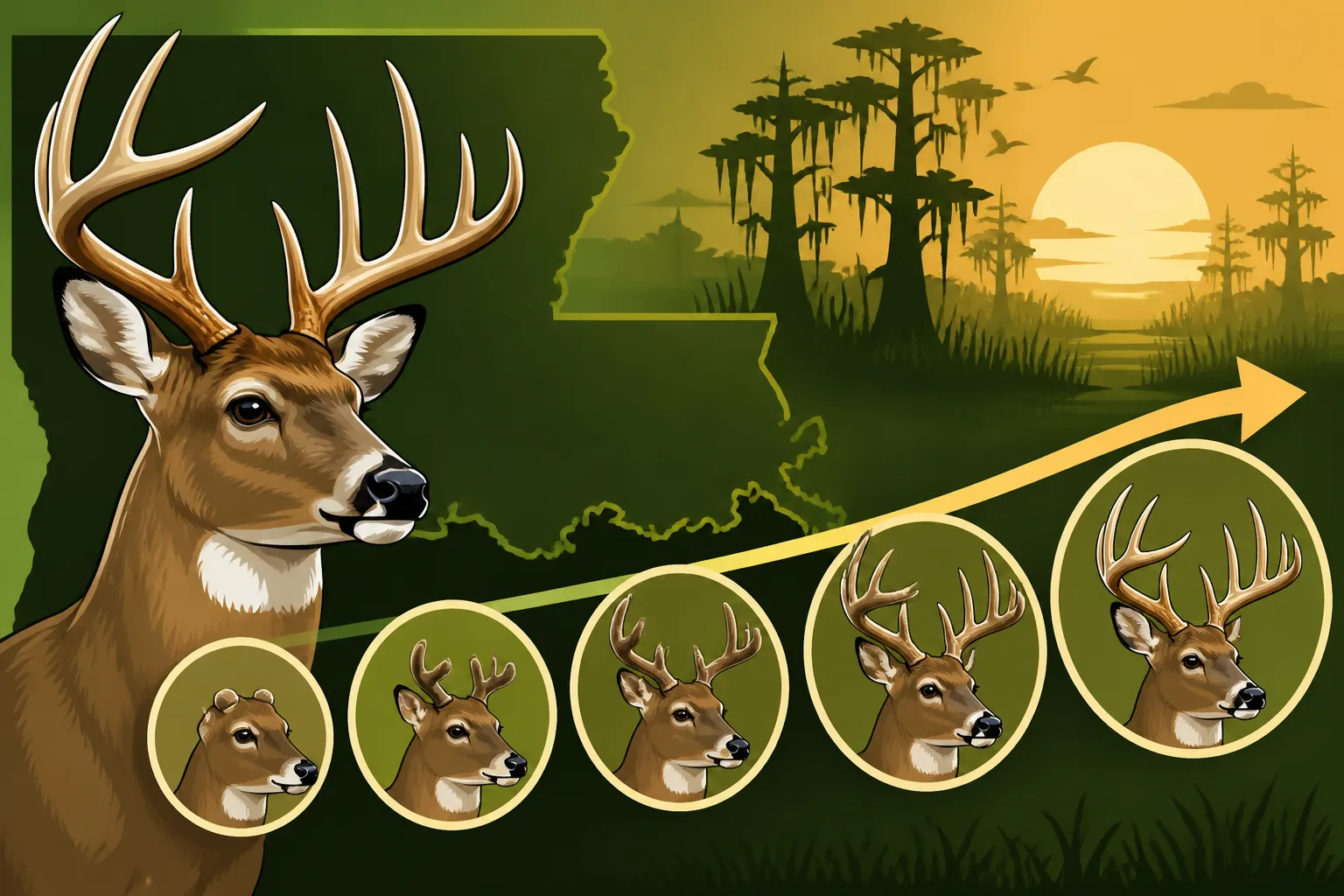
The antler growth timeline in Louisiana, like elsewhere, follows a predictable pattern driven by the changing seasons. Knowing these distinct phases can greatly influence your scouting strategies and help you understand what bucks are doing at different times of the year. It's a journey that starts in the chill of late winter and culminates in the peak of the fall rut, and each stage offers unique opportunities for observation and interaction.
It's tempting to think of antler growth as a continuous, linear process, but it's really a series of distinct phases, each with its own characteristics and demands on the buck's body. From the vulnerability of a freshly shed buck to the hardened warrior ready for the rut, the changes are dramatic. This understanding can help you interpret the sign you find in the woods and anticipate deer movements.
Consider how a buck's energy is allocated throughout the year. In the spring, his body is channeling massive amounts of resources into growing those antlers. By late summer, that energy shifts to hardening the rack and preparing for the physical demands of breeding. This biological prioritization impacts everything from where a buck beds to what he feeds on, offering clues for savvy hunters.
Shedding: Late Winter to Early Spring (January-April)
This is where the cycle begins anew. After the rigors of the rut and the stress of winter, a buck's testosterone levels drop significantly, causing the connection between the pedicle and the antler to weaken. Eventually, the antlers simply detach and fall off. The exact timing can vary based on individual buck health, age, and local conditions, but generally, most bucks in Louisiana shed their antlers from late January through March, with some outliers into April. When Louisiana Bucks Shed Antlers delves deeper into this timing.
Finding sheds can be an incredibly rewarding experience and a great way to scout future hunting areas. It tells you a specific buck survived the previous season and was in that area. It also gives you a tangible representation of a buck's genetic potential and health. Look for areas where deer bed, common travel corridors, and around late-season food sources like green fields or mast crops that might still be available in pockets. This is a perfect time to use mapping tools like GoHunt to mark potential shed-hunting hot spots and plan your routes before spring green-up makes them harder to find.
After shedding, the pedicles bleed briefly before a scab forms. Within a few weeks, new antler growth begins, covered in sensitive velvet. This is the earliest stage of regeneration, often starting as tiny bumps or "buttons" on the pedicles. The buck's body is already hard at work, drawing calcium and other minerals from his bones and diet to start forming the next year's rack.
Growth Phases: Spring to Late Summer (April-August)
The spring and summer months are when the magic truly happens. Antler growth is incredibly rapid during this period, often adding inches daily.
- Early Spring (April-May): You'll see small knobs or "buttons" emerge, quickly elongating into spikes or small forks, all encased in thick velvet. Bucks are focused almost entirely on feeding to fuel this intense growth. They often keep to thicker cover and open areas during low light to minimize disturbance and maximize forage intake.
- Late Spring to Early Summer (June-July): This is the explosion phase. The main beams grow longer, and the tines begin to sprout and lengthen. Mass increases significantly. During this time, the antlers are still incredibly soft and vulnerable to injury, which can lead to abnormal points or deformities if a buck is jostled or runs into something. Nutrition remains paramount; ample protein and minerals are critical for reaching full potential.
- Late Summer (August): Antler growth slows down, and the antlers begin to harden and calcify. The velvet becomes thinner, and you might start to see bucks rubbing their racks on small branches, subtly checking the integrity of the velvet. This is also when bucks start to feel the increasing testosterone, getting them ready for the final velvet shedding.
Hard Horn and The Rut: Fall to Early Winter (September-December)
By late August or early September, most Louisiana bucks are shedding their velvet. This transition marks the official arrival of hard antlers and the pre-rut phase.
- Velvet Shedding (Late August-Early September): The velvet dries and becomes itchy, prompting bucks to rub it off on saplings and brush. This leaves characteristic "velvet rubs" that are distinct from the deeper rubs made during the rut. The antlers underneath are now hard, polished bone. These early rubs are great indicators of a buck's presence and travel routes.
- Hard Horn Season (September-December): With hardened antlers, bucks are ready for the breeding season. Testosterone levels are high, driving sparring, rub-making, and scrape-checking behavior. This is the time when bucks are most active and visible during daylight hours, especially as the rut approaches. Understanding Hunting the Louisiana Rut by Area can help you time your hunts for peak activity. After the rut, as testosterone levels drop, bucks become more reclusive, focusing on recovering lost weight and energy. They will carry these hard antlers until the shedding process begins again in the late winter.
Here's a quick overview of the typical antler growth timeline in Louisiana:
| Month | Antler Stage | Key Activities/Notes |
|---|---|---|
| January-February | Shedding/Post-Rut | Testosterone drops, antlers typically shed. Bucks recovering from rut. |
| March-April | Early Growth (Velvet) | Pedicles heal, new velvet growth begins as small buttons/nubs. Focused on feeding. |
| May-June | Rapid Growth (Velvet) | Main beams and points elongate rapidly. Intensive nutrient uptake needed. |
| July-August | Maturation (Velvet) | Growth slows, antlers calcify. Bucks gain mass. Velvet starts to thin. |
| Late August-Early Sep | Velvet Shedding | Testosterone surge, velvet dries and is rubbed off. Early rubs appear. |
| September-October | Hard Horn (Pre-Rut) | Antlers are hard. Bucks begin rubs and scrapes, establishing dominance. Pre-rut activity. |
| November-Early Dec | Hard Horn (Rut Peak) | Peak breeding activity. Bucks actively chasing does, high movement. |
| Late Dec | Hard Horn (Post-Rut) | Bucks recovering, focusing on food. Antlers held until testosterone drops. |
Factors Influencing Antler Size and Quality
It’s easy to look at a majestic ten-point buck and think he’s just naturally blessed, but antler size and quality are influenced by a complex interplay of factors, not just luck. As hunters and conservationists, understanding these elements allows us to better appreciate the challenges deer face and even contribute to healthier herds. It's not just about one "big secret" but a combination of influences that shape a buck's headgear.
Many hunters wish every buck had a Boone and Crockett rack, but the reality is far more nuanced. Some regions consistently produce bigger deer due to specific environmental factors, while others struggle. Recognizing what drives antler development beyond just age can help you understand the potential of the deer in your hunting area and adjust your expectations and strategies accordingly.
This knowledge also plays a significant role in herd management. By focusing on factors that promote better antler growth, such as providing quality nutrition or allowing bucks to reach maturity, we can foster a healthier and more robust deer population overall. It’s about more than just the size of the rack; it’s about the health of the entire ecosystem.
Age: The Most Significant Factor
Without a doubt, age is the single most critical factor determining a buck's antler potential. Young bucks, generally one-and-a-half to two-and-a-half years old, are still dedicating much of their energy to body growth. While they might show good genetics, their antlers will typically be smaller, shorter, and have less mass than their older counterparts. It takes several years for a buck to reach his physiological prime, which is usually between four-and-a-half and six-and-a-half years old.
During these prime years, a buck has typically reached his full body size, and his energy can be fully diverted to antler development once spring arrives. This is when you'll see the biggest jumps in tine length, mass, and overall score. After this peak, antler quality might slowly decline with old age, though some bucks can maintain impressive racks well into their later years. This is why Louisiana Buck Age Structure is a key indicator for herd health and potential.
Nutrition and Habitat Quality
No matter how good a buck's genetics or age, he can't grow impressive antlers without proper nutrition. Deer need a consistent supply of high-quality forage rich in protein, minerals (especially calcium and phosphorus), and carbohydrates. Areas with diverse habitat, including hardwood bottoms, agricultural fields, and managed pine forests, tend to produce better antlers.
In Louisiana, this means areas with abundant mast crops like acorns, lush natural forage, and supplemental food plots can significantly impact antler development. Poor soil quality, drought, or overpopulation can lead to nutrient deficiencies, resulting in smaller antlers across the herd. Conversely, a managed property with food plots and supplemental feeding programs, if legal in your area, can boost the nutritional plane and lead to larger racks.
Genetics
While age and nutrition are huge, genetics lay the blueprint. A buck inherits his antler potential from his parents. This is why some areas or specific bloodlines within a herd consistently produce larger-racked deer, even under similar environmental conditions. While we can't directly manipulate wild deer genetics, understanding the role they play helps us manage expectations and observe patterns.
Herd management often considers genetics by allowing certain bucks to mature and pass on their traits, or by focusing on antlerless harvest to control population density and ensure better nutrition for remaining bucks. Why the Florida Parishes Grow Big Bucks is a prime example of how favorable conditions and strong genetics can lead to exceptional antler development.
Health, Stress, and Injury
A buck's overall health significantly impacts his antler growth. Diseases, parasites, and injuries can divert vital energy away from antler development, resulting in smaller or deformed racks. For example, a severe leg injury could cause abnormal growth on the antler on the opposite side of the body, a phenomenon known as contralateral effect. High stress levels from intense hunting pressure or habitat disturbance can also negatively affect a buck's ability to maximize his antler growth.
Environmental stressors like severe drought or widespread disease outbreaks, such as EHD, can also have a noticeable impact on antler quality across a region. Bucks recovering from such events might show reduced antler size in subsequent years as their bodies prioritize recovery over elaborate bone growth.
How Knowing the Timeline Helps Your Hunting
Understanding the Louisiana deer antler growth timeline isn't just about satisfying curiosity; it's a practical skill that can give you a significant edge in your hunting endeavors. From preseason scouting to in-season tactics and even post-season activities, knowing what to expect from deer antlers throughout the year can make you a more efficient and successful hunter. It's about thinking like a deer and anticipating their natural rhythms.
Many hunters focus solely on the rut, but the truth is, year-round knowledge of deer biology opens up a wealth of opportunities. By linking antler development to deer behavior, you can unlock patterns that others might miss, leading to more productive time in the woods and a deeper connection to the wildlife you pursue.
It’s also an excellent way to connect with the land and the animals even when you’re not actively hunting. Shed hunting, for example, is a fantastic way to extend your time outdoors and gather valuable information about your local deer herd. Every piece of information you collect throughout the year builds a more complete picture, making your hunting decisions sharper.
Optimized Scouting and Trail Camera Strategies
Knowing when bucks are in different stages of antler growth allows you to tailor your scouting efforts. In spring and summer, when bucks are in velvet and often more predictable in their feeding patterns, you can use trail cameras to identify specific bucks and watch their racks develop. This is a great time to determine potential shooter bucks for the upcoming season without putting too much pressure on them. Using a tool like GoHunt to mark camera locations and upload pictures can help you keep track of individual deer year over year.
Once bucks shed their velvet and start rubbing, you know they're becoming more territorial. This is your cue to look for fresh rubs and scrapes, which are signposts of buck activity. Understanding that new rubs mean a buck is in hard horn and establishing dominance helps you interpret the sign correctly and predict where he might be traveling. Scouting Louisiana Public Land Before Season becomes even more effective when you know what specific sign to look for at each phase.
Timing Your Hunts for Peak Behavior
The antler growth timeline is intrinsically linked to a buck's hormonal cycle, which in turn drives his behavior. Knowing when antlers harden, and testosterone levels rise, directly correlates with the onset of aggressive pre-rut and rut behavior. This knowledge helps you pinpoint the most opportune times to be in your stand.
For instance, you know that when bucks are actively rubbing velvet in late August, they're not quite in the seeking phase of the rut. But by late September and October, when those antlers are fully hardened and polished, and you see fresh rubs everywhere, you know the pre-rut is heating up. This is a prime time for calling tactics like rattling and grunting, as bucks are feeling their dominance but not yet fully committed to chasing does.
Shed Hunting Success
As mentioned earlier, shed hunting is directly tied to the antler growth timeline. Knowing that most Louisiana bucks will drop their antlers between late January and April allows you to plan your shed hunting trips for maximum success. Focusing on bedding areas, known food sources, and major travel corridors during this window can significantly increase your chances of finding those elusive treasures. A long, cold winter can sometimes delay shedding, while a mild winter might see them drop earlier, so paying attention to local conditions is key.
Finding sheds not only provides a cool souvenir but also gives you crucial data. You can identify specific buck characteristics, approximate their size, and confirm that a particular buck survived the hunting season and is still in your area. This information is invaluable for planning future hunts or simply appreciating the individual deer on your property.
Contributing to Herd Management
Finally, understanding the antler growth timeline contributes to better herd management. By observing antler quality over several years, you can get a sense of the age structure and nutritional plane of the deer in your area. If you consistently see young bucks with small, spindly antlers, it might indicate a need for better habitat management or a reevaluation of harvest strategies.
This knowledge also plays a role in discussions about Louisiana Deer Antler Restrictions Debate. Regulations are often designed with the goal of allowing bucks to reach older age classes and express their full antler potential, which directly ties into the growth timeline we've discussed. Responsible hunting is about understanding the entire life cycle, not just the moment of the shot.
Disclaimer
This article is for general informational purposes only and does not constitute professional advice. Laws, prices and regulations vary by location and change over time. Consult a qualified professional for guidance on your specific situation.