Shot Placement on a Louisiana Black Bear
The thrill of drawing a Louisiana bear lottery tag is unparalleled, but it comes with a weighty responsibility: ensuring an ethical, humane harvest. Many hunters feel a natural anxiety about taking down such a powerful animal, especially when the anatomy isn't as familiar as, say, a whitetail. This comprehensive guide aims to demystify black bear shot placement, offering clear, actionable advice to maximize your chances of a clean kill and minimize tracking challenges in our dense Louisiana woods.
Understanding Louisiana Black Bear Anatomy for Ethical Shots
When you finally get that magnificent Louisiana black bear in your sights, whether it's in the dense bottomlands of the Tensas River Basin or the sprawling Atchafalaya, knowing precisely where to place your shot is paramount. Bears are incredibly resilient animals, and their anatomy, while sharing similarities with deer, also presents unique challenges due to their heavy bone structure, thick fat, and dense muscle. A misplaced shot can lead to a long, arduous, and potentially dangerous tracking job, or worse, a wounded animal that is never recovered.
The Vital Zone: Heart and Lungs
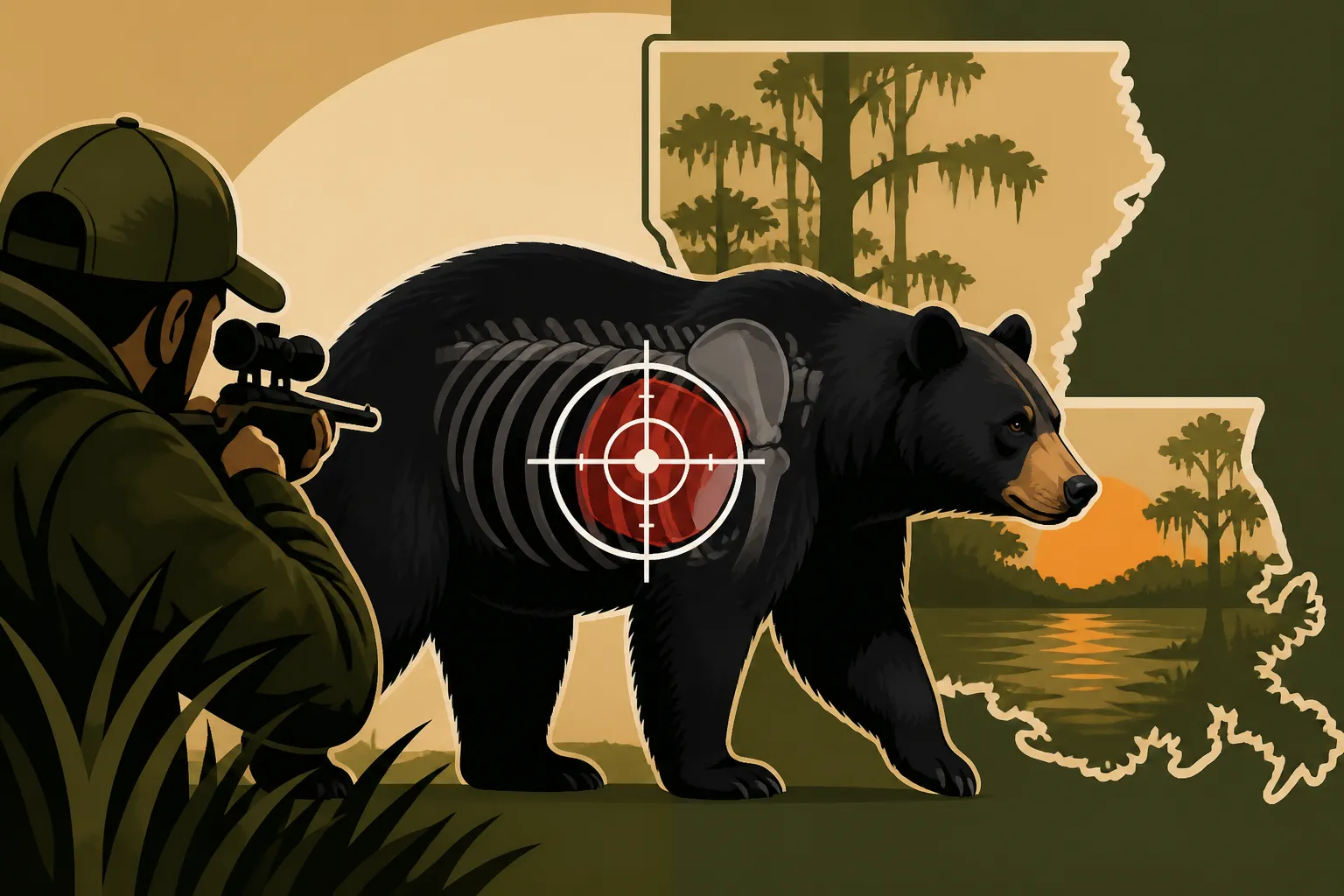
The absolute sweet spot for a humane black bear harvest is the heart-lung area. This vital zone is remarkably similar to a deer's in terms of its function, but its precise location relative to the shoulder blade can be deceiving on a bear. Imagine a baseball or softball-sized target tucked just behind the bear's shoulder, running roughly from the center of the chest cavity up to about one-third of the way down its body from the spine.
When a bear is standing broadside, facing directly sideways to you, your aim should be for the crease directly behind the front leg, about one-third of the way up from the belly line. This target area typically encompasses both lungs and, if slightly lower, the heart itself. The lungs are a large target, and a shot through both will quickly incapacitate the animal. The heart, while smaller, is a catastrophic hit. Remember that a bear's shoulder blade is robust and can deflect arrows or bullets if you hit it dead center. Aim behind that shoulder blade, letting your projectile slip into the soft tissue of the chest cavity. The dense muscle and thick hide on a bear mean you need sufficient kinetic energy and a stout bullet or broadhead for reliable penetration.
Skull Shots and Their Risks
While the image of a perfectly placed skull shot might seem appealing for an instant kill, it’s a high-risk, low-reward proposition for hunters in the field, and generally, it's strongly discouraged. The bear's brain, the target for such a shot, is surprisingly small, roughly the size of a human fist, and is encased in incredibly thick bone. Furthermore, a bear's skull is sloped, which can easily cause a bullet or broadhead to glance off, resulting in a non-lethal, painful injury.
Consider the immense pressure of a hunting scenario: adrenaline pumping, varying light conditions, and the bear potentially shifting its head even slightly. All these factors dramatically reduce the probability of hitting that tiny, vital brain target. If you miss the brain but hit the skull, you could shatter the jaw, blind the bear, or cause other debilitating injuries that do not result in a quick death but rather a prolonged, agonizing one. This is why most ethical hunters advocate for waiting for a broadside or quartering-away shot to the much larger and more forgiving heart-lung area. Unless you are in a very specific, controlled situation for dispatching a captured animal, avoid the skull shot during a typical hunting encounter.
Shot Angles and Trajectory Considerations
The angle at which a bear presents itself can make or break your shot opportunity. Unlike deer, bears often move with a rolling gait and can quickly change their orientation, making it critical to anticipate their movements and only take a shot when the odds are stacked in your favor for a clean kill. Patience is truly a virtue when hunting these formidable creatures.
Broadside and Quartering Away Shots
The broadside shot remains the gold standard for ethical bear hunting. When a bear is standing perfectly perpendicular to you, the vital organs are fully exposed, offering the largest target area. For a broadside shot, you want to aim for the crease directly behind the front leg, approximately one-third of the way up from the chest floor. This trajectory will pierce both lungs, leading to massive internal damage and a quick, humane death. When aiming, mentally draw a line from that point straight through the body to the exit side. Your projectile needs to have enough energy and construction to penetrate through the bear's heavy hide, fat, muscle, and potentially bone on the far side.
Even better, arguably, is the quartering-away shot. This means the bear is angled slightly away from you, with its head and front end pointed partially away. This angle offers an excellent entry point into the vital cavity because the shoulder blade on the entry side is now angled away from your line of fire. You're aiming for the opposite shoulder, letting your bullet or arrow travel through the vitals before exiting. For a quartering-away shot, aim slightly further back than a broadside shot, targeting the middle of the body, and visualize the exit point in the opposite shoulder. This angle often results in a double-lung or heart-lung shot with a good exit wound, which is invaluable for Blood Trailing After Dark in Louisiana or in dense cover. A great tool like GoHunt can provide overlays for different species, helping you visualize these vital zones and angles, even if you’re scouting areas like Richard K. Yancey Wildlife Management Area or the Kisatchie National Forest.
Frontal and Quartering Towards Shots
These are the shot angles you want to avoid whenever possible. A frontal shot, where the bear is facing you head-on, presents a small, challenging target. You'd need to thread your projectile through the sternum and potentially heavy brisket bone to reach the vitals. Even if successful, the wound channel might be less effective, and the chances of hitting non-vital areas are significantly higher. The thick muscle and bone around the chest can absorb a lot of energy, leading to shallow penetration and a wounded animal.
A quartering-towards shot, where the bear is angled partially towards you, is similarly problematic. This angle often means the animal's front shoulder is directly in the path of the vitals, presenting a formidable shield of bone and muscle. Trying to slip a bullet or broadhead through this dense mass dramatically increases the risk of a non-lethal or crippling shot. While seasoned hunters might occasionally take these shots under specific circumstances, the general rule of thumb for anyone seeking an ethical, clean kill on a Louisiana black bear is to exercise patience. Wait for the bear to turn, offer a broadside or quartering-away opportunity, and resist the urge to rush a risky shot. Remember, if it doesn't feel right, it probably isn't.
Ammunition and Equipment for Bear Hunting
Successfully hunting a Louisiana black bear, particularly after going through the process of Applying for a Louisiana Bear Lottery Tag and Attending the Mandatory Bear Hunter Course, hinges not just on shot placement, but also on having the right tools for the job. Bears are tough, and your equipment needs to be up to the task of delivering deep penetration and energy transfer to ensure a quick, clean kill.
Rifle Caliber and Bullet Construction
When it comes to rifle hunting for black bears, particularly in areas like the Atchafalaya Basin, you need to think "heavy for caliber" and "controlled expansion." While many deer calibers can technically kill a bear, a general rule of thumb is to opt for something with significant stopping power. Calibers like the .30-06 Springfield with heavy, quality bullets, .300 Winchester Magnum, .338 Winchester Magnum, or even larger, are often recommended. The key isn't just the caliber, but the bullet construction.
You want a bullet designed for deep penetration and controlled expansion, not rapid fragmentation. Bonded bullets (like Nosler AccuBond, Hornady InterBond), monolithic copper bullets (like Barnes TSX, Hornady GMX), or partition-style bullets (like Nosler Partition) are excellent choices. These bullets hold together well, retaining most of their weight as they drive through bone and dense tissue, ensuring that critical two-hole pass-through for maximum blood loss and a clear exit wound for tracking. Avoid varmint rounds or bullets designed for rapid expansion on thin-skinned game, as these will likely fail to reach the vitals effectively on a bear. Before heading out, consider what caliber will give you the confidence for a clean shot when you're fortunate enough to encounter a bear. Some hunters use primitive firearms as well, so understanding the Legal Primitive Firearms Under Louisiana Rules is also important.
Archery Setups for Black Bears
Archery hunting for black bears demands an even higher level of precision and equipment scrutiny. To ensure ethical penetration, you need a bow setup that generates sufficient kinetic energy and momentum. Most states, including Louisiana, don't set a minimum kinetic energy for bears, but generally, hunters aim for at least 60-70 ft-lbs for adequate penetration, though more is always better. This usually means a draw weight of 60 lbs or more, paired with a heavier arrow.
The broadhead choice is critical. For bears, many experienced archers favor fixed-blade broadheads due to their robust construction and guaranteed cutting action, which translates to better penetration, especially if you hit a bone. Look for three-blade or four-blade fixed heads with a strong ferrule and razor-sharp blades. Mechanical broadheads can work, but you need to ensure they are designed for large, tough game, providing maximum penetration without sacrificing blade integrity. Some mechanicals deploy too readily on impact with hide or fat, expending energy before reaching the vitals. Regardless of your choice, ensure your broadheads are absolutely razor-sharp. A dull broadhead will simply push tissue aside rather than cut it, drastically reducing the wound channel and effectiveness. Practice regularly to ensure pinpoint accuracy, because with archery, shot placement on a bear is even more unforgiving than with a rifle.
Here’s a quick overview of ideal bear shot placement:
| Shot Angle | Aiming Point | Key Considerations |
|---|---|---|
| Broadside | Crease behind front leg, 1/3 up from belly. | Best angle for double-lung/heart shot. Avoid shoulder blade. |
| Quartering Away | Aim for opposite shoulder, slightly further back. | Excellent for deep penetration into vitals, good exit wound. |
| Frontal | Center of chest, aiming for spine. | Very high risk, small target, thick bone. Generally avoid. |
| Quartering Towards | Avoid at all costs. | Shoulder blade shields vitals, high risk of non-lethal hit. |
Post-Shot Protocol and Tracking
The shot is fired, the bear reacts—what happens next can be just as crucial as the shot itself. Recovering a black bear, especially in Louisiana's dense swamps and thickets, can be a challenging endeavor. Having a clear, calm protocol after the shot will significantly increase your chances of a successful and safe recovery.
Immediate Reaction and Waiting Period
As soon as you take your shot, observe the bear's reaction intently. Did it buckle, run off quickly, or react violently? Any immediate visible blood or sounds of impact are also critical clues. A bear that runs off with a pronounced hunch in its back or a staggered gait often indicates a solid hit. Listen closely after the animal disappears; the sound of a crash or thrashing can confirm a short flight distance. Make mental notes of the last place you saw the bear and any landmarks that can help you find that exact spot.
Once the bear is out of sight, resist the immediate urge to pursue it. This is perhaps the hardest part, but also one of the most important. A wounded bear that feels pressured can run much further and can become dangerous. For a suspected heart or double-lung shot, a minimum waiting period of 30-60 minutes is usually advisable. If you suspect a less-than-ideal shot (e.g., gut shot or single lung), extend that wait time to at least 4-6 hours, or even overnight if conditions allow. This allows the bear to stiffen up and expire, preventing it from running further or, worse, turning on its pursuers. Use this time to calm your nerves, gather your thoughts, and quietly prepare your tracking gear. Planning for this wait is part of Hunting Louisiana's Reinstated Bear Season.
Blood Trailing and Recovery Strategies
After your waiting period, approach the shot site cautiously. Look for definitive signs of a hit: blood, hair, bone fragments, or stomach contents. The color and consistency of the blood can tell you a lot. Bright red, frothy blood indicates a lung hit; dark red, thick blood often suggests a muscle hit; and greenish-brown matter with a foul odor points to a gut shot. Mark your last known blood sign with flagging tape or a GPS waypoint.
Trailing a bear in Louisiana's often impenetrable undergrowth can be incredibly difficult. Bears don't leave tracks as obvious as deer, especially if they're not running hard. You'll need to move slowly, scanning not just the ground but also brush, trees, and low-hanging vegetation for any smears of blood or broken branches. Bears, like deer, will often follow paths of least resistance, but they can also push through incredibly dense cover. Pay attention to Wind and Thermals in Swamp Bottomland as you track, as a wounded animal may try to use these to its advantage, or you may need to use them to avoid alerting the animal.
If the blood trail is sparse or disappears, expand your search in concentric circles around the last sign. If you're still struggling, and it's legal in your area, consider calling a professional tracking dog service. Many handlers specialize in recovering game in tough conditions. Remember the importance of having backup. Never track a potentially wounded bear alone, especially in thick cover. Having a partner or two, moving slowly and deliberately, can increase safety and success. Recovering a bear from a deep slough or dense basin habitat might involve methods similar to Recovering a Deer From a Basin Slough, requiring extra hands and perhaps even a boat.
Disclaimer
Please note: Hunting regulations, seasons, and licensing requirements can change. Always consult the most current Louisiana Department of Wildlife and Fisheries (LDWF) regulations prior to any hunting activity. This guide is for informational purposes only and does not supersede official state regulations. Hunter safety is paramount; always follow safe firearm and archery handling practices.