Basin Tactics for Louisiana Swamp Deer
Hunting deer in Louisiana's vast river basins, especially the legendary Atchafalaya, isn't for the faint of heart. The thick, often flooded timber, relentless humidity, and challenging navigation can make you feel like you're lost in a different world, even if you're only a few miles from the launch. Many hunters get discouraged, spending countless hours pushing through seemingly impenetrable brush only to come up empty-handed. This guide is dedicated to equipping you with the specialized tactics and mindset you need to successfully pursue those elusive swamp deer and transform your frustration into triumphant stories from the depths of the basin.
Understanding the Unique Challenges of Basin Hunting
Hunting the Atchafalaya Basin is a beast all its own. It's not like hunting a piney woods clear-cut or a crop field in north Louisiana. The environment itself is your biggest hurdle, demanding a level of preparation and persistence that might feel overwhelming at first. But once you understand what you're up against, you can start building effective strategies.
The Watery Labyrinth and Navigation Nightmares
Imagine stepping out of your boat into knee-deep mud, surrounded by cypress and tupelo trees, all looking eerily similar. The basin is a maze of sloughs, bayous, and timbered islands that seem to shift and change with every flood and drought. Getting lost is a very real and unnerving possibility, and many hunters have faced that gut-wrenching feeling of not knowing which way is back to the boat. The water levels dictate everything, from where deer can travel to where you can even float a boat, making what was a dry walking path one week an impassable creek the next. This constant flux requires not just a map, but a deep understanding of how the water shapes the landscape and, in turn, deer movement.
Navigating this complex ecosystem often means relying on more than just visual cues. The dense canopy makes GPS signals spotty, and familiar landmarks are few and far between. Old logging roads, pipeline cuts, and abandoned oilfield canals might offer temporary relief or lead you further astray. The sheer scale of the basin can be daunting; it's a place where a short half-mile walk can feel like an eternity, especially when you're pushing through chest-high palmettos or slogging through sticky gumbo mud. The mental game of staying oriented and confident in such a disorienting environment is half the battle, and it's a challenge every serious basin hunter confronts head-on.
Extreme Heat, Humidity, and Bugs
Let's be brutally honest: Louisiana weather, especially during early deer season, is tough. We're talking about oppressive humidity that coats everything, temperatures that make you sweat just standing still, and a relentless swarm of mosquitoes, gnats, and horseflies that will test the patience of a saint. These aren't just minor annoyances; they are significant factors that impact your comfort, your ability to stay focused, and even your scent control. Deer, like us, are affected by these conditions, often moving more at night or during the brief cool spells, making daylight encounters even more precious.
The heat and humidity make every step more exhausting. Hydration becomes critical, and carrying enough water for a long day's hunt is non-negotiable. Beyond personal comfort, the bugs are a genuine problem for both you and your gear. They'll find every exposed patch of skin, buzz incessantly around your ears, and leave you itching for days. This constant distraction can make it incredibly hard to sit still for long periods or maintain the quiet discipline needed for a successful hunt. Moreover, the warm, moist environment plays havoc with scent, making it even harder to remain undetected by a deer's keen nose. Layering up in bug-proof clothing, using quality repellents, and managing your scent are paramount in this challenging climate.
Dealing with Heavy Hunting Pressure
The Atchafalaya Basin, despite its wild appearance, is not immune to hunting pressure, especially on public land. Opening weekends, youth hunts, and prime rutting windows can see numerous boats at popular landings, and hunters spreading out across the accessible areas. Deer in these pressured environments become incredibly wary, often going completely nocturnal or seeking out the thickest, most remote cover they can find. This means that simply finding a deer track isn't enough; you need to find unpressured deer, which usually means going where others won't, or can't.
Understanding Hunting Pressure on Louisiana Public Land is vital here. This pressure teaches bucks to be incredibly smart and cautious. They learn to identify human scent, boat noise, and even specific types of calls. Your strategies must account for this heightened awareness. This might involve pushing deeper into areas that require more effort to access, waiting out the initial rush of opening day, or adjusting your hunting times to catch deer moving at dawn or dusk when other hunters are less active. It also means being extra diligent about stealth, minimizing noise, and using the wind to your absolute advantage. The reward for enduring the pressure is often a chance at a mature, intelligent swamp buck that has evaded many before you.
Essential Gear for Navigating the Swamp Successfully
Success in the basin often boils down to preparation and having the right tools for the job. You can't just show up with your deer rifle and a pair of boots; the swamp demands specialized equipment designed to handle its unique challenges. Without it, you'll be fighting an uphill battle from the moment you leave the launch.
Choosing the Right Boat and Motor
Your boat isn't just transport in the basin; it's your lifeline, your base camp, and often your best way to access those secluded honey holes. A standard V-hull bass boat just won't cut it. You need something specifically designed for shallow water and rough terrain. Flat-bottomed jon boats, typically 16-20 feet long, are the workhorses of the swamp. They can slide over submerged logs and navigate skinny water that would leave other boats high and dry. The wider the beam, the more stable it will be, which is crucial when loading gear or retrieving a deer.
Equally important is your motor. A traditional outboard is great for open water, but in the basin's mucky, stump-filled bayous, it's quickly going to get bogged down or damaged. This is where mud motors shine. Brands like Go-Devil and Pro-Drive are practically legendary in Louisiana for their ability to push through thick vegetation, shallow mud, and even over dry ground for short distances. These motors, with their long shafts and surface-drive propellers, are built for abuse and can get you into places that seem impossible. When considering Launching a Boat Into the Atchafalaya Basin, remember that your choice of boat and motor will dictate where you can go and how far you can get away from the crowds, often making the difference between seeing pressured deer or just empty woods.
Waterproofing Your Essentials
In a place where water is omnipresent and rain showers can pop up unexpectedly, keeping your essential gear dry isn't a luxury; it's a necessity. From your phone and GPS to spare clothes and food, anything that can't get wet needs robust protection. Dry bags, often made of heavy-duty PVC or coated nylon, are your best friends. Invest in several different sizes: small ones for electronics and wallets, and larger ones for changes of clothes or sleeping bags if you're planning an overnight trip.
Beyond individual dry bags, consider waterproof boxes or cases for larger, more sensitive items. Pelican cases, for example, are renowned for their extreme durability and waterproof seals, perfect for expensive optics or emergency medical kits. Even your backpack should ideally be water-resistant, and packing crucial items inside another dry bag within your backpack provides an extra layer of security. Trust me, there's nothing worse than being miles deep in the swamp, having just successfully shot a deer, only to realize your phone is waterlogged and you can't navigate out or call for help. Being meticulous about waterproofing will save you a world of headache and potential danger.
Navigation Tools Beyond Your Phone
While smartphones with mapping apps like GoHunt are incredibly powerful, relying solely on them in the basin is a recipe for disaster. Battery life can dwindle quickly, especially with constant GPS use, and cell service is notoriously unreliable deep in the swamp. You absolutely need redundant navigation systems. A dedicated handheld GPS unit, even an older model, provides robust satellite tracking and is often more durable and water-resistant than a phone. Load it with detailed topographical maps that show bayous, sloughs, and elevations.
Beyond electronics, don't underestimate the power of a good old-fashioned compass and a paper map. Learn how to use them proficiently before you're standing in waist-deep water trying to figure out north. Printing satellite images and overlaying them with contour lines can provide invaluable context that a small screen might miss. Marking your path with reflective tape or ribbon on trees as you go can also be a simple yet effective way to find your way back, especially in low light or fog. Remember, the basin can swallow landmarks whole, so having multiple ways to orient yourself is critical for both safety and success.
Pre-Season Scouting: Your Foundation for Success
You wouldn't build a house without a foundation, and you shouldn't attempt to hunt the basin without thorough pre-season scouting. This isn't just a casual drive-by; it's an intensive investigation that happens both from your living room and out on the water. The more you know about your chosen area before opening day, the higher your chances of success.
Interpreting Aerial Maps and Topography
Your scouting starts long before you ever launch a boat. High-resolution aerial maps and topographic maps are your primary tools. Use platforms like Google Earth, GoHunt, or the LDWF's online mapping tools to scrutinize every inch of your target area. Look for patterns:
- Water features: Identify major bayous, smaller sloughs, dead-end canals, and areas of dense cypress/tupelo swamp. These dictate travel corridors and potential bedding.
- Elevation changes: Even subtle rises of a few feet can mean the difference between dry ground and flooded timber. Deer will gravitate to these higher spots, especially during high water. Look for "islands" of dry land within the swamp.
- Vegetation types: Can you differentiate between thick palmetto swamps, oak hammocks, willow thickets, and open water? Different vegetation offers different food sources and cover.
- Old cuts and trails: Look for any signs of old logging roads, pipeline clearings, or oilfield cuts. These often become natural travel routes for deer and humans alike.
- Access points: Where can you get your boat in? Are there smaller channels that lead deeper into the public land?
By understanding Reading Aerial Photos for Central Louisiana Deer, you can start to form a mental picture of the terrain, identify potential bedding areas, feeding zones, and the travel routes connecting them. Mark promising spots on your digital map, creating a game plan before you even step foot in the woods. This virtual scouting helps you narrow down vast areas into manageable sections, saving you invaluable time and effort in the field.
On-the-Ground Reconnaissance by Boat and Foot
Once you've done your homework with maps, it's time to hit the water. This is where the rubber meets the road, or rather, the mud motor meets the marsh. Take your boat, ideally during the off-season or before hunting pressure sets in, and physically explore the areas you've identified. This is crucial for verifying what you saw on the map and discovering new details.
- Run the bayous and sloughs: Check water depths, identify submerged obstacles, and get a feel for the current. Discover if those "small channels" on the map are actually navigable with your boat.
- Look for entry points: Find places where you can safely pull your boat up and access the woods on foot. These might be small mud banks, cypress knees, or even fallen trees that create a natural ramp.
- Walk the high ground: On those higher "islands" or ridges, look for deer sign. Fresh tracks, rubs, scrapes, and droppings are gold. Pay attention to how deer are using the terrain. Is there a clear trail along a subtle ridge? Are they crossing a small slough at a particular pinch point?
- Identify specific tree species: During scouting, you're not just looking for "trees," you're looking for food producing trees. Are there concentrations of oaks (especially water oaks or willow oaks), pecan trees, or other mast producers? These will be key food sources when acorns drop.
Focus on Scouting Louisiana Public Land Before Season to find these critical pieces of information. This hands-on experience will not only confirm your map-based suspicions but also build your confidence in navigating the real-world labyrinth. Don't be afraid to get out of the boat and walk around, even if it's just for a short distance, to see what the ground truly looks like and what kind of sign is present. This is also a good time to hang a few trail cameras in promising spots, but be mindful of WMA rules regarding cameras.
Reading Water Levels and Seasonal Changes
The basin is a dynamic environment, and its most significant variable is water level. What looks like prime hunting ground in August might be completely underwater in November, or vice-versa. Keeping an eye on river gauges (like those for the Atchafalaya River at Melville or Morgan City) is paramount.
- High water: When water levels rise, deer are pushed to higher ground. This can concentrate them on small islands, levees, or man-made structures, making them easier to pattern but also more exposed to pressure. Access might be easier for boats, but walking might be nearly impossible without hip waders or a pirogue.
- Low water: Conversely, low water opens up vast areas that were previously inaccessible. Deer can spread out, but new travel corridors and feeding areas become available. Mud flats might emerge, providing clear ground for tracking, but also making boat access more challenging.
- Seasonal food sources: Water levels also impact food sources. Flooding can drown out certain forage, while receding water might expose mud flats rich in vegetation. Pay attention to the mast crop each year; a good acorn crop will draw deer to oaks, while a poor one will send them searching for other browse.
By monitoring these changes, you can adapt your strategy. If the water is high, you might focus on hunting the edges of large levees or the small, isolated high spots. If it's low, you might concentrate on dry slough bottoms or newly exposed ground. Understanding Wind and Thermals in Swamp Bottomland also becomes critically important as water levels change, affecting air movement and scent distribution in the dense timber. A proactive approach to understanding these environmental shifts will give you a significant advantage.
Tracking Deer Movement in the Atchafalaya Basin
Understanding how deer move through the basin is the holy grail of swamp hunting. It's not about finding a deer; it's about finding their pattern, their preferred routes, and their sanctuaries. This takes time, observation, and an acute ability to read the subtle clues they leave behind in this often-challenging environment.
Identifying Primary Travel Corridors
Deer in the basin are masters of efficiency. They don't waste energy, so they'll utilize the paths of least resistance, especially if those paths offer cover and safety. Your job is to find these "highways."
- Subtle Ridges and High Ground: Even a foot or two of elevation difference can create a preferred travel route. These higher strips of ground stay drier, making for easier walking, and can act as natural funnels between lower, wetter areas.
- Levee and Bayou Edges: Deer will frequently walk along the edges of natural bayous, old pipeline canals, or man-made levees. These provide elevated paths and dense cover along their banks. Look for trails running parallel to the water's edge.
- Tree Lines and Thickets: Instead of busting through open, wet areas, deer will skirt the edges of dense thickets or use lines of trees as cover. These natural "walls" provide security and direct movement.
- Crossing Points: Pay close attention to narrow stretches of water or submerged logs that deer use as bridges. These pinch points can be incredibly productive for stand placement, especially if they connect bedding and feeding areas.
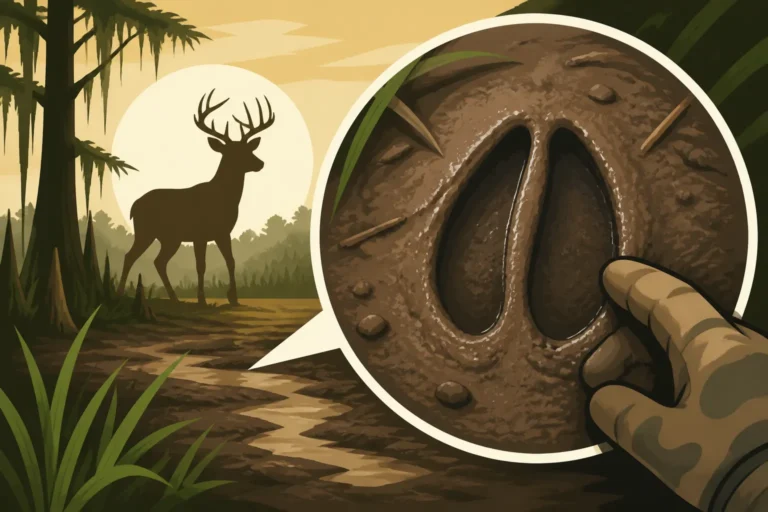
Think about Hunting a Funnel Between Two Sloughs or Reading Louisiana Mud for Fresh Deer Movement. These travel corridors aren't always obvious; they might be subtle trails through knee-high water or barely visible rubs along a thicket edge. Learning to identify these routes, even when submerged, is critical to intercepting a basin buck on the move. GoHunt mapping software often allows you to see topo lines that highlight these subtle elevation changes, making them easier to spot from afar.
Understanding Food Sources and Their Cycles
Just like anywhere else, deer in the basin are driven by their stomachs. What makes basin hunting unique is the variety and seasonal availability of food sources, often dictated by water levels.
- Acorns: When available, acorns are king. Water oaks, willow oaks, and nuttall oaks are common in the basin, and a good mast crop will draw deer like a magnet. Locate these oak flats during scouting and monitor when the acorns begin to drop. Remember, a poor acorn year means deer will shift their focus.
- Browse and Forbs: Even without a heavy acorn crop, deer rely heavily on natural browse (tender shoots and leaves) and forbs (broad-leafed plants). Look for areas with lush new growth, especially after a flood recedes or in areas with recent timber disturbance. Palmetto leaves, greenbrier, and various aquatic plants are common food sources.
- Agricultural Edges: If your hunting area borders any agricultural fields (like soybeans or corn) on the higher ground of the basin's edges, deer will absolutely utilize these, often under the cover of darkness. Finding Entry Routes Through Standing Soybeans or Hunting a Standing Cornfield in Farm Country can be highly effective, but these are typically on the fringes of the true swamp.
The key is to understand the current food availability. What were they eating last month? What are they eating now? This requires constant observation and adapting your hunting locations. Deer will move significant distances to capitalize on a fresh food source, so finding that hot spot is paramount. A good tactic is to scout just before the season to see what's currently being browsed or what mast is hitting the ground.
Pinpointing Bedding Areas in Cover
Bedding areas in the basin are typically the thickest, most impenetrable cover available, often situated on slightly higher ground or in areas that offer protection from both predators and hunters. These are the sanctuaries where deer feel safe to rest and chew their cud during daylight hours.
- Dense Palmetto and Cane Thickets: These areas offer incredible visual and scent-blocking cover. They are often incredibly difficult for a human to penetrate, which makes them ideal for wary bucks.
- Cypress and Tupelo Swamps: While open cypress stands might not offer much cover, areas with dense cypress regeneration, fallen trees, or thick undergrowth provide excellent bedding. The elevated root systems of cypress trees can also provide dry spots.
- Brush Piles and Blowdowns: Natural disasters, logging activity, or simply old age can create massive tangles of fallen trees and brush. These make fantastic bedding locations, especially if they're located on high ground.
- Remote Islands: Any patch of slightly higher, dense cover that is difficult to access by boat or foot can serve as a prime bedding island. Deer will swim to these spots to escape pressure. You need to understand Where Atchafalaya Basin Bucks Bed to truly put yourself in the game.
When looking for bedding, focus on areas that offer security and are close to, but not directly on, primary food sources. Bucks will often bed downwind of their travel routes, allowing them to scent-check anything approaching. Finding fresh beds, even empty ones, in these thickets is a strong indicator you're close to a deer's sanctuary. Remember, the goal isn't to walk through these bedding areas during your hunt, but to identify them so you can set up on the edges or along the travel corridors leading to and from them.
Effective Hunting Strategies for Basin Bucks
Once you understand the terrain, gear up, and scout your heart out, it's time to put a plan into action. Hunting the basin requires specific strategies that cater to its unique challenges, from where you place your stand to how you move through the woods.
Stand Placement for Water-Bound Deer
Hunting in the basin means thinking differently about stand placement. You're often not looking for a rub line on a dry ridge, but rather a travel route along a slough or an isolated piece of high ground.
- Edge of High Ground: Place your stand overlooking the transition zone between dry land and water. Deer will often skirt these edges, using the water as one side of a natural funnel.
- Across a Water Crossing: Identify places where deer habitually cross a narrow slough or bayou. A stand placed quietly across from such a crossing can offer excellent shot opportunities.
- Overlooking Funnels and Pinch Points: Look for natural bottlenecks where dense cover or water forces deer into a narrow travel path. This could be a small gap between two thickets, a point of land jutting into a bayou, or a narrow strip of dry ground. These are prime ambush points.
- Tree Choice: Cypress and tupelo trees often provide excellent height and cover for hang-on stands or ladder stands. However, be mindful of their bark, which can be slick or irregular. Use a sturdy safety harness and ensure your stand is secure, especially if you're hanging over water. Also, consider Using a Ground Blind on Louisiana Public Land if the cover is sufficient and you can brush it in effectively, especially near the ground on a travel corridor.
Regardless of your chosen spot, remember that access and egress are paramount. Can you get to and from your stand quietly and undetected? Is your entry and exit route free of hazards? The best stand in the world is useless if you spook every deer on your way in or out. Always factor in the wind, and consider how thermals might carry your scent through the dense canopy, even on slight elevation changes.
Still-Hunting the Swamp Edges and Ridges
Still-hunting is perhaps the most effective method for many basin hunters, allowing you to adapt to constantly changing conditions and actively seek out deer rather than waiting for them. It's an art form that requires extreme patience and attention to detail.
- Slow and Deliberate Movement: This isn't a casual walk. Take one step, pause, scan, listen, and then take another step. You should move at a snail's pace, often taking 15-20 minutes to cover just 50 yards.
- Utilize Cover: Always move from one piece of cover to the next. Use large trees, thick brush, or changes in elevation to break up your silhouette. Avoid walking in the open unless absolutely necessary.
- Wind and Thermals are King: Always, always hunt into the wind. In the swamp, thermals can be tricky, often falling in the morning and rising in the afternoon. Pay attention to how your scent is dispersing. Wind and Thermals in Swamp Bottomland are critical variables that will either make or break your still-hunt.
- Read the Ground: Look for fresh tracks, droppings, and browse. These tell you where deer have been recently. If you find fresh sign, slow down even more.
- Listen: The swamp is full of sounds. Distinguish between falling acorns, squirrels, and the tell-tale crunch of a deer moving through leaves or shallow water.
Focus on still-hunting the edges of known bedding areas, along ridges, or through areas of good mast production. You're essentially conducting an active form of scouting while hunting, constantly looking for movement, flicking ears, or the subtle outline of a deer in the thick cover. It's physically demanding and mentally challenging, but it can be incredibly rewarding, especially for an experienced hunter seeking mature bucks.
Using Calls and Scents in Thick Cover
While the basin is dense, calls and scents can still play a role, though they need to be used judiciously. The thick cover often limits visibility, making close-range encounters more likely, and therefore, realistic calling crucial.
- Grunt Calls: A simple grunt can pique a buck's curiosity, especially during the rut. Use short, soft grunts to imitate a cruising buck or a tending buck. In extremely thick cover, a buck might come investigate, but often won't commit to a fully open area. Remember, Grunt Calls in Mature Louisiana Timber need to be subtle.
- Rattling: Aggressive rattling can work during the rut, but in the dense basin, focus on shorter, less intense sequences. The sound doesn't carry as far, and you want to avoid sounding unnatural. A small set of synthetic antlers or rattling bag might be more practical than a full rack. Consider Rattling Volume in Thick Cover.
- Doe Bleats: A soft doe bleat can often draw in curious bucks or even other does. Use it sparingly, especially if you haven't seen any deer movement.
- Scents: Estrous doe urine or dominant buck scents can be effective, especially when placed along known travel corridors or mock scrapes. Use them with caution, always considering the wind, and avoid over-saturating an area. Place scent wicks on branches rather than directly on the ground.
The key with calls and scents in the basin is realism and subtlety. Don't overdo it. The thick cover means deer often appear silently and close, so be ready. The goal is to draw them slightly closer or to pause them in an opening, not to create a full-blown conversation. Always be prepared for a quick shot after calling, as the response might be sudden and unexpected.
Post-Shot Procedures and Recovery in Tough Terrain
Congratulations, you've successfully harvested a deer in the challenging Louisiana basin! But the hunt isn't over. Recovering, field dressing, and extracting a deer from this environment presents its own set of significant hurdles. A well-executed shot is only the first step; a well-planned recovery is just as crucial.
Blood Trailing Challenges in Water and Mud
Tracking a deer in the basin is often a nightmarish experience. The combination of thick vegetation, standing water, and deep mud can make even a good blood trail disappear quickly.
- Mark the Shot Location: Immediately mark the exact spot where the deer was standing when you shot it, and the direction it ran. This is paramount. Drop a hat, tie a ribbon, or use your GPS to mark a waypoint.
- Wait and Listen: Unless you saw the deer drop, give it time. If it was a good shot (heart/lungs), wait at least 30-60 minutes. If it was a questionable hit, wait several hours, or even until morning if it's getting dark and the weather is cool. This allows the deer to expire quietly and prevents pushing it further.
- Slow, Meticulous Search: Blood trailing in the swamp means crawling on your hands and knees, parting palmettos, and peering into every water moccasin-filled pool. Look for small specks of blood, broken branches, disturbed mud, or even overturned leaves. A flashlight or headlamp with a red filter can make blood stand out better at night.
- Dealing with Water: If the deer runs into water, the blood trail will dissipate quickly. Look for bubbles, disturbed vegetation, or tracks in the soft bottom. You might have to grid search, assuming the deer didn't go far. This is where Recovering a Deer From a Basin Slough becomes particularly challenging.
- Multiple Spotters: If possible, bring a second person. Two sets of eyes are always better than one, and having someone else to confirm small signs can make all the difference.
Never give up too soon. Basin deer are incredibly tough, and a seemingly good hit can still result in a long track. Persistence, patience, and methodical searching are your best allies.
Field Dressing and Transport in Warm Conditions
Louisiana's warm weather adds another layer of complexity to field dressing and meat preservation. Bacteria proliferate quickly in heat, so swift action is essential.
- Cleanliness is Key: Use sharp knives and try to keep the meat as clean as possible. Avoid getting dirt or stomach contents on the muscle tissue.
- Remove Entrails Quickly: The goal is to cool the carcass down as fast as possible. Remove all internal organs, including the heart and lungs, as soon as you find the deer. This allows air to circulate and heat to escape.
- Rinse if Possible: If you have access to clean water (like a flowing bayou), a quick rinse of the chest cavity can help remove residual blood and cool the meat. However, be mindful of CWD rules about carcass movement, especially if you're in a management zone.
- Getting it Out: This is often the hardest part. A deer cart is useless in the thick mud and water. You'll likely need to quarter the deer on site, especially if it's a large buck. This means packing out meat in game bags, often through difficult terrain. If you have help, simply dragging can work, but it's exhausting. For an in-depth guide, consult Field Dressing a Deer in Warm Weather.
Having a plan for processing and cooling the meat before you leave the house is crucial. Bring plenty of ice for coolers, and know where your nearest processor is located. Getting the meat cooled quickly is the single most important factor in ensuring quality venison.
Planning for Extraction Before the Shot
The biggest mistake a basin hunter can make is not having an extraction plan. It's one thing to shoot a deer, another entirely to get it out of the swamp.
- Consider Quartering: For most mature basin deer, quartering is almost a necessity. Bring game bags, a good boning knife, and a small saw (like a Wyoming saw) in your pack. Practice quartering at home so you're efficient when it counts.
- Two-Person Minimum: Always try to hunt with a buddy in the basin, or at least have someone on standby who can assist with extraction. Dragging a whole deer through mud and water by yourself is a Herculean task, if not impossible.
- Boat Access: If you shot the deer near water accessible by your boat, consider yourself lucky. This is why stand placement near water features is so advantageous. Get the deer to the boat as quickly as possible.
- Hoist or Game Carrier: If you're quartering and packing out, a frame pack or a sturdy game carrier can make the difference between one trip and three. A small hand-crank hoist can also be invaluable for lifting deer onto boats or higher ground if you're working with a partner.
- Know Your Limits: Don't be a hero. If you're alone and it's a huge buck, don't risk injury or losing meat by trying to drag it whole through miles of swamp. Quarter it, pack it, and make multiple trips if necessary. This planning extends to reporting your harvest, which is legally required in Louisiana. Be sure to check Checking a Louisiana Deer Harvest Online to understand the process.
The satisfaction of harvesting a basin buck is immense, but the true victory often lies in the successful, safe, and efficient recovery of that animal. Plan for the worst-case scenario, and you'll be ready for anything the swamp throws at you.
Safety First: Staying Safe in the Louisiana Swamp
The untamed beauty of the Atchafalaya Basin comes with inherent risks. Beyond the hunting challenges, personal safety must always be your top priority. The swamp can be unforgiving, and a small oversight can quickly escalate into a life-threatening situation.
Preparing for Emergencies
Hunting in remote, challenging environments like the basin requires a robust emergency plan and the right gear to execute it.
- Communication Devices: A fully charged cell phone is a start, but don't rely solely on it. Consider a satellite messenger (like a Garmin inReach or Zoleo) for truly remote areas where cell service is non-existent. These devices allow you to send SOS messages and communicate with loved ones even without signal.
- First-Aid Kit: Carry a comprehensive first-aid kit specifically stocked for hunting injuries (cuts, punctures, sprains) and environmental issues (bug bites, heat exhaustion, snake bites). Know how to use everything in it.
- Survival Essentials: Even on a "day trip," pack essentials: fire starter, water filter or purification tablets, an emergency blanket, extra rope, a whistle, and a bright headlamp with spare batteries. You never know when a simple broken-down boat could turn into an unexpected overnight stay.
- Tell Someone Your Plan: Always inform a trusted person of your exact hunting location, your intended return time, and who to call if you don't check in. This simple step can be a lifesaver. Give them your Hunting the Atchafalaya Basin trip details and contact information.
Being prepared for the unexpected isn't about being paranoid; it's about being responsible and ensuring you can handle whatever the wild throws your way. The swamp offers no second chances for recklessness.
Understanding Weather Patterns
Louisiana weather is notoriously fickle. A beautiful sunrise can quickly turn into a torrential downpour or a dangerous thunderstorm.
- Check Forecasts Religiously: Before you leave, check multiple weather forecasts for your specific area. However, understand that swamp weather can be localized and change rapidly.
- Watch the Sky: Learn to read the clouds. Dark, anvil-shaped clouds often signal approaching thunderstorms. Pay attention to wind shifts, as they can precede squalls.
- High Winds and Storms: These are incredibly dangerous on the water. High winds can create rough chop on larger bayous, making boat travel hazardous, and strong storms can bring down trees, blocking your path or even falling on your stand. If a storm rolls in, seek shelter immediately and consider pulling your stand if it's exposed.
- Fog: Early morning fog is common in the basin and can completely disorient you. If dense fog rolls in, stay put until it lifts. Trying to navigate in zero visibility is asking for trouble.
Being acutely aware of the weather and having a contingency plan for rapid changes can prevent you from being caught in a dangerous situation. It's always better to be safe and head in early than to push your luck against the elements.
Respecting Wildlife and the Environment
Hunting in the basin isn't just about bagging a deer; it's about being a responsible steward of this unique ecosystem.
- Alligators and Snakes: The basin is home to abundant wildlife, including alligators and venomous snakes. While they generally avoid humans, be aware of your surroundings, especially when navigating dense cover or retrieving game. Never corner an alligator or step blindly into thick grass. This is also important to remember during Alligator Hunting Louisiana's Coastal Marsh or Louisiana's New Recreational Alligator Season.
- Do Not Litter: Pack out everything you pack in, and then some. Leave no trace of your presence. This includes spent shell casings, food wrappers, and anything else.
- Ethical Hunting: Adhere strictly to all Louisiana Department of Wildlife and Fisheries (LDWF) regulations, including licensing, bag limits, and legal shooting hours. Practice ethical shot placement to ensure a quick, humane harvest.
- Protect the Resource: Report any poaching or illegal activity you observe. The health of the basin's deer herd and the availability of public hunting land depend on all of us doing our part. The basin is a precious resource, and it's our responsibility to protect it for future generations of hunters and outdoors enthusiasts.
By embracing these safety measures and respecting the incredible environment you're hunting in, you're not only protecting yourself but also contributing to the longevity and quality of Louisiana's unique basin hunting experience.
Disclaimer
Please remember that hunting regulations and conditions can change. Always consult the official Louisiana Department of Wildlife and Fisheries (LDWF) regulations for the most current and accurate information before planning any hunt. This guide is for informational purposes only and does not replace official legal guidelines. Safety should always be your top priority.