Hunting Standing Sugarcane for Deer
Hunting deer in Louisiana's vast, towering sugarcane fields presents a unique challenge, often leaving hunters feeling utterly lost in a sea of green walls where visibility is next to zero. It's not like hunting open pine forests or predictable food plots; these fields are dense, disorienting, and demand a completely different approach. This guide is dedicated to equipping you with the specialized knowledge and tactics needed to successfully navigate and hunt these seemingly impenetrable havens for whitetails, helping you understand deer behavior in these environments and how to capitalize on the unique opportunities they offer.
Understanding Deer Behavior in Sugarcane Country
Louisiana's sugarcane fields aren't just crops; they're dynamic ecosystems that transform into impenetrable fortresses for deer, offering both food and unparalleled cover. This unique environment shapes how deer live, move, and react, making it crucial for hunters to understand these patterns if they hope to be successful.
Sugarcane as a Primary Habitat and Food Source
Imagine a deer looking for the perfect hideout. Sugarcane fields, especially when mature and standing tall, provide exactly that: dense, nearly impenetrable cover that offers unparalleled security from predators and hunters alike. These fields become a deer's home range, where they can bed down safely, often only moving short distances within the stalks to feed. The sheer density makes it nearly impossible for a hunter to see more than a few feet in front of them, creating a sanctuary where deer feel protected. Beyond cover, sugarcane itself is a food source. While they don't typically munch on the sweet stalk core like we do, deer will browse on the younger, more tender leaves and the nutrient-rich tops of the plants, especially as the season progresses and other food sources dwindle or become less appealing. This means deer don't always have to leave the sanctuary for sustenance, complicating traditional hunting strategies focused on travel routes to external food plots.
Movement Patterns and Sanctuary Zones
Deer in standing sugarcane establish very specific movement patterns, often creating a maze of intricate trails within the stalks. These trails are their highways, leading from bedding areas deeper within the field to feeding zones, or sometimes to the very edge of the field before harvest begins. They become incredibly accustomed to moving through these narrow lanes. Because the cover is so absolute, deer often feel secure moving during daylight hours within the cane, only venturing to the edges or out into adjacent woods or fields under the cloak of darkness or during peak rut activity. The interior of a large sugarcane field acts as a significant sanctuary zone, making any attempt at still-hunting or stalking within it incredibly challenging and often unproductive. The deer have the home-field advantage, hearing and smelling you long before you ever get a glimpse. Understanding these sanctuary zones means your best bet often lies on the perimeters, where deer eventually have to cross or emerge.
Impact of Weather and Harvest Schedules
Weather plays a significant role in deer activity within sugarcane. Warm, humid days, common in Louisiana's early deer season, often see deer burrowed deep in the cool, shaded interior of the cane fields, moving minimally. A crisp cold front, however, can invigorate them, prompting more movement, especially towards the edges where sun can penetrate. But the most dramatic shift in deer behavior comes with the sugarcane harvest. This isn't just a simple seasonal change; it's a massive, unavoidable disruption that completely alters the deer's world. As the machines move through, cutting down the stalks, the deer are forced out of their secure hideaways. This can lead to a period of intense, often chaotic, deer movement as they scramble to find new cover, creating unique, albeit short-lived, hunting opportunities. Hunters who pay close attention to harvest schedules in their target areas, perhaps through local news or by directly asking farmers, can position themselves for prime intercepting. This disruption is a critical factor, often pushing deer into adjacent wooded areas or smaller pockets of unharvested cane, presenting a temporary vulnerability that smart hunters can exploit.
Scouting and Pre-Season Preparation for Sugarcane Hunts
Hunting standing sugarcane effectively isn't something you can just show up and do. It requires meticulous pre-season planning and scouting, much like preparing for a focused WMA hunt. The unique challenges of these fields mean you need to do your homework to even the odds.
Utilizing Aerial Imagery and Topographical Maps
Before you even step foot near a sugarcane field, your best friend will be a good mapping app or software. Tools like GoHunt are invaluable for scouting these areas from your couch. You can pull up satellite imagery and immediately start to identify key features that aren't apparent from the ground. Look for the distinct patterns of the cane rows and, more importantly, the transitions: where the sugarcane meets a patch of woods, a small creek, a drainage ditch, or a fencerow. These transition lines are critical deer travel corridors. You can also identify potential pinch points, bottlenecks, or small pockets of timber or dense brush within or immediately adjacent to the vast cane fields. These often serve as temporary bedding areas or staging points when deer are pressured. Pay attention to changes in elevation, even subtle ones. A slightly higher ridge or dry spot within what seems like a flat expanse could be a preferred bedding location. By "reading aerial photos for Central Louisiana deer" you can glean a surprising amount of information that would take days to discover on foot in such dense cover. Also, identify access points – roads, turn rows, and areas where you might be able to discreetly enter without disturbing the fields.
Identifying Key Entry and Exit Points
Once you've studied the maps, it's time for some careful, low-impact ground scouting. This isn't about crashing through the cane; it's about walking the perimeters, the turn rows, and any adjacent natural cover. Your goal is to pinpoint the exact locations where deer are entering and exiting the sugarcane fields. Look for well-worn trails leading into the cane, especially at intersections with woods, hedgerows, or overgrown ditches. These trails will be much more defined than random tracks. Pay close attention to corners of fields, areas where the cane abuts a creek, or places where the field narrows. These are natural funnels. You'll often find concentrated sign here: tracks, droppings, and even rubs or scrapes if it's nearing the rut. Identifying these specific points early on will save you countless hours of unproductive hunting. Remember, deer will use the path of least resistance, especially when entering and leaving heavy cover. Sometimes, they'll pop out into a small, isolated patch of woods on private land. This is where Hunting Small Private Tracts in Louisiana can give you an edge, as these often overlooked areas can be honey holes.
Building Relationships with Landowners
Let's be real: most sugarcane fields are on private land. Without permission, you're not hunting them. This means building a rapport with landowners is absolutely essential. Start well before the season. Introduce yourself, explain your intentions, and offer to help with chores or even assist with feral hog control – a common problem in these agricultural areas. Be respectful of their property and their farming operations. Understand that their priority is the crop, not your deer hunt. Asking about their harvest schedule is also critical information for your hunting plans, as mentioned earlier. A landowner might also be able to tell you where they've seen deer consistently, or point out areas that aren't actively harvested at certain times. This inside knowledge is gold. Always get explicit permission, and clarify boundaries and any specific rules they might have. For many new hunters, or those moving to a new area, understanding Getting Private Land Permission in Louisiana is the first, and most important, step. GoHunt can also help by identifying property owners, making it easier to initiate those crucial conversations.
Hunting Tactics for Standing Sugarcane
Once you've done your homework and secured permission, it's time to put boots on the ground. Hunting standing sugarcane requires patience, precise placement, and often, a willingness to adapt on the fly.
Stand and Blind Placement on Field Edges
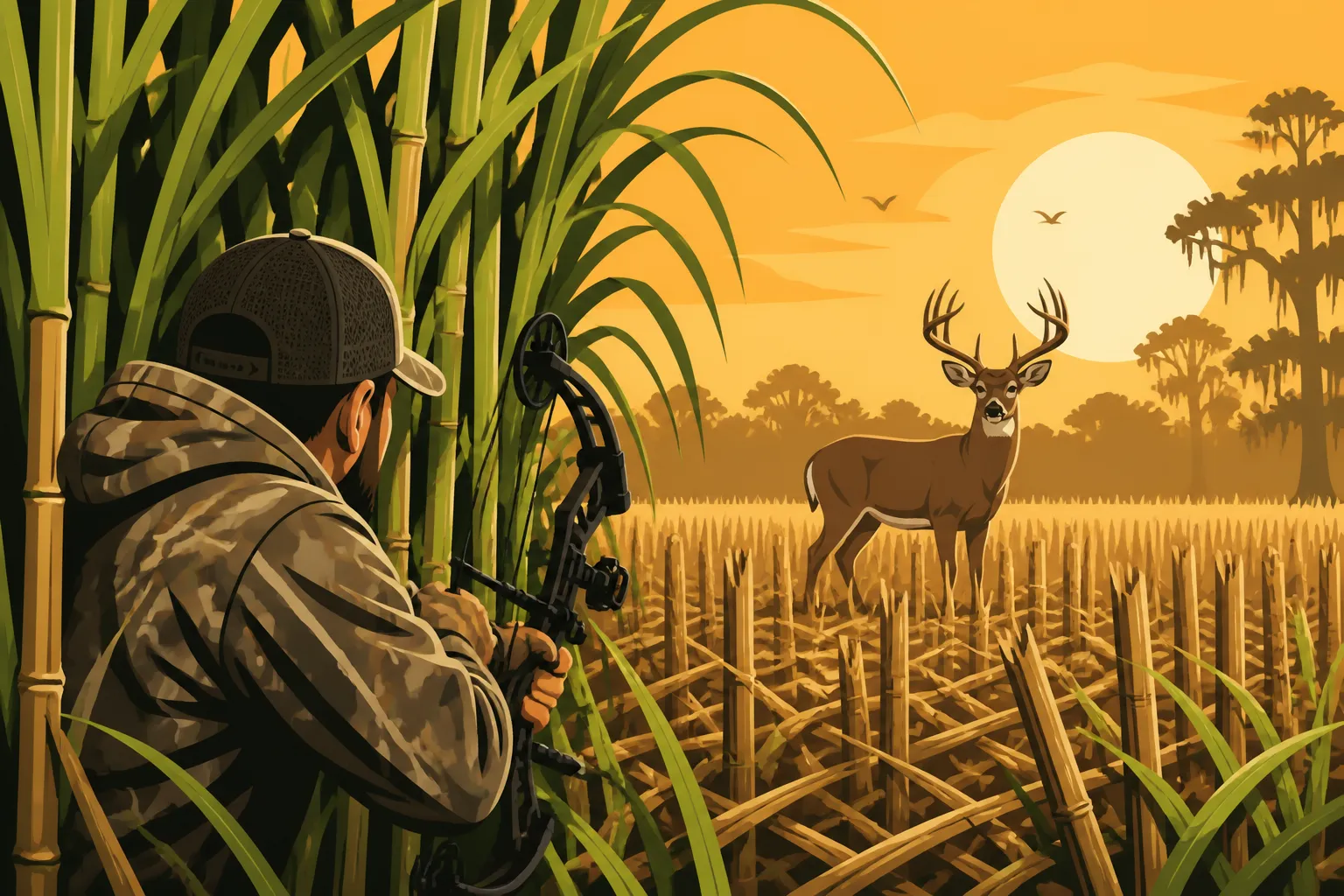
Given the impenetrable nature of standing sugarcane, your primary strategy will almost certainly revolve around intercepting deer as they move along the edges or exit/enter the fields. This means precise stand and blind placement. You want to set up along those established deer trails you identified during scouting. Look for natural funnels – a narrow strip of woods between two cane fields, a thick fencerow, or a small drainage ditch. These are prime locations. Consider the prevailing winds and thermals. In Louisiana's often warm climate, scent control is paramount. Always try to set up with the wind in your favor, anticipating which direction the deer will approach from. A pop-up ground blind brushed into a field edge can be incredibly effective, offering concealment and a barrier against your scent, especially when you consider Using a Ground Blind on Louisiana Public Land. If you're using a treestand, focus on points where deer transition from the cane into adjacent hardwoods or smaller food plots. These transition areas are often hotbeds of activity, particularly during the early morning and late evening hours. Don't forget that late in the season, after the initial harvest of some fields, deer will often seek out the remaining standing cane as their last bastion of cover, so positioning on those edges becomes even more critical.
Still-Hunting Perimeters and Funnels
While still-hunting within a dense sugarcane field is generally a losing battle, carefully still-hunting the perimeter can be a productive strategy, especially when done slowly and deliberately. This is about moving with extreme stealth along the edge of the cane, staying just inside the adjacent woods or thick cover. You're looking for deer that are moving parallel to the cane, or those just about to emerge. Utilize the dense vegetation as natural concealment, breaking up your outline. Pay close attention to any subtle sounds – a rustle in the cane, a snapped twig in the woods. When the wind is right and the conditions are damp, making for quieter footfalls, this method can work. Focus on those funnels and pinch points you identified earlier. These areas concentrate deer movement and increase your chances of an encounter. Remember, this isn't a race; it's a slow, methodical crawl, pausing frequently to observe and listen. Just like when you're focusing on Hunting the Atchafalaya Basin Swamp Deer, patience and a keen awareness of your surroundings are your greatest assets.
Strategic Deer Drives
When the standing cane is truly dense and deer are holding tight, a well-executed deer drive can be highly effective. This typically requires a group of hunters and clear communication. The idea is to have "pushers" slowly and noisily move through a section of the cane, pushing deer towards "posters" positioned strategically at the opposite end or along the sides. The key here is safety and knowing the landscape intimately. Pushers need to move slowly, allowing deer to get up and move rather than bolting. Posters must be in elevated positions (treestands are ideal for safety and visibility) and have clear lanes of fire. This is not a chaotic run-and-gun; it's a coordinated effort. Identifying natural breaks or thinned sections in the cane, or areas where the field neck down, can help direct the deer. It's crucial to map out the drive beforehand and establish clear communication protocols. This method works particularly well when a section of cane is slated for harvest soon, as deer will be even more reluctant to leave their sanctuary and might need a little encouragement. For more insights on coordinated efforts, look into Deer Drives on Louisiana Public Land.
The Sugarcane Harvest and Its Impact on Hunting
The harvest of sugarcane fields is arguably the most impactful event for a deer hunter targeting these areas. It completely reshapes the landscape and dictates deer movement. Being prepared for this transition is key to success.
Hunting During and Immediately After Harvest
As combines and cutting crews move through the sugarcane fields, what was once an impenetrable fortress quickly becomes an open, exposed landscape. This disruption forces deer out of their long-held sanctuaries. Hunting during and immediately after the harvest can be incredibly productive, but it requires swift action and adaptability. During the actual cutting, deer will often hold tight until the last possible moment, sometimes running just ahead of the machines before bursting out. If you have permission and are positioned safely, you can intercept these fleeing deer. More commonly, hunters focus on the period immediately following the cut. Deer, disoriented and suddenly exposed, will scramble for any available cover. This could be an adjacent patch of woods, a fencerow, a drainage ditch, or even a smaller, unharvested section of cane nearby. These deer are often stressed and moving more frequently, making them vulnerable. Set up on the edges of these newly exposed fields, targeting the likely escape routes into remaining cover. Pay attention to how the wind is blowing relative to the cutting, as deer will often try to flee downwind. GoHunt can be useful here, as sometimes satellite imagery updates can give clues to recently harvested areas, or at least show access roads that the harvest uses.
Transitioning Deer to Alternative Cover
Once the sugarcane is down, deer don't just vanish; they transition to alternative cover. This is where your pre-season scouting for adjacent habitat pays off. If there are small woodlots, creek bottoms, dense brush thickets, or even just overgrown fencerows nearby, these will become primary bedding and travel corridors for the displaced deer. They will also seek out any other standing crops or thick natural vegetation that offers concealment. This transition phase is when deer are often most exposed and actively seeking new secure areas. Focusing your efforts on the fringes of these alternative covers, especially where they meet the newly cut fields, will be your best strategy. Look for fresh tracks indicating new travel patterns into these areas. Deer may also use the remnants of the cut cane – the leafy tops that are left behind – as a temporary food source before moving on to other Late-Season Food Sources for Louisiana Whitetails. The key is to think like a deer that has just lost its home: where would you go for safety and food?
Post-Harvest Food Sources and Persistence
After the harvest, the rich soil of the sugarcane fields is usually tilled and replanted, but for a brief period, the leftover cane tops and root systems can still provide some forage. However, deer will quickly shift their main feeding to other available sources. This could be acorns in nearby hardwoods, green winter food plots planted by farmers or hunters, or natural browse in adjacent woodlands. Understanding these alternative food sources is critical for continued success after the cane is gone. Your hunting strategy needs to adapt from intercepting deer leaving cover to intercepting them moving between their new cover and these alternative food sources. This often means longer sits, colder weather, and a different approach to stand placement. The persistence required to hunt these areas effectively year after year, understanding the seasonal cycle of cane growth and harvest, truly sets successful sugarcane hunters apart.
| Sugarcane Growth Stage | Deer Behavior & Location | Recommended Hunting Tactics |
|---|---|---|
| Early Growth (Short Cane) | Less cover, deer move more freely, often in adjacent woods/food plots. | Hunt natural funnels, food plots, and transition zones outside cane. |
| Mid-Growth (Waist to Head High) | Deer start using cane for bedding & security, but still venture out. | Focus on field edges, entry/exit trails, especially dawn/dusk. |
| Mature/Standing Cane (Pre-Harvest) | Cane is dense sanctuary; deer live & feed mostly inside. | Best strategy: set up on prime field edges, funnels. Still-hunt perimeters. Consider deer drives. |
| During Harvest | Extreme disruption; deer flee ahead of machines, seeking new cover. | Position safely on exit routes, adjacent thickets, or unharvested cane. |
| Post-Harvest (Stubble/Tilled Field) | Deer displaced, relocate to alternative cover. Food source shifts. | Hunt adjacent woods, thickets, and new food sources. Focus on new travel corridors. |
Gear and Safety Considerations for Sugarcane Hunts
Hunting in sugarcane is a unique beast, and your gear and safety protocols need to reflect that. It’s not just about the right caliber; it’s about preparedness for a challenging environment.
Essential Gear for Sugarcane Hunters
Given the dense, often wet conditions of sugarcane fields, your gear choices are paramount. Waterproof boots are a non-negotiable item. You'll be walking through dew-laden fields, muddy turn rows, and potentially shallow water in ditches, so keeping your feet dry is crucial for comfort and preventing blisters. Durable, brush-resistant clothing is also essential. The sugarcane stalks and leaves can be surprisingly abrasive, and walking through them will quickly shred flimsy fabrics. Consider a good pair of briar pants or chaps. A small, but powerful, flashlight or headlamp is critical for navigating in the low light of dawn and dusk, especially when retrieving game or setting up a blind in the dark. A reliable GPS or mapping app like GoHunt on your phone is also a must. The rows can be disorienting, and it's incredibly easy to get turned around, even in seemingly straightforward sections. Make sure your phone is fully charged and consider a portable power bank. Finally, don't forget insect repellent! Louisiana is notorious for mosquitoes and other biting insects, and the humid, dense cane provides a perfect breeding ground. Having a Thermacell or good bug spray can make the difference between a miserable hunt and an enjoyable one.
Navigational Challenges and Communication
Getting lost in standing sugarcane is a real concern. The rows all look alike, and without a clear landmark, it’s surprisingly easy to lose your bearings. This is where your GPS or mapping app becomes your most important piece of gear. Mark your stand location, entry point, and any key trails you've identified. Always inform someone of your hunting location and your expected return time. If you're hunting with a partner or in a group for a drive, two-way radios are invaluable for communication, especially where cell service might be spotty deep within the fields. Establish clear rendezvous points and emergency procedures before you head out. Remember that when you’re out of sight, you’re out of mind, so consistent check-ins are vital. The same navigational challenges you face when Hunting the Atchafalaya Basin can apply here, albeit in a different setting.
Safety Protocols and Retrieval Challenges
Safety, as always, is paramount. When hunting with a group, especially during a deer drive, bright blaze orange is a must for all participants, whether pushing or posting. Everyone needs to be aware of each other's positions at all times. Discuss shooting lanes and angles beforehand to avoid any miscommunications or dangerous situations. Retrieving a deer from deep within standing sugarcane is a formidable task. The dense cover makes it difficult to blood trail, and dragging an animal through the stalks can be exhausting. Consider bringing a deer cart if the terrain allows, or at least a sturdy drag rope. If it's a warm day, remember that Field Dressing a Deer in Warm Weather needs to happen quickly to preserve the meat. Having a plan for retrieval before you ever pull the trigger is crucial. Sometimes, the best strategy is to wait until the harvesting equipment is nearby or to coordinate with the landowner to use a four-wheeler if possible, but these options depend entirely on prior arrangements and permissions. Always prioritize safety over speed when tracking and retrieving.
Disclaimer
Hunting is an inherently dangerous activity. This guide provides general information and recommendations. Always consult the latest Louisiana Department of Wildlife and Fisheries (LDWF) regulations, ensure you have all necessary licenses and permits, and prioritize safety above all else. Local conditions and rules may vary, so always verify information with local authorities and landowners before hunting.