Hanging a Stand on a Kisatchie Ridge
Hunting the rolling pine hills of Kisatchie National Forest can be one of Louisiana's most rewarding challenges, but it also presents a unique set of obstacles. Unlike the flat, swampy bottoms or agricultural fields found elsewhere in the state, Kisatchie's terrain demands a different approach, especially when it comes to effectively hanging a treestand. Many hunters struggle to consistently locate and access deer in this undulating landscape, feeling like they're always a step behind the deer. This comprehensive guide will walk you through the precise steps and strategies for identifying prime locations, safely installing your stand, and maximizing your success on Kisatchie's distinctive ridges.
Navigating the Unique Kisatchie Ridge Landscape
Kisatchie National Forest isn't your typical Louisiana hunting ground. Forget the cypress-tupelo swamps and endless cane breaks; here, you're dealing with piney woods, hardwood drains, and, most importantly, those prominent ridges. Understanding this terrain is the first crucial step to finding success.
Decoding Topography and Terrain Features
When you're out in Kisatchie, those subtle rises and falls in elevation aren't just scenic; they're highways and hideouts for deer. A ridge, in this context, isn't necessarily a mountain range, but often a significant rise in elevation that runs for a good distance, sometimes with smaller fingers or secondary ridges branching off. Deer use these natural contours to their advantage. They'll often travel the spines of these ridges, using the higher ground for better visibility and easier movement. But don't just focus on the very top; benches – those flat, subtle shelves on the side of a ridge – are absolute magnets for deer movement and bedding.
To truly understand these features before you even step foot in the woods, you need to become proficient at reading topographical maps. Tools like GoHunt or other mapping apps can be invaluable here. Look for those tightly packed contour lines indicating steep slopes, and then identify areas where they spread out, suggesting benches or saddles. A saddle, which is essentially a dip in the ridge line between two higher points, acts as a natural funnel, channeling deer movement from one side of the ridge to the other. Drainage systems are also critical; deer will often travel along the edges of small creeks or ephemeral drainages that cut through the ridges, using the slight depression for cover. Taking the time to study these maps will give you a significant advantage in pinpointing potential stand locations before you ever lace up your boots.
Understanding Kisatchie's Timber and Cover
Beyond the elevation, the type of timber and undergrowth on a Kisatchie ridge plays a massive role in how deer use the area. While Kisatchie is famous for its vast pine plantations, the ridges often present a mix. You'll find dense stands of mature pine on some ridge tops, offering limited browse but good visibility. However, as you move down the slopes or into the drains, you'll often encounter mixed hardwoods like oaks, hickories, and sweetgums. These areas are food factories, providing acorns and other mast crops that deer absolutely key in on during the fall and winter.
Deer will use different cover types for different purposes. The thick pine regeneration or brushy clear-cuts on a ridge side might be prime bedding areas, offering thermal cover and security. More open, mature timber might be travel corridors or feeding zones, especially if there are mast-producing trees present. Understanding this mosaic of vegetation is key to finding where deer will be at different times of the day and throughout the season. For example, a morning hunt might focus on a stand overlooking a hardwood flat just off a ridge where deer are feeding, while an evening hunt could be higher up on the ridge, catching deer moving towards a feeding area or back to a bedding thicket. The trick is recognizing that the ridge isn't uniform; it's a dynamic environment with varying habitat types that influence deer behavior profoundly.
Strategic Scouting for Ridge Stand Placement
Once you've got a grasp of the Kisatchie terrain, the next step is getting boots on the ground and confirming your assumptions. Effective scouting is what transforms a "maybe" spot on a map into a high-confidence treestand location. This isn't just a leisurely walk; it's a detective mission. If you really want to maximize your efforts, consider taking an entire weekend for Scouting Louisiana Public Land Before Season.
Pinpointing Key Deer Travel Corridors
Deer on Kisatchie ridges are creatures of habit, and they leave a lot of clues if you know what to look for. Your goal is to identify their natural highways and intersections. Start by walking the ridge lines and paying close attention to any dips or saddles. These are almost always funnel points. Look for well-worn trails that cross these saddles or that run parallel to the ridge on those subtle benches. Distinguish between faint, infrequent trails and those well-used "superhighways" that multiple deer are consistently using. The freshest sign will be the most telling.
Beyond main trails, keep an eye out for rub lines and scrape lines. On a ridge, a rub line often indicates a buck's travel route, especially during the pre-rut and rut. Bucks will use the ridge system to patrol their territory, checking for does and other bucks. A series of rubs along a bench or the crest of a ridge can be a goldmine. Similarly, scrape lines, often found along the edges of trails or under low-hanging branches, signal active buck communication. While you might find individual rubs and scrapes anywhere, concentrated activity suggests a heavily used corridor. Understanding Reading a Ridge for Central Louisiana Deer will help immensely here, as will paying attention to areas where dense cover meets more open timber, as these edges are often prime travel routes and ambush points. Deer, especially mature bucks, love to skirt the edge of thick stuff, giving them a quick escape if danger arises.
Analyzing Wind, Thermals, and Scent Control
This is arguably the most critical aspect of ridge hunting, and it's where many hunters fall short. Kisatchie's undulating terrain creates complex air currents that behave very differently from flat ground. Thermals are air currents driven by temperature changes. In the morning, as the sun heats the ground, warm air rises up the slopes, carrying your scent uphill. In the evening, as the air cools, heavy cold air sinks down the slopes, carrying your scent downhill. If you're not accounting for this, you're broadcasting your presence directly to deer.
Your stand placement must always factor in the prevailing wind and these thermals. A general rule of thumb for ridge hunting is to position yourself on the downwind side of where you expect deer to approach, but also consider the thermal drift. For a morning hunt, you might want to be lower on the ridge, letting your scent rise up and away from deer still in the bottoms. For an evening hunt, being higher up might be better, allowing your scent to fall into an empty drainage or away from where deer are feeding. Crosswinds on a ridge can be particularly tricky, sometimes swirling unexpectedly. Always consult a reliable weather app for wind direction, and remember that local topography can modify it significantly. Even a seemingly insignificant ditch can create a micro-thermal. The principles discussed in Wind and Thermals in Swamp Bottomland apply here, even with the different environment, as both deal with critical air movement. Your goal is to keep your scent cone from ever touching a deer's nose, no matter how subtle the air movement.
Selecting and Securely Hanging Your Stand
Now that you've done your homework and found some promising spots, it's time to think about getting your stand up. This isn't just about putting metal on a tree; it's about safety, stealth, and maximizing your shot opportunity.
Choosing the Right Stand for Ridge Hunting
The type of treestand you choose can make or break your Kisatchie ridge hunting experience. Portability and adaptability are often paramount here, especially if you're hunting public land.
- Hang-on Stands with Climbing Sticks: These are arguably the most versatile option for Kisatchie ridges. They're lightweight, allowing you to carry them deep into the woods to those hidden ridge pockets. You can place them on a wider variety of trees, often getting into spots a climber just can't handle due to limbs or crooked trunks. Many hunters utilize a mobile approach, hanging a stand quickly and quietly each hunt or having a few pre-set locations. Lightweight climbing sticks like those from Lone Wolf or XOP are essential for this strategy, providing a secure ascent. This method provides excellent flexibility for Treestand Setups in Kisatchie National Forest, allowing you to adjust to fresh sign or changing conditions.
- Climbing Stands: While great for speed and mobility in certain types of timber, climbers can be challenging on Kisatchie ridges. The terrain often features crooked trees, too many low limbs, or specific tree species that don't lend themselves to a comfortable climb. They work best in areas with uniform, straight-trunked pines, which aren't always found in the ideal deer travel corridors on ridges.
- Ladder Stands: These offer comfort and stability but are generally less practical for deep public land hunting on Kisatchie ridges due to their bulk and weight. They shine on private land with established trails and where you want a more permanent, comfortable setup for multiple hunts.
Here's a quick comparison of stand types for Kisatchie ridge hunting:
| Stand Type | Pros | Cons | Ideal Kisatchie Ridge Use |
|---|---|---|---|
| Hang-on with Sticks | Versatile, lightweight, quiet, adaptable | More setup time per hunt, requires multiple pieces of gear | Mobile hunting, scouting new spots, irregular trees, steep terrain |
| Climbing Stand | Fast setup/takedown, self-contained | Limited by tree type (straight, limbless), can be noisy | Uniform pine plantations on flatter ridge tops |
| Ladder Stand | Comfortable, stable, easy access | Heavy, bulky, permanent setup, difficult to move | Private land, easily accessible, long-term ambush points |
The Safe and Stealthy Installation Process
Safety always comes first. Before you even think about climbing, make sure your tree is healthy and sturdy. Check for dead limbs, rot, or any signs of weakness. Once you've picked your tree and stand type, always, always, wear a full-body safety harness from the moment your feet leave the ground until they return. This isn't optional; it's non-negotiable. Ensure your lifeline is secured before you start attaching anything else.
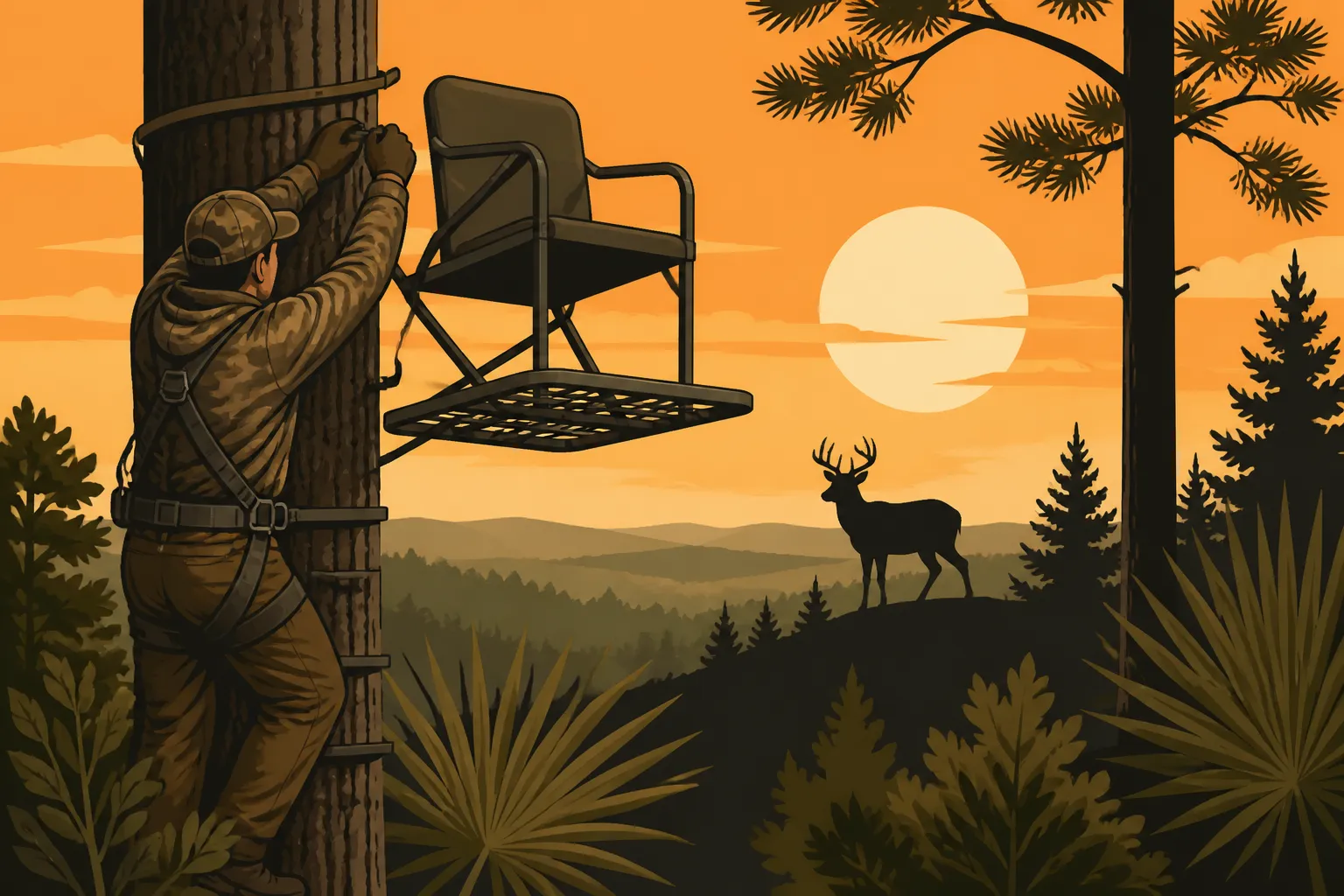
For hang-on stands, attach your climbing sticks first, making sure they are snug and secure against the tree, minimizing any wobble or noise. Climb carefully, ensuring each step is firm before ascending further. Once at your desired height (usually 15-20 feet, but adjust for cover and visibility), securely strap your stand to the tree. After the stand is installed and you're safely tethered in, take a moment to clear any shooting lanes. Do this before the season, if possible, to minimize disturbance during hunting hours. Trim only what's necessary to get clear shots in your primary zones, and remember that less is often more to maintain cover. Pack out all your trimmings; leave no trace behind.
When installing, try to be as quiet as possible. Metal on metal can echo through the quiet woods. Consider using felt tape on any moving parts, and apply anti-squeak coatings where appropriate. The deer on Kisatchie are wise to human presence, especially on public land. Your goal is to be a ghost, leaving nothing but an empty stand and a silent ascent.
Maximizing Your Hunt from a Ridge Stand
Getting your stand up is just half the battle. The real art is in how you hunt it. Kisatchie deer demand cunning and adaptability.
Crafting Effective Entry and Exit Strategies
You've spent all that time finding the perfect ridge, hanging your stand, and getting it dialed in. Don't blow it by spooking every deer in the area on your way in or out! This is especially critical on Kisatchie's public lands, where deer are more likely to be pressured. Plan your entry and exit routes meticulously. Avoid walking directly down known deer trails, especially if they lead to or from a bedding area you're trying to hunt. Instead, use natural terrain features like ditches, thick creek bottoms, or the backside of smaller ridges to mask your approach.
Walking a circuitous route to get to your stand, even if it adds a little time, is often better than a direct line that blows out deer. Use the lowest points of the terrain for entry, as sounds and scents tend to rise. For exits, wait until dark if possible, or until you're confident all deer have left the area. A headlamp with a red or green light setting can help navigate in the dark without spooking nocturnal animals as much as a bright white beam. Always be mindful of the wind and thermals, choosing routes that keep your scent away from where you expect deer to be bedded or feeding. Think like a deer: where would they feel safe, and how can you avoid disturbing those areas?
Adapting to Conditions and Pressure
Kisatchie deer are notoriously responsive to hunting pressure. What works one day might not the next, especially on opening weekend or after a cold front. Be prepared to adapt. If you're seeing a lot of sign but not much movement during daylight hours, it might be due to heavy pressure. This is where Hunting Pressure on Louisiana Public Land really plays a factor. Deer will often go nocturnal or shift their bedding areas to thicker, less disturbed spots. Having multiple scouted locations, perhaps marked on your GoHunt app, allows you to move to a fresh area or one that's less impacted by other hunters.
Weather changes also dictate deer movement. A strong cold front usually gets deer on their feet, particularly after a period of warm weather. These are prime times to be in your stand. On the flip side, extremely warm, still days can make daylight movement scarce, pushing deer to move mostly at night. During these periods, focus on bedding areas or water sources. Don't be afraid to change your game plan on the fly. If the wind shifts unexpectedly, consider getting down and moving to an alternative stand, or even trying a ground blind setup if you have one cached nearby. Even simple changes in deer movement, like them feeding on specific mast crops that have just fallen, can require a shift in focus.
The Role of Calling and Decoys
While Kisatchie deer are pressured, calling can still be incredibly effective, especially during the rut. From your ridge stand, using grunt tubes, bleat cans, and rattling antlers can help draw in curious bucks. Because sound travels well through the more open timber on many ridges, your calls can reach deer over a significant distance. Be mindful of volume; start subtle and increase if there's no response. During the rut, a series of aggressive grunts or a rattling sequence can bring a buck right into your shooting lane, particularly if he's cruising the ridge looking for does. Learning the nuances of Rattling and Grunting in Louisiana can give you a significant edge.
While less common from a treestand on public land, a small, collapsible deer decoy can occasionally be used to draw in a buck's attention, especially if positioned where he can see it from a distance. However, decoys require careful consideration of wind, scent, and safety, as they can attract other hunters. For most Kisatchie ridge hunts, focusing on strategic stand placement and effective calling will be your primary tools.
Disclaimer
Hunting is an inherently dangerous activity. Always prioritize safety, including wearing a full-body harness when hunting from an elevated position. Adhere to all Louisiana Department of Wildlife and Fisheries (LDWF) regulations and ensure you have the appropriate licenses and permits before heading afield. This guide provides general information and should not replace professional safety instruction or official regulations.