Judging a Legal Forty-Eight-Inch Alligator
The thrill of spotting a large alligator in a Louisiana bayou or marsh is unmatched, but that excitement can quickly turn to anxiety when you realize you need to accurately judge if it meets the legal 48-inch minimum. Many hunters struggle with this crucial measurement in the heat of the moment, leading to potential legal trouble or missed opportunities. This guide will walk you through the essential visual cues and practical techniques to confidently determine if that alligator is a legal harvest, ensuring a successful and compliant hunt.
The Importance of the 48-Inch Rule in Louisiana Alligator Hunting
Louisiana's alligator hunting regulations are put in place for a good reason, and understanding the "why" behind the 48-inch minimum length requirement can help you appreciate its significance. It's not just an arbitrary number; it's a carefully considered component of a successful conservation strategy. For hunters, respecting this rule is paramount, not just for legal compliance but for the long-term health of the alligator population that makes our state so unique.
Why 48 Inches? Understanding the Regulation's Purpose
The 48-inch minimum total length for harvested alligators in Louisiana is a cornerstone of the state's robust alligator management program. This specific size threshold is primarily designed to protect juvenile alligators and ensure they have ample opportunity to grow and contribute to the breeding population. Smaller alligators, those under four feet, are typically still in their most vulnerable stages, often relying on their mothers or specific nursery habitats. By allowing them to mature past this point, the Louisiana Department of Wildlife and Fisheries (LDWF) helps maintain a healthy age structure within the population, which is vital for sustained breeding success and overall population stability. It's all about balancing harvest opportunities with conservation efforts, ensuring future generations can enjoy this incredible resource.
Consequences of Misjudging Size
Misjudging an alligator's size can lead to some pretty significant headaches, both legally and ethically. If you harvest an alligator that measures under the 48-inch minimum, you're not just looking at a slap on the wrist. LDWF agents take these violations seriously. You could face hefty fines, lose your alligator tags (which are hard to come by, especially if you're lucky enough to draw one through the Applying for the Alligator Recreational Lottery), and potentially even have your hunting license suspended. Beyond the legal ramifications, there's the ethical side. As responsible hunters, we have a duty to respect the regulations designed to protect wildlife. Harvesting an undersized gator not only undermines conservation efforts but also tarnishes the reputation of ethical hunters who strive to follow the rules and make sound decisions in the field. It’s a moment of truth that demands focus and knowledge.
Visual Cues for Estimating Alligator Length in the Wild
Trying to guess an alligator's length while it's in the water, often partially submerged, can feel like a game of chance. The marsh or swamp environment offers few consistent reference points, and what looks like a giant head might belong to a surprisingly small body once you get a closer look. However, there are several reliable visual cues and estimation methods that experienced hunters use to make an educated guess before committing to a capture.
Head Size and Body Proportion
One of the most commonly used methods for estimating alligator size revolves around the visible portion of its head and its apparent proportion to the rest of the body. While it's true that some alligators might have disproportionately large or small heads for their body length, generally, a larger, broader head indicates a longer, more mature animal. When an alligator is floating, pay close attention to the width and length of its head above water. A truly legal gator, especially one well over 48 inches, will typically have a head that looks substantial. Compare its head size to objects around it if possible – a piece of floating debris, a specific type of vegetation, or even a known dimension on your boat. If only the eyes and snout are visible, try to visualize the rest of its skull. A wider skull between the eyes often correlates with a longer body. For instance, a gator that's just a foot long might have a head that's only a few inches. A four-foot gator will have a head that feels much more substantial, perhaps 6-8 inches or more from snout tip to the back of the skull.
Snout to Eye Ratio and "Foot Rule"
This technique is a classic for a reason, even if it requires a bit of practice. The general rule of thumb, or "foot rule," states that the distance from the tip of an alligator's snout to the front of its eye sockets, measured in inches, roughly corresponds to its total length in feet. So, if you can estimate that distance to be 4 inches, you're likely looking at a 4-foot alligator (48 inches). If it's 5 inches, you're probably seeing a 5-foot gator (60 inches), and so on. This isn't an exact science, as individual alligator head shapes can vary, but it provides a very strong baseline for field estimation. To use this, you really need a clear view of the alligator's head. You might have to wait patiently for the animal to surface or get into a better position. Many seasoned hunters mentally "mark" this distance with their fingers or a small object to help with consistency. Practice makes perfect here – the more you observe gators, the better your eye becomes at this subtle yet effective measurement. When you're out Hunting the Atchafalaya Basin, for example, you'll see a lot of gators, giving you ample opportunity to hone this skill.
Girth and Tail Taper
Beyond just the head, the overall body shape and dimensions offer critical clues, especially when you're looking for an animal that clearly surpasses the 48-inch mark. A young, undersized alligator will generally have a sleeker, more slender body profile and a relatively thin tail that tapers quickly. In contrast, a legal alligator, particularly one of significant size, will display a noticeable girth. Its body will appear fuller, more muscular, and its tail will likely be thick and powerful, tapering more gradually towards the tip. This is particularly noticeable when the alligator is swimming or resting near the surface. You're looking for that "beefy" appearance. The musculature along the back and at the base of the tail should be substantial. If the gator looks like a thin pencil, it’s probably not four feet. If it looks like a thick log, you're likely in the clear. Keep in mind that a gator that's just barely 48 inches might still look a bit slender, so this cue is more about confirming larger, more mature animals. The brand GoHunt often emphasizes these subtle visual cues in their educational materials, helping hunters refine their observation skills.
Practical Tips for Accurate Field Measurement and Confirmation
Even with a keen eye for visual cues, the conditions in the wild can make accurate length judgment incredibly challenging. Low light, choppy water, heavy vegetation, or a skittish alligator can all complicate the process. That's why having some practical strategies and pre-hunt preparations can be the difference between a confident harvest and a regretful mistake. Don't underestimate the power of preparation and having a plan for those critical moments.
Using Reference Points on Your Boat or Gear
One of the smartest things you can do before hitting the water is to create your own reliable reference points. Take a measuring tape and mark a 48-inch (4-foot) line directly onto your boat's gunwale, paddle, or even your snatch-hook pole. Make it visible with a permanent marker or a piece of colored tape. When you spot an alligator you're interested in, try to position your boat or hold up your marked gear next to it, using the reference point as a direct comparison. This eliminates the guesswork of mental estimation. For instance, if you're using Snatch-Hook Alligator Tactics, your hook pole can become an instant measuring stick. If the gator's body appears significantly longer than your 48-inch mark, you can proceed with more confidence. This simple trick provides a real, tangible measurement in a situation where perception can be easily skewed by excitement or tricky conditions.
Best Times and Conditions for Assessment
The time of day and prevailing weather conditions play a huge role in your ability to accurately judge an alligator's size. Early mornings and late afternoons, when the sun isn't directly overhead, often provide better light for visibility without harsh glare. Calm water is your best friend. A still surface allows the alligator's full profile to be seen more clearly and reduces optical distortions. If the water is choppy, it can make a gator look shorter or longer than it actually is. Try to approach alligators slowly and quietly, allowing them to remain calm on the surface for as long as possible. A relaxed alligator is more likely to give you a clear, extended view of its head and body. Clear skies and good visibility are ideal, but we can't always control the weather. If conditions are poor, err on the side of caution. It's always better to let a questionable gator go than to harvest an illegal one. Utilizing an app like GoHunt can often provide real-time weather and water conditions for specific areas, helping you plan your assessment attempts for optimal visibility.
Dealing with Difficult Situations
Not every alligator will present itself in perfect light, on calm water, offering a leisurely assessment. Sometimes, you only get a fleeting glimpse, or the gator is in thick vegetation. In these tricky scenarios, patience becomes your most valuable tool. If an alligator quickly submerges or hides, don't rush. Back off quietly and wait. Often, it will resurface nearby, perhaps in a more open area. If it’s in heavy cover, try to observe how much of its body is visible between reeds or cypress knees. Look for consistent sections of its back and tail, trying to mentally piece together its full length. It's also helpful to have multiple sets of eyes if you're hunting with a partner. Two opinions are often better than one, especially when adrenaline is pumping. Never make a hasty decision based on a poor view. If you can't get a clear, confident assessment, it's always best to move on and find another opportunity. Remember, a legal alligator needs to be accurately judged before it's captured and tagged. The regulations around Louisiana Alligator Legal Methods are strict, and ensuring compliance is your responsibility.
Beyond the Eye Test: Confirming Length After Capture
The moments after you've successfully secured an alligator can be a whirlwind of adrenaline and excitement. However, this is when accuracy truly counts. The visual estimation you made in the water was just that – an estimation. Now, with the alligator captured and secured, you must perform a precise measurement to confirm its legal status. This final step is non-negotiable and requires careful adherence to specific methods to ensure compliance and ethical practice.
Safe Handling and Measurement Techniques
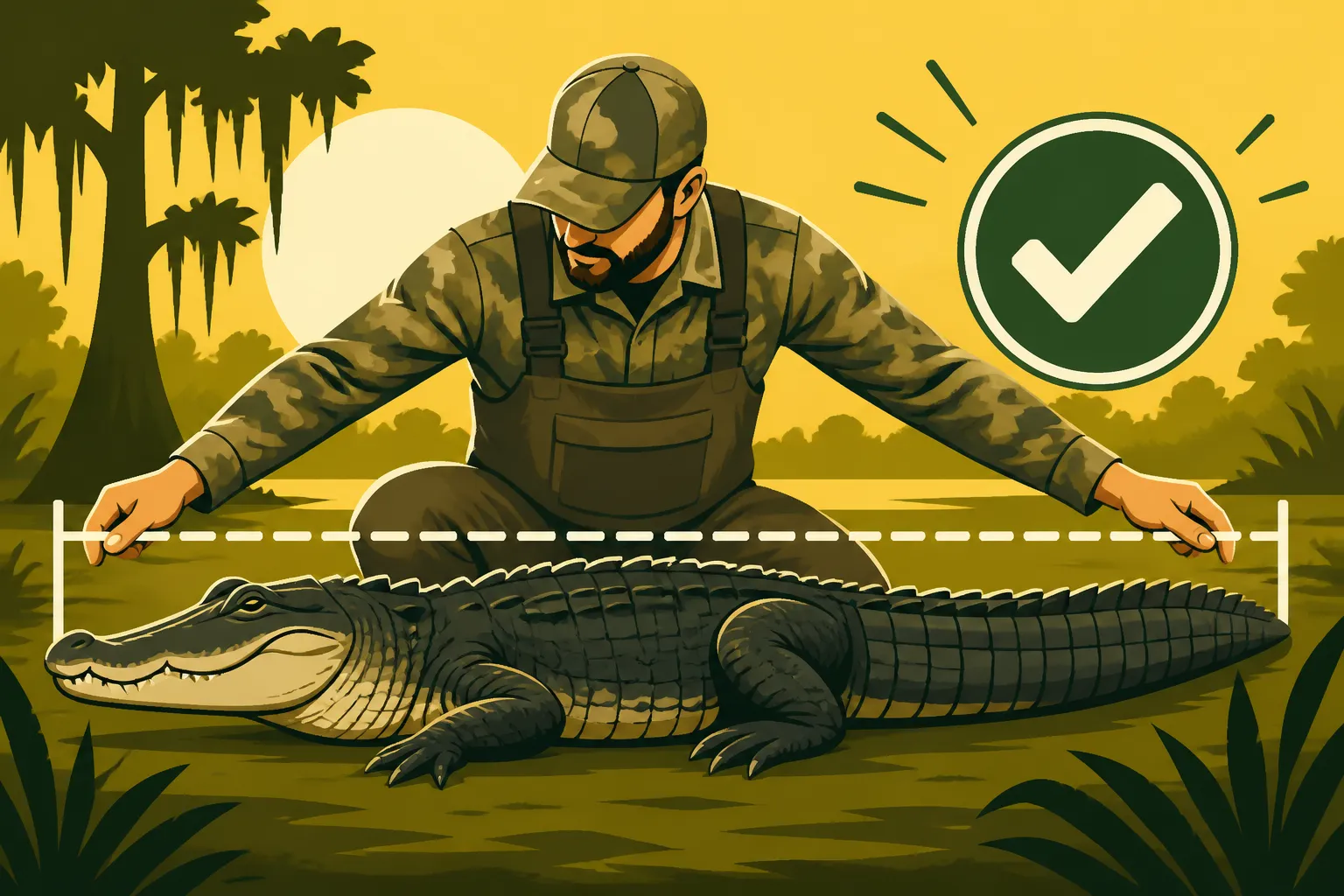
Once you've managed to get an alligator secured, the immediate priority is safety for everyone involved. Alligators are powerful creatures, and even after being dispatched, their reflexes can be surprising. Always ensure the animal is completely subdued and handled according to all safety protocols before attempting to measure. Have your measuring tape ready. The most common and accurate way to measure is to lay the alligator flat on a firm, level surface, if possible, or alongside your boat. One person should hold the tail straight while another holds the head. Use a flexible, yet sturdy, measuring tape. You want to measure in a straight line, not curving over the body. It’s a good idea to have a second person double-check the measurement to eliminate any error. If you’re dealing with a large gator, this might be a two-person job. Take your time, stay calm, and ensure the measurement is as accurate as possible. Even a slight bend in the body can shave off an inch, potentially turning a legal gator into an illegal one.
The "Tip-to-Tip" Standard
In Louisiana, the legal definition of an alligator's length is measured "tip-to-tip." This means from the very tip of its snout to the very end of its tail, including any scutes or natural tail damage that might affect the overall length. You are not allowed to stretch the animal excessively, but it should be laid out as straight as possible to get an accurate, natural length. Imagine a straight line from one end to the other. This isn't like measuring a fish where you might pinch the tail; it's the absolute furthest points. This precise method leaves little room for ambiguity, ensuring that all measurements are consistent across the board. If you've been practicing your estimation using the "foot rule" (snout to eye in inches equals feet), this is the moment of truth where your field skills meet the official standard. The data collected from these tip-to-tip measurements, which you'll report online, contributes directly to the LDWF's understanding of How Many Alligators Louisiana Has and helps shape future regulations.
What to Do If It's Undersized
It's a disheartening moment, but it happens: you measure an alligator after capture, and it comes up short, under the 48-inch minimum. If this occurs, you must release the alligator immediately and unharmed. This is a critical legal and ethical requirement. Do not tag an undersized alligator. Releasing an alligator safely means getting it back into the water as quickly and gently as possible. If it was dispatched, then it's a very unfortunate situation, and you've committed a violation. This is precisely why the field estimation and pre-hunt preparation are so vital. It’s far better to release a gator that was close to the minimum than to take one that is clearly illegal. The integrity of your hunt and the future of alligator hunting in Louisiana depend on every hunter adhering to these rules, even when it means walking away empty-handed. Always carry the means to quickly and safely release an alligator if your post-capture measurement doesn't meet the legal requirements.
Comparing Alligator Size Estimates
To help visualize the subtle differences that can mean the difference between a legal and an illegal alligator, here's a table outlining visual cues for various size ranges. Remember, these are general guidelines, and observation in the field is key.
| Length Category | Snout-to-Eye Estimate (Inches) | Head Appearance | Body Girth & Tail Taper | Behavior & Presence |
|---|---|---|---|---|
| Under 3 feet | 2-3 inches | Small, narrow, almost pointed snout | Very slender, thin tail, fast taper | Skittish, hides quickly, minimal surface presence |
| 3-4 feet | 3-4 inches | Noticeably larger than juveniles, still relatively narrow | Slender to moderate, tail tapers clearly but not abruptly | More confident, might bask, still somewhat wary |
| 4-5 feet (Legal) | 4-5 inches | Broader head, distinct width between eyes, robust | Moderate girth, tail thickens at base, tapers gradually | Confident, might hold ground, noticeable mass |
| 5-6 feet | 5-6 inches | Clearly large head, very broad skull, substantial | Good girth, powerful tail, slow taper | Less wary, looks substantial, often seen cruising |
| Over 6 feet | 6+ inches | Very large, massive head, powerful jaws | Thick, heavy body, very muscular tail, barely tapers | Dominant, appears unafraid, unmistakable size |
Disclaimer
The information provided in this guide is for informational purposes only and is not a substitute for official regulations. Always consult the current Louisiana Department of Wildlife and Fisheries (LDWF) hunting regulations pamphlet or their official website before any hunting activity to ensure full compliance with all laws and rules. Regulations can change, and it is the hunter's responsibility to stay informed.