Night Hunting Rules for Louisiana Coyotes
Navigating the ins and outs of coyote hunting regulations in Louisiana, especially when you're looking to head out after dark, can feel like trying to solve a complicated riddle. Many landowners and hunters are frustrated by the constant pressure coyotes put on deer herds, livestock, and even small game, and they know that to truly make an impact, you often need to hunt when these wily canines are most active: at night. This comprehensive guide is here to untangle those rules, clarify legal equipment, and help you understand the specific guidelines for night hunting coyotes in the Pelican State, ensuring you stay legal and safe while protecting your property or enhancing your hunting grounds.
Understanding Louisiana's Coyote Predation Problem
Coyotes weren't always a widespread fixture in Louisiana's landscape, but they've certainly made themselves at home over the past few decades. Their adaptability and prolific breeding have led to a significant increase in their population across the state, creating a real challenge for wildlife management and a headache for many who live and hunt here. It's not just about seeing more coyotes; it's about the tangible impact they have on other species, which often necessitates active and effective management strategies, including hunting after sunset.
Why Coyotes Require Year-Round Management
The presence of a healthy coyote population can undoubtedly put stress on native wildlife, particularly white-tailed deer. These cunning predators are opportunistic hunters, and while they'll certainly take down adult deer if the opportunity arises, their primary impact often comes from preying on fawns. Imagine a spring where your local deer herd has a great fawn crop, only for a significant portion of those young deer to disappear within weeks due to coyote predation. It's disheartening and directly affects the health and size of future deer generations. Landowners trying to manage their land for deer know this all too well.
Beyond deer, coyotes are also notorious for preying on domestic livestock like calves, sheep, and poultry, costing farmers and ranchers significant financial losses. This economic impact is a major reason why the Louisiana Department of Wildlife and Fisheries (LDWF) recognizes the need for continuous coyote management. Unlike many other game species, coyotes don't have a closed season, reflecting their status as a nuisance animal that requires ongoing control. This year-round approach, especially when coupled with the ability to hunt at night, offers a crucial tool for mitigating their impact on both wild and domestic animals. Many of the same principles for managing other nuisance animals, like those covered in our guide to Hunting Louisiana's Year-Round Feral Hogs, apply here.
The Rationale Behind Night Hunting Regulations
Coyotes are, by nature, largely nocturnal animals. While you might spot one crossing a field during the day, their peak activity often occurs from dusk until dawn. They use the cover of darkness to move undetected, hunt, and travel vast distances. This nocturnal behavior is precisely why night hunting becomes such an effective management strategy. Trying to control a species that primarily operates under the cloak of night using only daylight hours would be like trying to catch a ghost – incredibly difficult and often fruitless.
The LDWF understands this fundamental aspect of coyote behavior, which is why they’ve established specific regulations that permit night hunting for these animals under certain conditions. These rules aren't designed to make things harder for hunters; rather, they're a careful balance. They aim to provide landowners and hunters with effective tools to manage coyote populations while simultaneously ensuring public safety, preventing the accidental harvest of other wildlife, and maintaining ethical hunting practices. It acknowledges the real-world frustrations of dealing with these intelligent and elusive predators.
Navigating the Specific Night Hunting Rules for Coyotes
When it comes to hunting coyotes at night in Louisiana, the devil is truly in the details. The rules can vary significantly based on where you're hunting and what methods you intend to use. It’s absolutely critical to understand these distinctions because what’s perfectly legal on private property might lead to a hefty fine or even loss of hunting privileges on public land. Nobody wants to deal with that kind of trouble, especially when you're just trying to do your part in wildlife management.
Public vs. Private Land Distinctions
This is arguably the most crucial distinction you'll encounter. On private land, with explicit permission from the landowner, you generally have far more flexibility to hunt coyotes at night. This often includes using lights, electronic calls, and even night vision or thermal optics. The reasoning is that the landowner is responsible for managing their property and its resources, and they have a vested interest in controlling nuisance animals. Always ensure you have clear, documented permission, as outlined in our guide on Louisiana Trespass and Permission Law, to avoid any misunderstandings.
However, the moment you step onto public hunting land, such as a Wildlife Management Area (WMA) or National Forest, the rules change drastically. Most public lands in Louisiana prohibit night hunting for coyotes. The reasons are primarily safety and preventing conflicts with other users. Imagine multiple groups of hunters with lights and firearms operating in the same general area after dark – it's a recipe for confusion and potential accidents. While the LDWF manages these areas for various species, the blanket restriction on night hunting for coyotes on public land is a common point of frustration for hunters who see it as a missed opportunity for control. Always check the specific WMA regulations, which you can find by using tools like the LDWF app or website when Scouting Louisiana Public Land Before Season.
Legal Hours and Seasons for Coyote Hunting
As mentioned, coyotes in Louisiana are classified as unclassified quadrupeds, meaning there is no closed season and no daily or season bag limit. You can technically hunt them 365 days a year, day or night, on private land with landowner permission. This perpetual open season reflects the LDWF's commitment to allowing continuous management of this abundant species.
When it comes to night hunting specifically, the primary restriction isn't a season, but rather the type of land. As long as you are on private property and have permission, you can pursue coyotes after sunset. However, on public lands like WMAs, even though coyotes can be hunted during daylight hours within the WMA's designated open seasons, night hunting is almost universally prohibited. There might be rare, specific exceptions or managed hunts on certain WMAs that could allow night hunting, but these are exceptions that would be clearly listed in the WMA's annual pamphlet. Always assume night hunting is off-limits on public land unless you have explicit, written documentation to the contrary.
Weapon and Ammunition Restrictions
Louisiana's regulations for hunting coyotes are quite permissive when it comes to firearms, especially on private land. Generally, there are no specific caliber or gauge restrictions for hunting unclassified quadrupeds like coyotes. This means you have a wide range of choices, from rimfire rifles to centerfire rifles, shotguns, and even handguns.
For night hunting, common choices often lean towards centerfire rifles (.223 Rem, .243 Win, 6.5 Grendel) for their accuracy and range, especially when paired with night vision or thermal optics. Shotguns loaded with buckshot can also be effective in thick cover or at closer ranges. The key is to choose a firearm and ammunition appropriate for the size of the animal and to ensure a humane kill. While there are specific rules for other game, like Louisiana Legal Firearms for Deer Hunting, coyote regulations are much more flexible, reflecting their status as a nuisance animal. Always be mindful of your surroundings, especially your backstop, as bullets can travel far, even at night.
Permitted Equipment and Methods for Night Hunting
The advancements in hunting technology over the last couple of decades have revolutionized night hunting for coyotes. What once required bulky, expensive gear is now more accessible and effective than ever. However, just because a piece of equipment exists doesn't mean it's legal in Louisiana, especially when hunting after dark. Understanding these regulations is crucial for a successful and lawful night hunt.
Legal Lighting Devices
When you're out in the pitch black, a good light is indispensable. In Louisiana, for night hunting coyotes on private land, lights are generally permitted. This includes:
- Headlamps and Handheld Lights: These are common for navigation, blood trailing, and scanning for eyes. There are no specific restrictions on the color or intensity of these lights when hunting coyotes. Many hunters prefer a red or green light filter for scanning, as it’s often believed to be less alarming to nocturnal animals and preserves your own night vision.
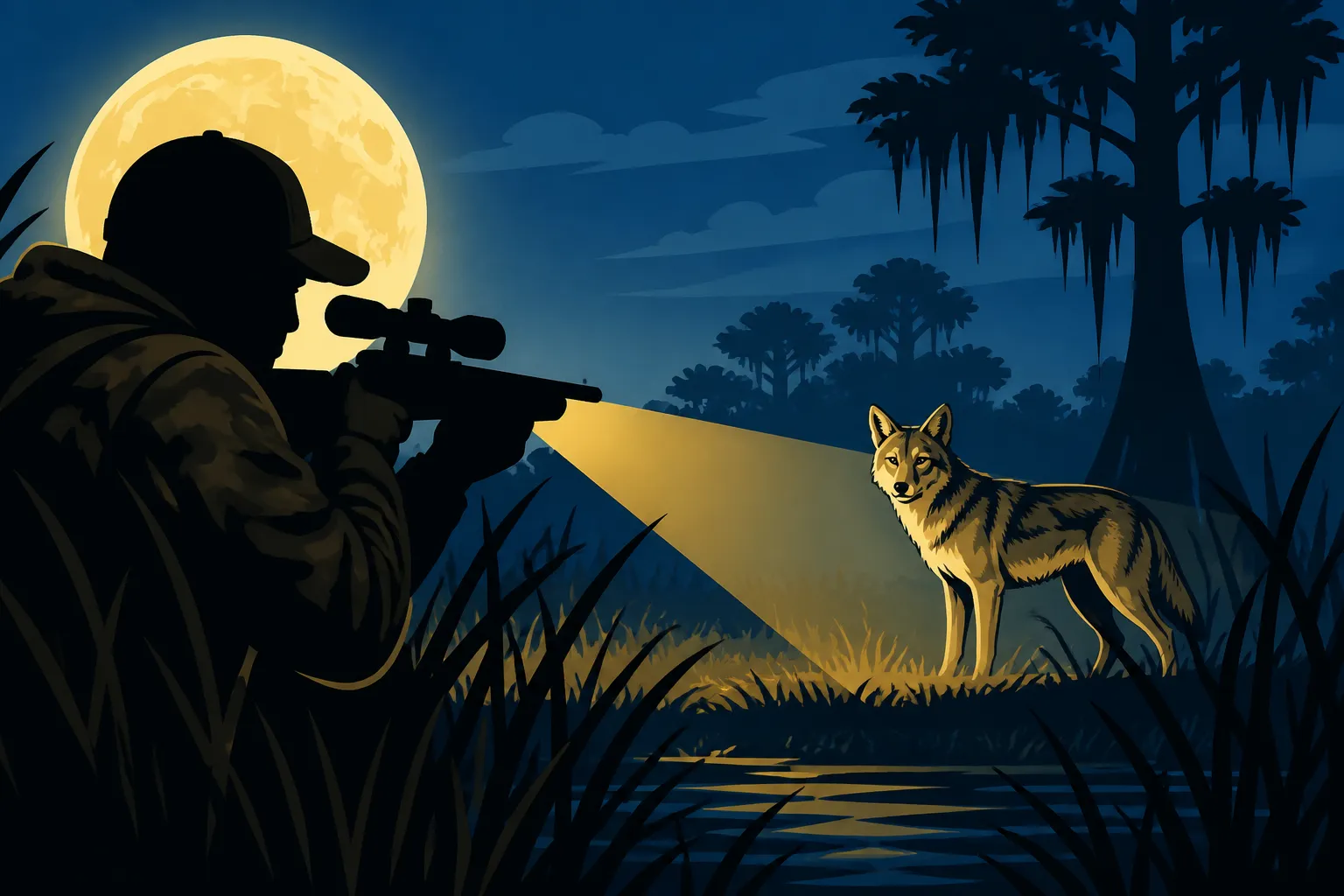
- Weapon-Mounted Lights: Attaching a light directly to your firearm is also generally legal for coyote hunting at night on private land. This allows for quick target illumination and aiming. Again, no specific color or intensity restrictions apply, but white lights are most common for identifying targets.
It's important to differentiate these rules from those for other species. For instance, while you can use lights for night hunting coyotes, you cannot use them to "shine" for deer, which is illegal spotlighting. The intent behind the light's use is critical. Always double-check current LDWF regulations, as rules can sometimes change or be interpreted differently. When scouting gear or researching what's available, platforms like GoHunt can be invaluable for seeing what's on the market and what others are using successfully.
Electronic Calls and Thermal/Night Vision Devices
These technological marvels have completely changed the game for night hunters. Fortunately, Louisiana is quite progressive in allowing their use for coyote hunting on private land:
- Electronic Calls: Absolutely legal and highly effective. Electronic calls can replicate a vast array of sounds – distress calls, pup howls, coyote barks, rabbit squeals – drawing coyotes into range. These are often far more consistent and realistic than mouth calls, making them a staple for serious coyote hunters. Many hunters find specific calls from brands like FoxPro or Convergent Hunting Solutions to be game-changers.
- Night Vision and Thermal Optics: This is where the night hunting truly shines. Both night vision and thermal imaging devices are legal for night hunting coyotes on private land in Louisiana.
- Night Vision (NV) amplifies ambient light, allowing you to see in near darkness. It’s excellent for identification at reasonable ranges.
- Thermal Imaging detects heat signatures, making animals "glow" against a cooler background, even in complete darkness or through light brush. This technology is incredibly effective for spotting coyotes that would otherwise be invisible.
The ability to use these advanced optics dramatically increases your chances of spotting and effectively dispatching coyotes. Before investing, remember to do your research on reputable brands and ensure you understand how to operate them safely and effectively. When looking for reviews or comparisons of the latest thermal and night vision gear, resources like GoHunt often have user-submitted insights and product guides that can help with your decision. The use of these devices for other night hunting scenarios, such as Night Hunting Hogs With Lights on Private Land, operates under similar permissions.
Vehicle Use and Discharge of Firearms
Understanding the rules around vehicles is vital to staying legal and safe while night hunting coyotes.
- Shooting from a Vehicle: Generally, it is illegal to shoot from a public road or highway in Louisiana. On private land, however, discharging a firearm from a stationary vehicle is often permissible if the vehicle is entirely within the private property and you are not on or across any public right-of-way. This can be especially useful for setting up on field edges or logging roads.
- Loaded Firearms in Vehicles: Louisiana law prohibits having a loaded firearm in a moving vehicle on a public road. While hunting, this means your firearm should be unloaded until you are in your hunting position and ready to hunt. Always err on the side of caution and ensure firearms are unloaded and cased while traveling on public roads.
It's paramount to verify that your hunting location is unequivocally private land and that you have all necessary permissions. Never assume you can shoot from a vehicle if there's any ambiguity about public access or property lines.
Here's a quick comparison of key coyote night hunting rules:
| Feature/Method | Private Land (with permission) | Public Land (WMAs, National Forests) |
|---|---|---|
| Season | Year-round | Restricted to specific WMA daylight seasons (no night) |
| Legal Hours | Day or night | Daylight hours only (unless specific WMA exception) |
| Lights | Yes (handheld, headlamp, weapon-mounted) | Generally No |
| Electronic Calls | Yes | Generally Yes (during daylight season) |
| Night Vision/Thermal | Yes | Generally No |
| Weapon Restrictions | Generally none (common sense applies) | As per WMA regulations |
| Shooting from Vehicle | Permissible if stationary and entirely on private property, not across public right-of-way | Generally No |
| Loaded Firearm in Vehicle | Unloaded while moving on public roads | Unloaded while moving on public roads |
Essential Safety and Ethical Considerations
Hunting at night, while effective for coyotes, introduces a unique set of safety challenges. The reduced visibility means that every decision, every movement, and every shot must be made with extreme caution. Beyond personal safety, maintaining ethical hunting standards is crucial for the public perception of hunters and for respecting the animals we pursue.
Identifying Your Target and Backstop at Night
This is non-negotiable and perhaps the most critical safety rule for night hunting. In the dark, distances can be distorted, and shapes can be misleading. A bush can look like an animal, and a raccoon can look like a coyote.
- Positive Identification: You must be 100% certain of your target before pulling the trigger. This means not just "it looks like a coyote," but "it is a coyote." Thermal optics are fantastic for spotting heat signatures, but pairing them with a night vision device or a white light burst for final visual confirmation is often a smart practice to ensure you're not targeting a domestic animal or another non-target species.
- Backstop Awareness: Equally important is knowing what's behind your target. In daylight, you can clearly see hillsides, open fields, or thick woods. At night, that clear view disappears. Always hunt with a full understanding of the terrain, using tools like a topographic map or an app like GoHunt to visualize potential backstops even in the dark. A good rule of thumb is to only take shots that are against an elevated bank, into thick ground cover that will stop a bullet, or in a direction where you know there are no houses, roads, or other hunters for a significant distance. The consequences of a stray bullet at night are severe and unforgivable.
Respecting Property Lines and Neighbors
Even on private land with full permission, your actions during a night hunt can affect others.
- Know Your Boundaries: Modern mapping apps, like those available through GoHunt, allow you to precisely delineate property lines. Before you even head out, spend time studying the boundaries of your hunting area. It's too easy to inadvertently cross a line in the dark, especially when focusing on a calling coyote. Respecting these boundaries isn't just a legal requirement; it's a matter of good neighbor relations.
- Communicate with Neighbors: If you plan to hunt at night, especially with lights or loud rifle shots, it's a courteous and responsible practice to inform any adjacent landowners. A quick call or text can prevent alarm, unnecessary police calls, and maintain good relationships within the community. Explaining that you are legally hunting coyotes to protect livestock or game can go a long way in gaining understanding and support. This ties into the broader discussions about private land access and ethical behavior, much like asking permission to recover game, as highlighted in Retrieving Game From Private Land in Louisiana.
Hunter Orange Requirements (Day vs. Night)
Louisiana law requires hunters to wear specific amounts of hunter orange (or "blaze orange") during daylight hours when hunting specific game species, primarily deer during gun season. This is a crucial safety measure to ensure hunters are visible to one another.
However, these hunter orange requirements typically do NOT apply to night hunting for coyotes. The logic is that hunter orange is designed for visibility in daylight, and it offers little to no benefit in the dark. In fact, wearing bright colors at night could potentially make you more visible to the coyotes you're trying to call in.
That being said, if you transition from a night hunt to a morning hunt, or if you are hunting coyotes during daylight hours when other game seasons (like deer gun season) are open, you must adhere to the hunter orange laws. Always consult the current LDWF hunting regulations pamphlet for the most up-to-date and specific rules regarding hunter orange requirements based on the time of day, species hunted, and open seasons in your particular deer area.
Disclaimer
Please remember that hunting regulations can change. It is always your responsibility as a hunter to consult the most current Louisiana Department of Wildlife and Fisheries (LDWF) hunting regulations pamphlet or visit their official website before heading afield. This guide provides general information and should not be considered a substitute for the official state regulations.