Louisiana Elk History and Extirpation
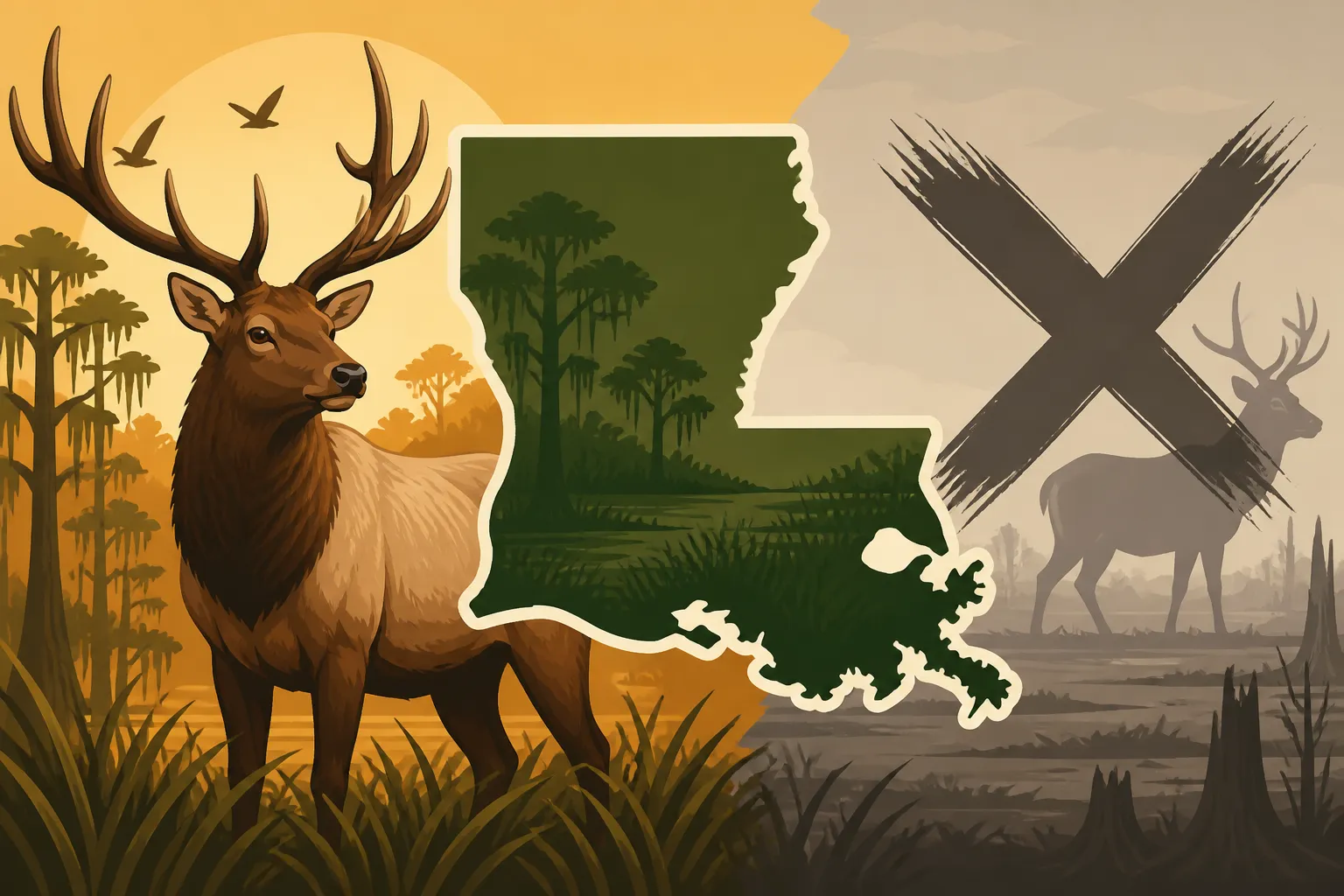
It's quite common for folks to imagine Louisiana's wild past as solely teeming with deer, bears, and alligators, but many are surprised to learn that another magnificent big game animal once roamed our forests: the elk. The idea of elk in the bayou state might seem foreign today, but they were once a vital part of our ecosystem. This guide aims to pull back the curtain on this forgotten chapter, exploring the history of elk in Louisiana and the circumstances that led to their disappearance from our landscape.
A Glimpse into Louisiana's Wild Past: The Eastern Elk
Imagine Louisiana centuries ago, a landscape far wilder and more untamed than anything we know today. It was a place of vast, unbroken forests, intricate river systems, and open savannas. In this vibrant tapestry of nature, the majestic Eastern elk, a subspecies of elk, thrived. Their presence was not just a fleeting moment in time but an integral part of the ecological balance that existed before widespread human settlement truly began to reshape the land. These were not the Rocky Mountain elk we often picture today; the Eastern elk was adapted to the dense woodlands and bottomland hardwoods of the eastern United States, a true forest dweller.
Historical Range and Habitat
The historical range of the Eastern elk was extensive, stretching across much of the eastern and central United States, and Louisiana was firmly within its southern reaches. Our state, with its rich, diverse habitats, provided everything these large herbivores needed. Picture the deep, shadowed canopies of old-growth forests, the expansive floodplains along major rivers like the Mississippi, and the nutrient-rich bottomland hardwoods. These areas offered abundant forage, from tender shoots and leaves to acorns and other mast crops, especially during the crucial fall and winter months. The dense cover also provided sanctuary from predators and the elements. Elk, being grazers and browsers, would have played a significant role in shaping these forest understories, much like White-Tailed Deer Across Louisiana do today, though on a much grander scale due to their size. Their movements through these vast wildernesses created trails and openings, influencing plant growth and distribution.
Evidence of Their Existence
While we can't see them roaming today, the historical record provides compelling evidence of elk in Louisiana. Early European explorers and settlers often made note of "stag" or "red deer," which were undoubtedly elk, in their journals as they navigated the continent's interior. Archaeological digs across the state have unearthed elk bones, providing tangible proof of their presence. These discoveries often occur near ancient Native American habitation sites, suggesting that elk were a significant food source for indigenous peoples for thousands of years. Think about what a huge undertaking it would have been to harvest an animal of that size, providing sustenance for many. Without tools like those found on GoHunt today to track game movements, early hunters relied on deep knowledge of the land, much like we try to do now when Scouting Louisiana Public Land Before Season. The stories passed down through generations of Native American tribes also contain references to these magnificent creatures, painting a picture of a landscape where elk were a regular, if sometimes elusive, sight. These accounts often describe them in the context of the deep woods and fertile river valleys, far from the coastal marshes that would have been more difficult for them to navigate.
The Decline and Eventual Disappearance
The story of the Eastern elk in Louisiana, much like in many other eastern states, is one of a slow but relentless decline, culminating in their complete disappearance. It wasn't a single catastrophic event but a perfect storm of factors, each chipping away at their populations until they simply couldn't recover. The forces of westward expansion, coupled with an increasing human population and changing land use practices, proved to be an insurmountable challenge for these once-abundant animals. It's a sobering reminder of how quickly even a large, seemingly robust species can vanish without proper management and conservation efforts.
Factors Contributing to Extirpation
Several key factors contributed to the extirpation of elk from Louisiana. First and foremost was habitat loss and fragmentation. As settlers moved in, vast tracts of forest were cleared for agriculture, timber, and towns. The ancient, unbroken woodlands that elk relied upon were broken into smaller, isolated patches, making it harder for them to find food, shelter, and mates, and creating vulnerable pinch points. Secondly, unregulated hunting played an enormous role. Before modern wildlife management, game laws were practically non-existent. Market hunters targeted elk for their meat and hides, often killing large numbers without regard for sustainability. Subsistence hunting by a growing population also added pressure, especially in areas where other game became scarce. Unlike today, when we have strict Louisiana Deer Harvest Records and tag requirements, there were no bag limits or seasons, just an endless demand. Finally, competition with livestock for forage and the spread of diseases from domestic animals likely weakened remaining populations, making them even more susceptible to decline. Imagine large herds of cattle and hogs competing for the same browse and acorns that elk needed to survive, especially during lean years.
The Final Years and Last Sightings
The exact timeline for the last remaining elk in Louisiana is somewhat hazy, as records from that era weren't always meticulously kept. However, by the mid-19th century, their numbers were drastically reduced. It's generally believed that the Eastern elk was completely extirpated from Louisiana by the late 1860s or early 1870s. The pressure from human expansion after the Civil War, with a boom in logging and agriculture, pushed the last few scattered individuals to their breaking point. These last sightings would have been isolated, dwindling remnants, likely deep within the most remote sections of the state's wilderness, perhaps in the densest Hunting the Atchafalaya Basin or the then-unbroken hardwood forests of the Tensas River Basin. They faded away quietly, one by one, leaving behind only bones, fragmented stories, and a profound ecological void. It’s a stark contrast to how closely we monitor species today, using mapping tools like GoHunt to understand modern habitat and population dynamics.
Why No Elk in Modern Louisiana?
For many, the natural question that follows the history of elk extirpation is: why don't we have them back now? Other species, like Louisiana's Recovering Black Bear and How Turkeys Were Restored to Louisiana, have seen successful reintroduction efforts. However, the situation for elk is far more complex, touching on habitat suitability, genetics, and the realities of a densely populated, modern landscape.
Modern Landscape and Habitat Suitability
Louisiana's landscape today, while still rich in natural beauty, is fundamentally different from the one the Eastern elk once called home. The vast, contiguous forests have been significantly fragmented by urban development, agricultural expansion, and infrastructure like roads and pipelines. While we have wonderful public lands like Kisatchie National Forest Hunting and numerous Louisiana Wildlife Management Areas, these tracts, though significant, often lack the sheer scale and connectivity that a wide-ranging animal like an elk requires. Elk need enormous areas of unpressured habitat to thrive, moving between diverse forage areas and seeking sanctuary. The dense populations of white-tailed deer, while a boon for hunters, also present potential challenges, including competition for food sources and the risk of disease transmission if elk were to be reintroduced. Comparing the historical piney hills and bottomland hardwoods with today's mosaic of land uses highlights the profound shift.
The Challenges of Reintroduction
Reintroducing elk into modern Louisiana faces a multitude of challenges, making it a conservation dream that is likely to remain just that. Firstly, the genetic integrity of the Eastern elk subspecies is gone; they are extinct. Any reintroduction would involve a different subspecies, typically Rocky Mountain elk, which might not be perfectly adapted to Louisiana's specific climate, forage, and disease pressures. Secondly, the sheer amount of suitable habitat simply isn't available at the necessary scale. Elk are much larger than deer and require considerably more space. Imagine a herd of elk trying to navigate the more populated and developed parts of the state. This leads to the most significant hurdle: human-wildlife conflict. Elk are large, can be destructive to crops, and pose a significant risk in vehicle collisions. Public acceptance and tolerance would be critical, and securing enough contiguous private and public land for a viable population to thrive without constant conflict would be an immense undertaking. While states like Arkansas have had some success with reintroducing Rocky Mountain elk, their landscape and population density differ significantly from Louisiana's, especially in the areas that would be considered for such a project. The idea of large, free-ranging elk herds doesn't easily mesh with the realities of How Many Acres of Public Land Louisiana Has and the intense land use across much of the state.
Understanding Extirpation and Conservation Lessons
The story of Louisiana's elk, while sad, is not without its profound lessons. It serves as a historical marker, illustrating the consequences of unchecked exploitation and a lack of understanding regarding ecological limits. But it also highlights the incredible progress we've made in wildlife management and the importance of ongoing conservation efforts for the species we still cherish. Today's wildlife agencies, like the Louisiana Department of Wildlife and Fisheries (LDWF), employ scientific principles and data from tools like those on GoHunt to monitor populations and manage habitats, ensuring that species don't face the same fate as the Eastern elk.
Learning from the Past
The disappearance of the Eastern elk from Louisiana underscores the critical importance of effective wildlife management. In the era when elk vanished, there were no regulations, no scientific understanding of population dynamics, and no concept of sustainable harvest. We've learned immensely from these mistakes. Today, we have seasons, bag limits, and robust habitat management plans for species like deer, turkey, and bear. Comparing past practices with the detailed frameworks for Louisiana Deer Hunting Area by Area or Louisiana Spring Turkey Season Rules shows how far we've come. The lesson is clear: proactive conservation, based on sound science and public participation, is essential to prevent similar losses in the future. It’s a testament to dedication that species like the Louisiana black bear have made such a strong comeback, a reminder that with effort, we can make a difference.
The Legacy of Louisiana's Lost Elk
Even though elk no longer roam Louisiana, their legacy lives on as a reminder of our wild heritage and the ongoing need for stewardship. Their story compels us to appreciate the wildlife we do have and to vigorously protect the remaining habitats. When we look at the efforts to preserve unique ecosystems like the Hunting the Tensas River Basin or understand the dynamics of Piney Hills Versus Basin Deer, we are implicitly working to prevent other species from facing a similar fate. The absence of elk is a powerful reminder of the fragility of even the largest species in the face of human impact. It reinforces the value of public land, such as our WMAs, as critical sanctuaries and management zones, ensuring that future generations will always have wild places and wildlife to experience, even if the magnificent Eastern elk remains a creature of history in Louisiana. Their story is a foundation for understanding why groups like LDWF and conservation organizations work so hard today to maintain healthy populations for all our remaining game species, from Louisiana Deer Population Estimate to Louisiana Turkey Population Trends.
Comparing Historical and Modern Factors for Elk Presence
| Factor | Historical Louisiana (Pre-1870s) | Modern Louisiana (Today) | Impact on Elk |
|---|---|---|---|
| Habitat Extent | Vast, unbroken forests and woodlands | Fragmented forests, agricultural lands, urban sprawl | Insufficient contiguous habitat for wide-ranging elk |
| Human Population | Sparse, largely indigenous, with growing European settlements | High, with significant land development and infrastructure | Increased human-wildlife conflict, limited suitable refuge |
| Hunting Pressure | Unregulated, market hunting, subsistence | Highly regulated, scientific management, defined seasons/limits | Historical unregulated hunting led directly to extirpation; modern hunting not a factor for elk due to absence |
| Competition/Disease | Minimal competition from domestic livestock, few introduced diseases | Significant domestic livestock presence, potential for disease transmission | Increased stress on remaining wild populations, potential for disease spread to reintroduced elk |
| Conservation Efforts | Non-existent | Robust state and federal wildlife management agencies, public support | Modern conservation aims to prevent extirpation but faces reintroduction hurdles |
This table clearly illustrates the dramatic shift in factors that once supported elk and now present significant barriers to their return.
Disclaimer
This article is for general informational purposes only and does not constitute professional advice. Laws, prices and regulations vary by location and change over time. Consult a qualified professional for guidance on your specific situation.