Reading Louisiana Mud for Fresh Deer Movement
Hunting deer in Louisiana can sometimes feel like trying to find a needle in a haystack, especially with our dense cover, frequent rainfall, and the sheer amount of water that defines so much of our landscape. You might spend hours walking, only to feel like the deer are always one step ahead. But what if I told you that the very ground beneath your feet, particularly our ubiquitous Louisiana mud, holds some of the most reliable clues to fresh deer movement? This guide is all about showing you how to read those subtle messages in the mud, helping you pinpoint exactly where deer are traveling, feeding, and living, making your scouting efforts far more efficient.
Why Louisiana Mud is Your Best Scouting Partner
When you think about scouting for deer, your mind probably jumps to trail cameras, looking for rubs and scrapes, or glassing food plots. And those are all excellent methods, no doubt. But in a state like Louisiana, where we have so much low-lying ground, swamp, and frequently wet conditions, the mud isn't just an inconvenience – it's an unparalleled recording device. Every deer that steps through soft earth leaves a detailed signature, a timestamp, and a direction of travel. In dryer regions, you might struggle to find consistent, clear tracks, but here in the Bayou State, mud is almost always an option, and it's a goldmine of information if you know how to interpret it.
The Ever-Present Canvas of Soft Ground
Think about it: after a good rain, our forest floors, swamp edges, and even logging roads become a soft, pliable canvas. Unlike hard-packed dirt or thick leaf litter where tracks are fleeting or invisible, mud preserves every hoofprint with remarkable clarity. This constant presence of soft ground means you almost always have a medium to read, whether you're deep in the Atchafalaya Basin or exploring a piney hills creek bottom. This consistency is a huge advantage for hunters willing to slow down and really look. You can walk the edges of sloughs, check low-lying crossings, and examine trails where water tends to pool, and you’re almost guaranteed to find evidence of recent activity. This makes scouting so much more productive because you're not just guessing; you're seeing physical proof of where deer have been.
Freshness and Direction: Key Insights from Mud
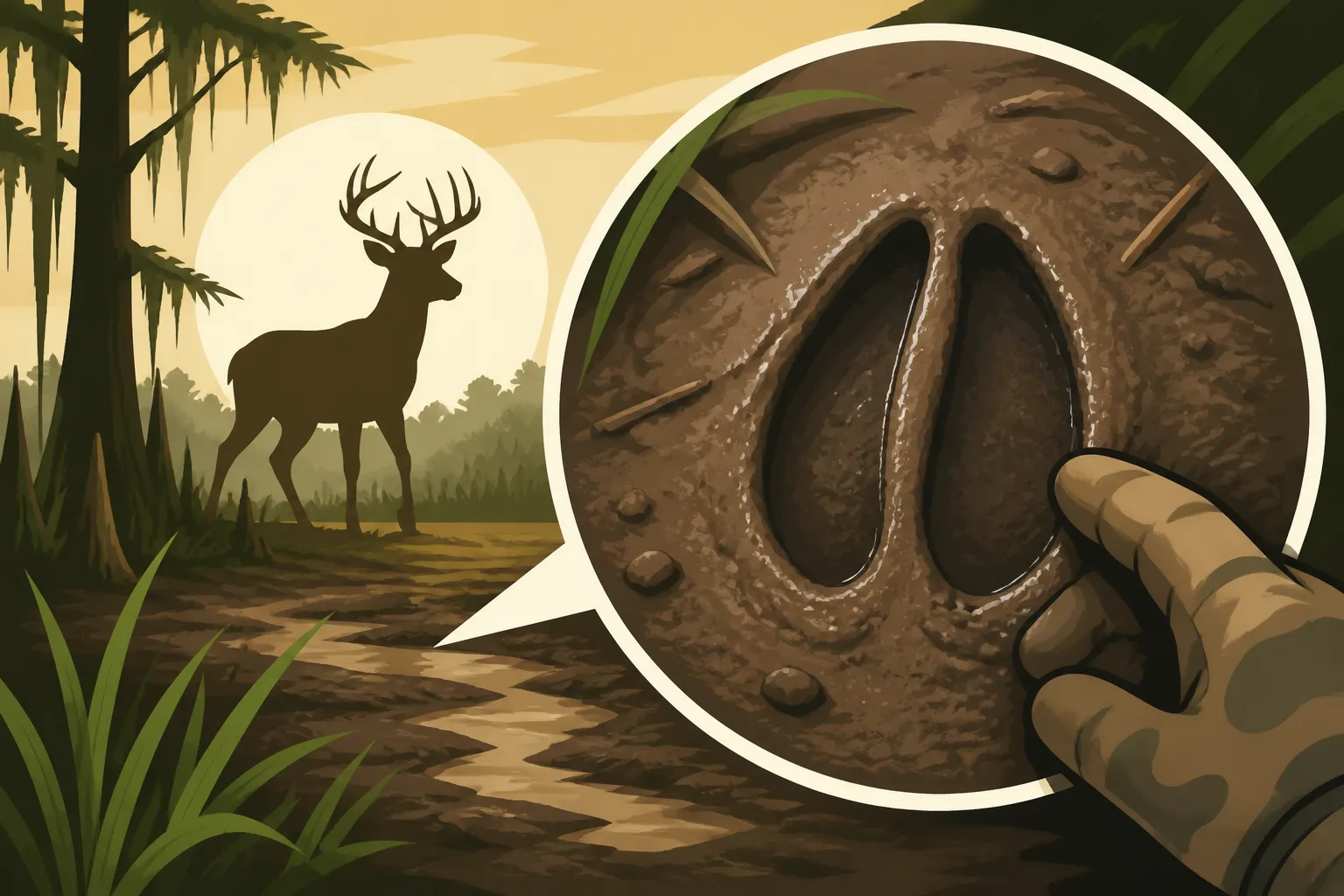
One of the biggest frustrations in scouting is finding old sign – a rub from last month, a scrape from last week. While those can tell you where deer might be, they don't tell you when. Mud, however, offers a much more immediate answer. The crispness of a track, the amount of water still in it, and whether the edges have started to dry or crumble all speak volumes about how recently a deer passed by. A truly fresh track might still have water seeping into it, or the mud around it will be shiny and slick. As it ages, the edges will dull, and if it's been a while, it might even have leaves or debris settled into the bottom.
Beyond freshness, mud also gives you irrefutable proof of direction. This is crucial for understanding travel corridors, bedding-to-feeding routes, and escape paths. By carefully observing the direction of the toe and the drag marks, if any, you can tell exactly which way that deer was headed. This helps you confirm funnel points, identify where deer are entering or exiting a feeding area, or even find that elusive bedding thicket. For instance, if you're Hunting a Funnel Between Two Sloughs, knowing the primary direction of travel through that funnel is paramount to setting up effectively. Without the clear sign offered by mud, you'd be making a much more educated guess, but still a guess.
Decoding Deer Tracks: More Than Just Hoofprints
Looking at a deer track might seem straightforward, but there's a lot more information embedded in those two little crescents than meets the eye. From size and shape to depth and spacing, each detail contributes to a larger story about the deer that made it. Learning to differentiate these nuances can significantly improve your ability to target specific deer or understand overall herd movement.
Size, Shape, and Depth: Identifying Individual Deer
The most obvious clue is the size of the track. A bigger track usually means a bigger deer. However, it's not just length and width; also pay attention to the splay of the hooves. A really heavy-bodied buck, especially one carrying a lot of muscle or antlers, might splay his hooves more widely as he steps, particularly in soft mud. The depth of the track is another indicator of weight and thus, size. A track that sinks deeply into the mud clearly belongs to a heavier animal than a shallow impression.
The shape of the track can also give you hints. Buck tracks often appear more blocky or rounded at the toe, whereas doe tracks tend to be more pointed and dainty. However, this isn't a hard-and-fast rule and can vary based on terrain and gait. The key is to look for consistency. If you find a series of large, blocky, deep tracks following a specific path, you can be fairly confident that a mature buck is using that route. Using a tool like GoHunt's mapping features can help you mark these track locations and patterns directly on your digital map, allowing you to track movement over time. This kind of data layering is invaluable when you're trying to piece together a deer's home range.
Gait and Stride: Unmasking Speed and Sex
Beyond individual tracks, the overall pattern of tracks, or the gait, tells you a story of the deer's movement.
- Walking: When a deer is walking casually, its hind track will often land directly into or slightly ahead of its front track (called "overstepping"). The stride will be consistent, and the tracks will be relatively uniform in depth. This tells you the deer is calm, likely feeding or meandering, and not pressured.
- Trotting: As a deer speeds up to a trot, the hind feet will land well ahead of the front feet. The stride length increases, and the tracks might show a bit more "toe drag" if the mud is sticky. This indicates a deer moving with purpose, perhaps traveling between areas or sensing something is amiss.
- Running/Bounding: When a deer is spooked and running, its tracks will be widely spaced, often with a significant splay of the hooves, and you might see pronounced drag marks as the deer pushes off the ground. The depth will be inconsistent, often deeper in the push-off and landing points. If you find these kinds of tracks, it's a clear sign of recent disturbance or danger in that area.
A very subtle but important detail is the "straddle." A mature buck often walks with a wider straddle than a doe, meaning the tracks are further apart laterally. This is due to their wider shoulders and body. Combine this with larger, blunter tracks and a deep impression, and you've got strong evidence of a mature buck. This attention to detail on gait is critical when Hunting the Louisiana Rut by Area, as bucks will be covering ground with purpose, and their tracks will reflect that intensity.
Beyond the Hoofprint: Other Telling Mud Signs
While deer tracks are the star of the show when reading mud, they're not the only actors. The soft, pliable earth can also capture other important signs that provide a richer, more complete picture of deer activity. Looking for these additional clues can confirm your suspicions about a deer's presence and guide your stand placement.
Scrapes and Rubs in Muddy Terrain
We often think of scrapes as bare patches of dirt with an overhanging limb, and rubs as bark-stripped trees. But in persistently muddy or wet areas, these signs take on a slightly different character that's worth recognizing.
- Muddy Scrapes: Instead of bare dirt, a scrape in a very wet area might be a disturbed, churned-up patch of mud. The ground will be visibly worked, often with distinct hoof impressions from the buck digging with his front hooves, and a distinct odor from the tarsal glands. The overhanging branch (the "licking branch") above it will likely be broken or frayed. If you find these, especially along a well-used trail or at the edge of a field, you know a buck is actively marking his territory. Pay close attention to the freshness of the mud here; if it’s recently worked, you’re in a prime spot.
- Rubs Near Wet Areas: While rubs are on trees, the location of rubs often coincides with muddy travel corridors. Bucks will frequently rub trees bordering muddy paths, creek crossings, or swamp edges. If you find fresh rubs (bark newly stripped, wood underneath still light in color) immediately adjacent to a muddy trail with clear buck tracks, you've hit a jackpot. This tells you the buck is not just traveling there, but also actively claiming that space. These are excellent places to set up, especially if you're interested in Bowhunting Louisiana's Long Archery Season where close encounters are key.
Feeding and Bedding Indicators in Soft Ground
Deer aren't just passing through muddy areas; they're often feeding and bedding there, and they'll leave evidence of that too.
- Feeding Sign: In agricultural areas, deer will leave tracks in the mud around the edges of cornfields or soybean fields, showing where they entered and exited to feed. But even in the timber, deer will browse on various plants. In muddy bottoms, look for tracks leading to patches of favored browse, or disturbed mud around fallen acorns. If you find multiple tracks converging on a specific area with small, distinct tracks of fawns and larger doe tracks, you've likely found a doe family group's feeding spot. After a poor acorn year, these specific browse zones become even more critical, and mud will reveal their usage.
- Bedding Areas: While deer usually bed in thick cover, the approach and exit routes to these beds often traverse softer ground. Look for clusters of tracks leading into thickets, especially on elevated hummocks or slightly drier ground within a swamp. The tracks leading into and out of these areas will often be very fresh, indicating recent use. Finding these points can be challenging, but using a mapping application like GoHunt, you can identify potential bedding cover (dense pines, briar patches, cane thickets) and then use mud sign on the perimeter to confirm if deer are actually using them. This combination of aerial scouting and ground-truthing with mud is incredibly effective for pinpointing elusive bucks.
Putting It All Together: Combining Mud Sign with Modern Scouting
Reading mud is an ancient art, but it truly shines when integrated with contemporary scouting tools and a broader understanding of deer behavior. It’s not about choosing one method over the other, but about creating a synergistic approach that leverages every available clue to maximize your hunting success.
Integrating Mud Sign with Technology
While your boots on the ground are essential for finding mud sign, modern technology can amplify your efforts.
- Mapping Apps: Tools like GoHunt allow you to mark specific track sightings, scrape locations, and travel corridors directly onto your GPS map. This creates a visual record of deer movement patterns over time. You can overlay aerial photos to identify natural pinch points, creek crossings, or transitions between different habitat types (e.g., hardwood bottoms transitioning to pine uplands) that are likely to hold mud and, consequently, deer sign. When you're Reading Aerial Photos for Central Louisiana Deer, you can then confirm your suspicions on the ground by checking those identified areas for fresh mud sign.
- Trail Cameras: Place trail cameras along muddy trails or at the edges of muddy scrapes. The clear tracks you find will tell you where to put the camera, and the camera will tell you when the deer are moving and provide high-quality photos to identify specific bucks. If you're consistently finding fresh, large tracks in a particular muddy area, setting up a camera there is a no-brainer. This also helps you understand how many deer are using an area and at what times, providing critical intel for your hunt. Don't forget to consider factors like Wind and Thermals in Swamp Bottomland when placing your cameras and stands near these muddy hot spots.
Creating a Comprehensive Deer Movement Picture
Think of mud sign as pieces of a puzzle. Each track, each disturbed patch of earth, is a clue that helps you build a complete picture of deer movement.
- Travel Corridors: By following tracks in the mud, you can identify the most heavily used travel corridors. These might be along creek banks, power line cuts, old logging roads, or subtle ridges in the bottomland. Understanding these main arteries of movement is paramount for stand placement. If you see tracks consistently leading from a thick bedding area through a muddy funnel to a feeding area, you've found a high-odds ambush point.
- Seasonal Changes: The importance of mud sign can shift throughout the season. Early in the season, you might find more tracks around summer food sources. As the rut approaches, you’ll find more buck tracks, especially those with a purposeful gait, along primary travel routes and around scrapes. Later in the season, deer might be concentrated around specific Late-Season Food Sources for Louisiana Whitetails, and mud will reveal their access points. Regular scouting and monitoring of mud sign allow you to adapt your strategy as the deer's patterns change.
Here’s a quick overview of what different mud signs might indicate:
| Mud Sign Type | What It Looks Like | What It Often Means | When to Look |
|---|---|---|---|
| Crisp, Wet Track | Hoofprint with shiny, uncracked edges; may seep water | Very recent deer movement (hours old) | Post-rain, early morning |
| Dull, Drying Track | Edges slightly crumbly or dull; no standing water | Moderately recent deer movement (up to 24 hours old) | Any time, especially a day after rain |
| Large, Blocky Track | Wider hoofprint, rounded toes, deeper impression | Likely a mature buck | All season, especially rut |
| Small, Pointed Track | Narrower hoofprint, pointed toes, shallower impression | Likely a doe or young deer | All season |
| Wide Stride/Straddle | Tracks spaced further apart laterally | Likely a mature buck | All season, but pronounced during rut |
| Muddy Scrape | Churned mud patch with hoof impressions, broken limb | Active buck territory marking | Pre-rut and rut phases |
| Track Cluster | Multiple tracks converging or overlapping | Congregation point (feeding, staging, bottleneck) | Around food sources, water crossings, funnels |
| Drag Marks | Scrapes or furrows between hoofprints | Deer running or moving quickly (spooked, chasing during rut) | During or after heavy pressure, during peak rut |
| Edge Tracks | Tracks along creek, swamp, or field edges | Natural travel corridors or access points to resources (water, food, cover) | Regularly, these are prime scouting routes |
By diligently applying these observation skills, you'll find that Louisiana's abundant mud is less of a nuisance and more of a gift, constantly providing fresh intelligence on the deer you're pursuing. It takes patience, but the rewards are well worth the effort.
Disclaimer
Hunting is an inherently dangerous activity. Always prioritize safety, understand and follow all Louisiana Department of Wildlife and Fisheries (LDWF) regulations, and obtain appropriate licenses and permits. The information provided in this guide is for educational and informational purposes only and should not be considered a substitute for professional instruction or direct adherence to official wildlife guidelines. Always confirm current regulations with the LDWF before engaging in any hunting activities.