How Early Season Squirrels Give Themselves Away
The early season in Louisiana is a beast, isn't it? The humidity is still thick, the mosquitos are out in force, and the woods are an impenetrable wall of green. Trying to spot a squirrel through all that foliage can feel like searching for a needle in a haystack, especially when they're playing hide-and-seek among the leaves. But don't despair! Those wily bushytails, for all their stealth, actually give themselves away in a multitude of subtle, and not-so-subtle, ways if you know what to look and listen for. This guide will walk you through the tell-tale signs that betray an early season squirrel's presence, turning frustrating hunts into successful ones.
Listening for the Forest's Hidden Clues
When the woods are so dense you can barely see twenty yards, your ears become your most valuable hunting tool. Squirrels are surprisingly noisy creatures, especially when they're going about their daily business of feeding and moving. Tuning into these sounds can often pinpoint their exact location long before you ever lay eyes on them.
The Distinctive Rustle of Leaves and Scramble of Claws
One of the first sounds you'll likely pick up in the early season is the rustling of leaves. Now, it's easy to dismiss this as just the wind or another small critter, but a squirrel's rustle has a particular cadence. It's often a frantic, stop-and-go sound as they dart across the forest floor, digging for buried nuts or foraging for fallen mast. Pay attention to the intensity and duration. A prolonged, focused rustle in a specific area, especially if it's accompanied by small twigs snapping, is a strong indicator of a squirrel on the move, rather than just a gentle breeze.
Beyond the ground, listen for the rapid scratch-scratch-scratch of claws on tree bark. When a squirrel goes up or down a tree, especially at speed, their claws make a distinct sound. It’s not the slow, deliberate scrape of a raccoon, nor the heavy thump of a deer. It’s light, quick, and often accompanied by a tiny shower of bark fragments. If you hear this sound, immediately scan the trunk, looking for that tell-tale twitch of a tail or a fleeting glimpse of gray or fox fur.
Understanding these auditory differences helps you differentiate between a potential target and just general forest noise. It takes practice, but once you train your ear, the woods will reveal their secrets more readily. You might even find yourself anticipating their movements, knowing they're about to pop out from behind a trunk based purely on the sounds they make. For more on navigating these environments, consider looking into tactics for Squirrel Hunting Louisiana Bottomland Hardwoods.
The Tell-Tale Bark and Chirp of a Squirrel
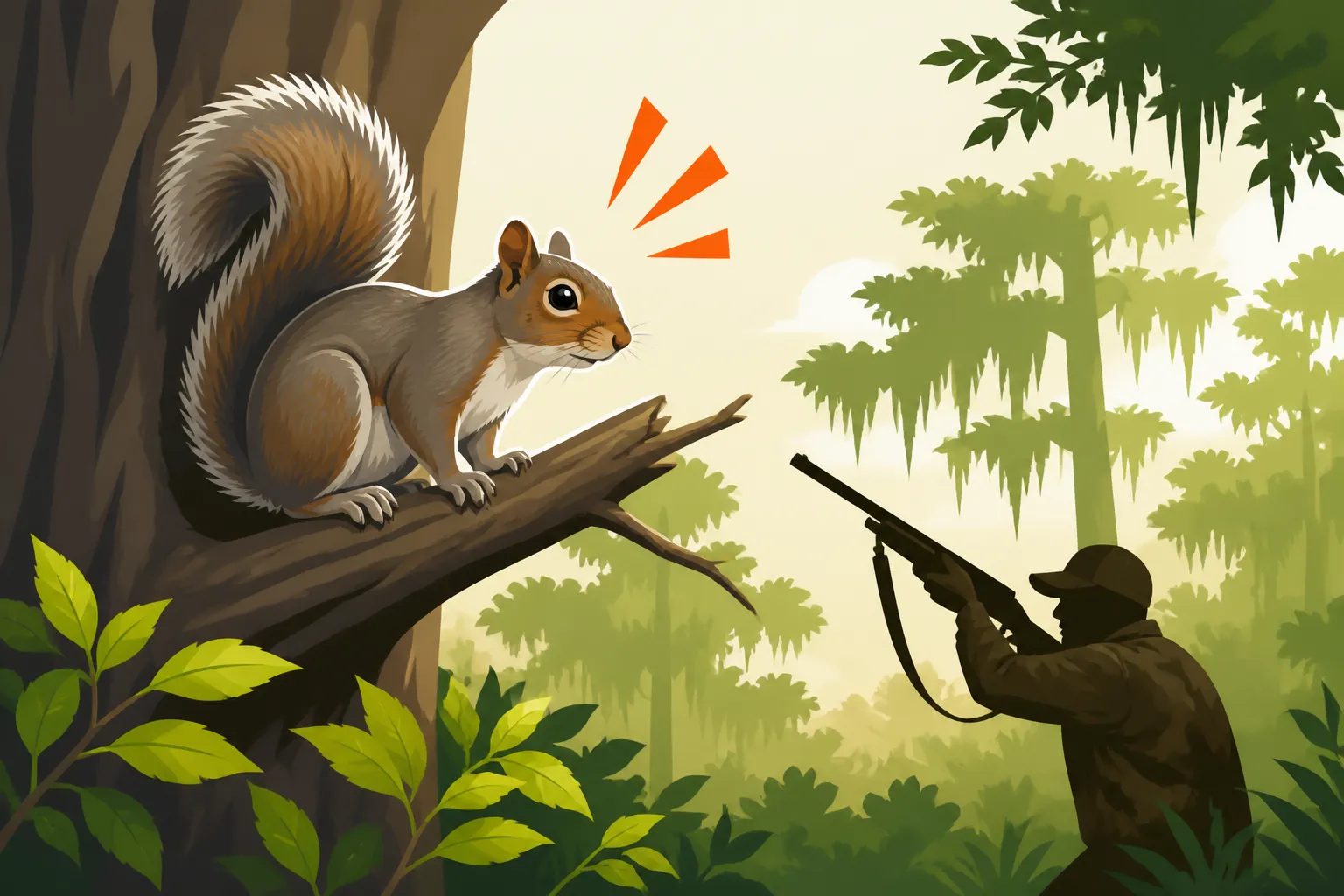
Squirrels are quite vocal, and their calls are unmistakable once you learn to recognize them. The classic "bark" is often a warning or an alarm call, letting other squirrels (and any nearby hunter) know that a predator is in the vicinity. This bark is sharp, repetitive, and carries well through the woods. If you hear a squirrel barking, it means you've been spotted, or they've spotted something they deem a threat.
But it's not always a bark. Squirrels also emit a variety of chirps, chatters, and whines. These sounds are often communication between individuals or expressions of contentment while feeding. A softer, almost conversational "chuck-chuck-chuck" might indicate a squirrel that's comfortable and actively feeding, not necessarily aware of your presence. This is your cue to move slowly and cautiously towards the sound. Learning to interpret these vocalizations is a crucial skill for any serious squirrel hunter. Sometimes, mimicking their calls can even bring a curious squirrel closer, giving you a better look.
The Sound of Cutting and Falling Debris
This is perhaps the most obvious auditory cue in the early season, especially when nuts are starting to ripen. Squirrels have incredibly strong incisors and can "cut" into acorns, pecans, or hickory nuts with surprising speed. The sound itself is a distinctive, rapid chink-chink-chink as they chew through the shell. But even more telling than the cutting sound is the rain of debris that often accompanies it.
Stand still in an area known for squirrel activity, particularly near oak, hickory, or pecan trees. If a squirrel is actively feeding up in the canopy, you'll hear tiny fragments of nut shells, caps, and sometimes even whole discarded nuts plinking onto the leaves below. This is an undeniable sign. Look up carefully in the direction of the sounds, scanning the branches for any movement. The debris will often fall directly below where the squirrel is sitting, creating what hunters call a "dinner plate" or "cutting pile." Finding these fresh cuttings on the ground beneath a tree can confirm active feeding even if you can't see the squirrel itself. This method is incredibly effective and often leads to quick success.
Visual Clues in the Green Canopy
Even with all the green, squirrels are not invisible. They constantly make small movements and leave subtle signs that, when combined with auditory cues, can give away their position. You just have to train your eyes to look for the right things.
Tail Twitches and Shaking Branches
A squirrel's tail is a massive giveaway. Even if the rest of its body is obscured by leaves, that long, bushy tail is often visible, flicking and twitching. A nervous or agitated squirrel will often twitch its tail almost incessantly. Look for rhythmic, unnatural movement among the static leaves. It’s rarely just a gentle sway from the wind; a squirrel’s tail flick is usually quick and purposeful. If you spot a persistent twitching, slowly bring your gun up and focus on that area, waiting for the rest of the animal to reveal itself.
Furthermore, pay close attention to the branches themselves. While the wind will make many branches sway, a squirrel moving through the canopy creates a distinct, more abrupt shaking. One branch will jiggle, then another, then another, indicating a direct path of movement. It's not a general, widespread sway, but a localized, sequential disturbance. This is particularly helpful when the squirrel is in a thick tangle of vines or denser growth. You might not see the animal, but you'll see the path of its travel as the branches react to its weight and momentum.
The Fleeting Flash of Gray or Fox
Sometimes, all you get is a fleeting glimpse. A streak of gray against a dark trunk, a flash of red-brown fur as it bounds from one limb to another. In the dense early season, squirrels rarely offer you a full, clear view right away. The trick is to look for any unnatural color or shape, no matter how brief. Your brain is wired to recognize the full form of an animal, but in hunting, you need to train it to react to partial sightings.
Focus on breaking up the patterns of the forest. Look for anything that doesn't quite fit the organic lines of trees and leaves. This is where a good pair of binoculars, or even just a quick scope acquisition, can help. If you see a flash, freeze, and then scan that exact spot, and the surrounding area, with heightened attention. Often, the squirrel will pause shortly after a quick movement, giving you a second, more stable opportunity for a shot. Remember, Louisiana is home to both Gray Versus Fox Squirrels in Louisiana, and while their colors differ, their movements are similar.
Evident Food Sources and Scattered Debris
Squirrels are creatures of habit, especially when it comes to food. In the early season, they're heavily reliant on developing mast crops like acorns, pecans, and hickory nuts. Locating trees that are actively dropping nuts is key. Look for freshly fallen nuts on the ground that show signs of being chewed on – clean cuts, not ragged tears. These are "cutting piles" or "middens." A scattering of fresh nut fragments below a particular tree is a definite hotspot. This isn't just an auditory cue, but a visual confirmation of recent feeding activity.
Beyond nuts, squirrels also forage for other items. They might chew on fungi, berries, or even certain plant shoots. Keep an eye out for these more unusual food sources as well. If you notice a particular patch of mushrooms that have fresh bite marks, or berries that have been stripped from a bush, you’re likely in a squirrel’s feeding zone. When scouting prior to the season, using a mapping tool like those found on GoHunt can help you identify large stands of mast-producing trees, giving you a huge head start on finding these active feeding areas. Understanding these food preferences helps you predict where to focus your efforts, making your hunt far more efficient.
| Early Season Squirrel Sign | Type of Clue | Hunter's Action |
|---|---|---|
| Rustling Leaves | Auditory | Listen for frantic, stop-and-go patterns, differentiate from wind. Move slowly towards the sound. |
| Scrambling Claws | Auditory | Pinpoint light, quick scratch-scratch on bark. Scan trunk and limbs for movement. |
| Barks & Chirps | Auditory | Interpret as alarm (freeze, observe) or conversational (approach cautiously). |
| Cutting/Falling Debris | Auditory/Visual | Listen for chink-chink-chink and plinking sounds. Look for falling fragments and fresh cutting piles on the ground below. |
| Tail Twitches | Visual | Scan for rhythmic, unnatural flicks in the canopy. Focus on the area, await full body reveal. |
| Shaking Branches | Visual | Observe localized, sequential branch movement (not widespread). Track the disturbance path. |
| Fleeting Fur Flash | Visual | React to any unnatural color/shape. Freeze, scan area intently for a pause. |
| Fresh Cutting Piles | Visual | Locate areas with chewed nuts/debris on the ground. Indicates active feeding area. |
Behavioral Tells and Daily Patterns
Squirrels aren't entirely random in their movements. They follow routines and exhibit predictable behaviors that, once understood, can be exploited by the observant hunter. Knowing their habits in the early season can put you in the right place at the right time.
The Morning Rush Hour and Midday Lull
Just like humans, squirrels have a "rush hour." They are typically most active in the first few hours after sunrise and again in the late afternoon, approaching sunset. During these times, they are actively foraging, moving between den trees and feeding grounds, and generally being more visible and vocal. If you hit the woods at dawn, you're tapping into their peak activity period, which significantly increases your chances of encountering them. This aligns well with general Louisiana Small Game Season Rules that often encourage early morning and late afternoon hunting.
Conversely, squirrels often take a midday break, especially during the warmer early season months. They'll retreat to their dens or find shady spots to rest, making them much harder to locate. While you can find them at midday, your success rate will likely be lower. This is a good time to move to a new area, scout for fresh sign, or simply take a break yourself. Planning your hunts around these peak activity times is a simple yet effective strategy.
Running the Tree Highways
Squirrels aren't haphazard in their travel through the trees. They often use established "highways"—specific limbs, vine tangles, or even fallen logs—to move between their dens, feeding trees, and water sources. These routes are chosen for efficiency and cover. Look for signs of wear on certain limbs, or areas where the bark might be slightly rubbed smooth from repeated use. Observing their movement patterns, even for just one or two squirrels, can reveal these preferred pathways.
Once you identify a tree highway, you can position yourself strategically along it. Sometimes, it's a funnel between two clusters of mast trees, or a particularly large branch stretching across a gap. By setting up quietly and patiently near these routes, you can often intercept squirrels as they travel. This is a more advanced tactic that comes with experience and careful observation, but it's incredibly rewarding when it pays off. Understanding their travel patterns also helps you determine the best approach when you hear a distant squirrel, ensuring you don't inadvertently spook it.
Middens, Den Trees, and Old Sign
While early season hunting often focuses on current activity, understanding past activity can be just as important. A midden is essentially a long-term cutting pile, an accumulation of discarded nut shells, seed husks, and other debris that indicates a heavily used feeding area over time. While individual fresh cuttings are key, finding a well-established midden tells you that this spot is a perennial favorite for squirrels. Even if it's not active right now, it's highly likely to become active again.
Similarly, identifying den trees—trees with visible holes or cavities where squirrels nest—can give you insight into where they are living. Squirrels often have multiple den trees within their home range. Look for old rub marks around the entrance, or perhaps chewed-up bark. Knowing where they live helps you understand their travel patterns to feeding areas. Even "old sign," like last year's cutting piles or abandoned nests, can give you clues about where to focus your scouting efforts for the current season. Using resources like Scouting Louisiana Public Land Before Season can help you pinpoint these promising areas even before the season opens.
Final Thoughts on Early Season Squirrels
Hunting squirrels in the dense early season Louisiana woods is a unique challenge, but it's also incredibly rewarding. It forces you to slow down, pay attention to the subtle details, and truly engage with the environment. By honing your observational skills—listening for those distinct rustles and barks, looking for the tell-tale tail flicks and branch shakes, and understanding their daily routines—you'll transform your early season hunts.
Remember, patience is paramount. Sometimes you'll hear them long before you see them. Take your time, move slowly, and let the squirrels give themselves away. Before you head out, make sure your gear is dialed in, and you're familiar with all the current regulations, including Louisiana Squirrel Daily Bag Limit. Good luck, and enjoy the sights and sounds of the Louisiana woods!
Disclaimer
Hunting and outdoor activities carry inherent risks. Always prioritize safety, adhere to all Louisiana Department of Wildlife and Fisheries regulations, and obtain proper licenses and permits. The information provided in this guide is for informational purposes only and does not substitute for professional advice or personal responsibility.