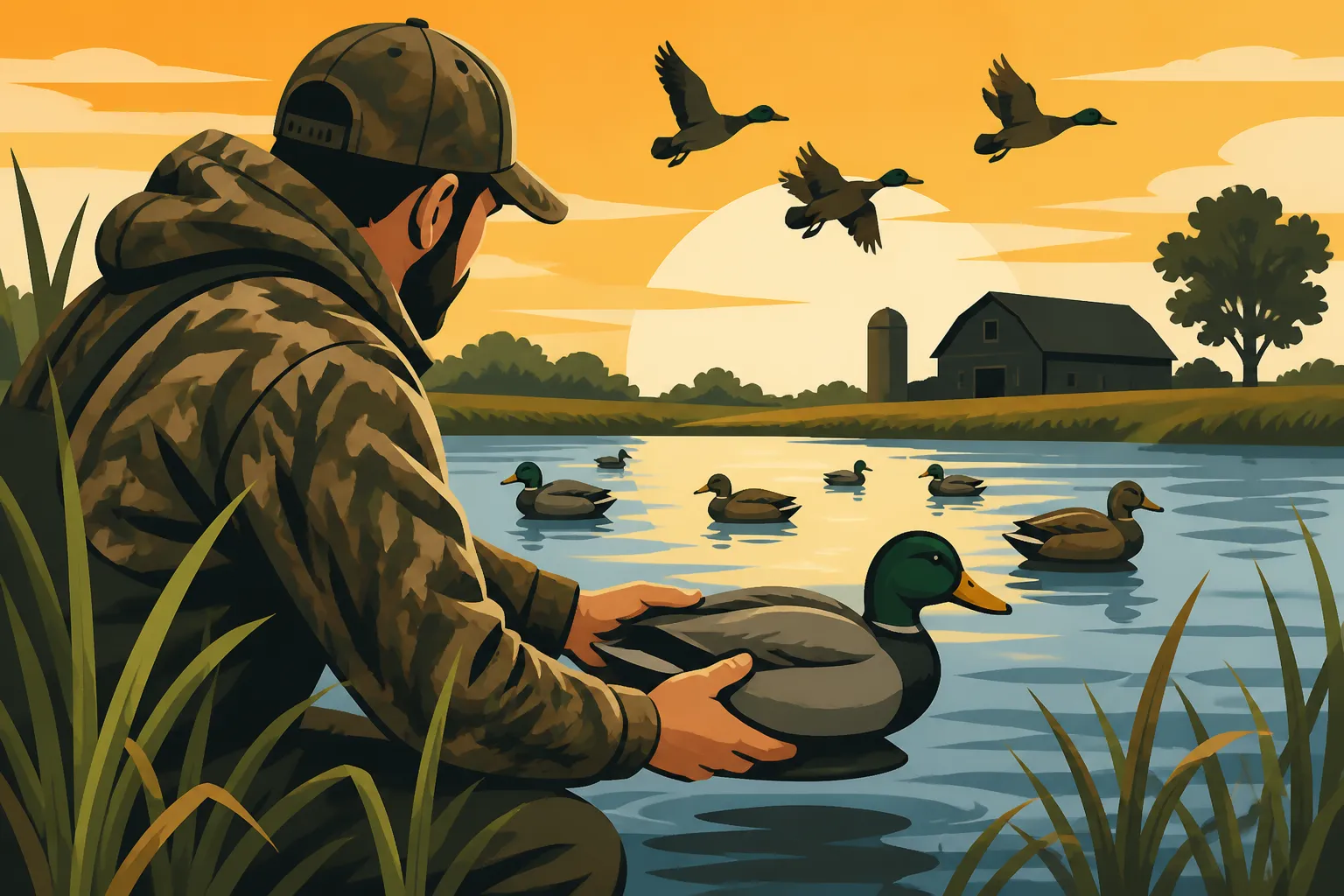
Setting Decoys on a Farm Pond
If you've spent any time duck hunting on Louisiana farm ponds, you know the frustration: you set out a few decoys, hide as best you can, and watch as birds come in, circle once, and then flare just out of range. It feels like they know something's off, right? This guide is going to walk you through the nuances of setting up a truly convincing decoy spread on these often-overlooked hot spots, helping you turn those frustrating flares into successful retrieves.
Understanding Farm Pond Dynamics for Decoys
Hunting farm ponds isn't like hunting the vast coastal marsh or flooded timber. These smaller bodies of water have their own unique characteristics that demand a tailored approach to decoy placement. Ignoring these dynamics is a surefire way to send ducks packing before they even consider dropping in.
Reading the Water and Surrounding Cover
Before you even think about tossing out your first decoy, take a good, hard look at the pond itself and its immediate surroundings. Is it a long, narrow strip, or more of a classic circular shape? Are there trees, brush, or a levee on one side offering natural concealment? Ducks, especially on smaller waters, are incredibly wary, and they've got sharp eyes. They're looking for clear landing zones, but also places where they feel safe and where predators can't easily sneak up on them. They'll often land into the wind, so understanding the prevailing wind direction on your hunt day is paramount. You need to identify potential blind locations first, then plan your spread to draw birds into that kill hole. Sometimes, a subtle depression in a field edge or a thick clump of reeds is all you need for a decent hide, but you'll have to adjust your decoy placement accordingly to put birds where you want them.
Consider the depth of the water, too. Puddle ducks, like our familiar mallards and gadwall, prefer shallower areas where they can tip up to feed. Divers, on the other hand, will favor deeper sections. If your pond offers a mix, you can cater to both, but you’ll typically focus on the most prevalent species you expect to encounter. Also, pay attention to any natural features like points, coves, or small islands. These can create natural funnels or resting areas that ducks already prefer, giving you a huge advantage in where you concentrate your spread. A smart hunter uses tools like satellite imagery, which can be found on apps like GoHunt, to scout these features beforehand, noting entry and exit points for birds and potential ambush locations. This pre-hunt scouting is just as crucial as the setup itself.
Identifying Key Duck Species on Ponds
Louisiana is a waterfowl hunter's paradise, but not every duck species behaves the same way, especially when it comes to farm ponds. Knowing what ducks you're likely to encounter will dictate the size, type, and arrangement of your decoys. On most farm ponds, you're primarily going to be targeting puddle ducks. Think mallards, gadwall, green-winged teal, blue-winged teal, and often a good number of wood ducks. These birds are looking for calm, shallow water where they can rest, feed on submerged vegetation, and feel secure.
Mallards and gadwall are often attracted to larger spreads, and they respond well to feeder-style decoys and motion. Teal are fast and often buzz smaller ponds in tight groups; a few teal decoys mixed in can be very convincing. Wood ducks, with their incredible agility, often dart into wooded pond edges, so placing a few wood duck decoys near cover can be effective. While some deeper farm ponds might hold a few ring-necked ducks or other divers, the bread and butter of farm pond hunting in Louisiana will almost always be the puddle duck species. Understanding the feeding habits and social structures of these different birds is the first step to creating a truly realistic and enticing spread. For example, knowing the Louisiana Mottled Duck Population Trend helps you understand that these resident birds are often found in coastal and intermediate marsh, but they can occasionally make their way to private farm ponds if conditions are right, adding another layer to your potential quarry.
Essential Decoy Spreads for Louisiana Farm Ponds
Once you’ve got a good handle on the pond and the ducks you're after, it’s time to talk about the actual decoy setup. There’s no single "magic" spread that works every time, but there are proven patterns that maximize your chances on these smaller, more intimate waters. The goal is always to create a scene that looks natural and inviting, drawing ducks directly into your shooting lane.
The Classic "J" or "U" Spread
This is arguably the most common and effective spread for farm ponds, especially when you have a prevailing wind. The idea is to create an open "landing strip" for the ducks, guiding them right to where you want them to be. Imagine the letter "J" or "U" laid out on the water. The curved part of the "J" or "U" is placed upwind, with the long "tail" stretching downwind past your blind. Ducks naturally want to land into the wind, just like an airplane, and this spread funnels them into that open area in the bend of the "J" or "U."
Your blind should be positioned at the crook of the "J" or "U" or slightly downwind of the opening. This way, when the ducks commit to land, they are directly in front of you, wings cupped, and often at their closest point. For a typical farm pond, 12 to 24 decoys are usually plenty for this setup. You'll want to space them naturally, not in perfect rows. Mix drakes and hens, and include a few feeder decoys at the "top" of the "J" to suggest a feeding flock. This spread is particularly effective for mallards and gadwall, which are very social and often decoy well into a visible landing zone.
Puddle Duck Pods and Feeding Flocks
Smaller, more intimate spreads can be incredibly effective on farm ponds, especially when targeting wary birds or when hunting smaller ponds that feel "over-decoyed" by large spreads. Instead of one big mass, think about several smaller, distinct pods of ducks. Each pod represents a small group of birds doing something specific: one group might be feeding, another resting, and another just loafing. This broken-up look mimics natural duck behavior far better than a monolithic block of decoys.
For example, you might place a tight cluster of 6-8 mallard and gadwall decoys near a shallow bank, with a few feeder decoys in the mix. Further out, you could have a smaller group of 3-4 resting decoys. If you anticipate teal, set a separate small pod of teal decoys off to one side. The key is to leave a clear, open pocket in front of your blind where the ducks can comfortably land. This approach works wonders when you're targeting mixed bags or when hunting ponds where hunting pressure has made ducks shy of large, obvious spreads. Remember, ducks are always looking for safety in numbers, but they also like their space, especially when feeding. Integrating a few motion decoys, like a jerk string or a spinning-wing decoy, strategically placed within these pods can add vital realism.
Divers on Deeper Ponds
While farm ponds are often synonymous with puddle ducks, some deeper ponds, especially those with good submerged vegetation or a direct connection to a larger waterway, can attract diver ducks like ring-necks, scaup, or even redheads. If you've scouted and consistently seen divers on your particular farm pond, then adjusting your spread to accommodate them is a smart move. Diver ducks have different habits than puddle ducks; they feed by diving deeper underwater and tend to raft up in larger, tighter groups on open water.
For divers, your decoy spread should generally be placed further out from shore, in the deeper sections of the pond. Divers are less concerned with shallow feeding areas and more about open water and security. A "line" or "string" of diver decoys, extending out into the deeper water, can be very effective. You can run a long main line with several decoys attached at intervals, or simply set out tighter clusters. Unlike puddle ducks, divers often decoy directly into the main body of the spread rather than seeking a clear landing zone within it. A mix of drakes and hens is good, but divers are less concerned with exact species representation as long as the size and color profile are right. However, always leave a decent landing area for them, even if it's within the main group. Don't forget that if you're hunting during an early goose season, adding a few Canada goose decoys can sometimes help calm wary ducks, too, as per Early Goose Season Tactics in Louisiana advice.
Maximizing Your Decoy Spread with Realistic Tactics
Having the right decoys is only half the battle. How you present them and how you interact with the ducks once they're working your spread can make or break your hunt. It's all about convincing those birds that your spread is a safe, natural spot to land.
Incorporating Motion Decoys
Static decoy spreads can look lifeless on a calm day, and even with a breeze, they often lack the convincing movement that real ducks display. This is where motion decoys come into their own. Spinning-wing decoys (SWDs), like a Mojo Mallard, are incredibly effective, especially for attracting ducks from a distance. The flashing wings catch their attention and often pull them in for a closer look. However, be mindful of hunting pressure; highly pressured ducks can sometimes become "Mojo shy," flaring if the motion seems unnatural or too aggressive. In these cases, subtle motion is key.
Jerk strings are fantastic for adding realistic, intermittent movement to your spread. A few tugs on a line connected to several decoys can simulate ducks splashing, feeding, or just moving around, which is incredibly lifelike. You control the timing and intensity, making it much harder for ducks to peg as fake. Another great option is a simple shaker decoy or a bobber decoy, which creates ripples on the water, especially effective on still days. The key is to make the motion look natural. If it's a calm day, too much frantic spinning might look unnatural. On a breezy day, a spinning-wing decoy can blend in better. Always consider the weather and the temperament of the birds you're hunting.
Camouflage and Concealment for Success
No matter how perfect your decoy spread, if the ducks see you, the hunt is over. Superior camouflage and concealment are absolutely critical on farm ponds, which often offer limited natural cover. Ditch the idea of just standing behind a tree; ducks have an incredible vantage point from above. You need to become part of the landscape. This might mean building a temporary blind from natural vegetation, using a layout blind, or even digging a pit blind if you have permission and the means.
When choosing your hide, think about the sun's position. Early morning sun directly in your face can make it hard to see incoming birds and can also silhouette you against the bright sky. Try to position your blind so the sun is at your back, making you less visible and putting the sun in the ducks' eyes as they approach. Furthermore, think about your silhouette against the skyline. A dark figure against a clear sky is a dead giveaway. Break up your outline with natural brush, camo netting, or a specialized blind that blends seamlessly. Even something as simple as wearing a face mask and gloves can make a huge difference. Every hunter should prioritize their concealment as much as their decoy spread. Don't underestimate the keen eyesight of a wary mallard, and always remember to check your full setup from the ducks' perspective before the light breaks. This is where good scouting, perhaps even using a drone (if legal and safe), or simply walking the field, helps you identify weaknesses in your hide.
Calling to Complement Your Spread
A convincing decoy spread can pull ducks in from a distance, but calling is often what seals the deal, especially on farm ponds where birds might approach cautiously. Your calls should always complement your spread, not replace it. Think of it as having a conversation with the ducks. Start with softer, more inviting calls like feeding chuckles and soft greetings to simulate a contented flock already on the water. These are often enough to draw in birds already interested in your spread.
As birds get closer, watch their reaction. If they're cupping wings and committing, ease off the call or go silent. If they're circling, looking, but not quite dropping in, a soft comeback call or a series of quacks might entice them. Avoid over-calling, especially loud, aggressive calls, as this can often spook wary birds, particularly on smaller ponds. The goal isn't to blast them with noise but to sound like a realistic group of ducks that they want to join. Learn to read their body language; a slight head turn or a change in flight path can tell you exactly what call they need, or if they need silence. Remember, the best callers are often the best observers. Using a good multi-reed call like those from GoHunt's selection can give you a wide range of tones to mimic different ducks.
Common Pitfalls and How to Avoid Them
Even experienced hunters can fall into traps when setting decoys on farm ponds. Being aware of these common mistakes can save you a lot of frustration and increase your success rate.
Over-Decoying Small Waters
One of the biggest mistakes hunters make on farm ponds is putting out too many decoys. It's a natural inclination to think "more is better," but on a smaller body of water, a massive spread can look incredibly unnatural and intimidating. Ducks are intelligent creatures; they know how many birds typically occupy a small pond. A spread of 40+ decoys on a half-acre pond screams "trap!" to them.
Instead, less is often more. For most farm ponds, 12 to 24 decoys are usually ample. If it's a really small pond, even 6-8 well-placed decoys with some motion can be highly effective. Focus on quality over quantity. Use good quality decoys that look realistic and are in good condition. A few realistic-looking decoys, spaced naturally, will always be more convincing than a hundred cheap, worn-out fakes packed together. This is where Using a Ground Blind on Louisiana Public Land can be a good parallel; sometimes the simplest setup is the most effective. Remember, your goal is to make the pond look inviting, not overcrowded or suspicious.
Ignoring Wind and Sun Direction
We touched on this earlier, but it's worth reiterating because it's such a fundamental mistake that's easy to overlook. Ducks almost always land and take off into the wind. If your decoy spread doesn't account for this, you're asking birds to land in an unnatural way, and they'll often flare or swing wide. Your landing zone should always be upwind of your blind, allowing the ducks to approach head-on, slow down, and drop into the pocket you've created.
Similarly, the sun's position can make or break your hunt. Hunting with the sun in your eyes not only makes it harder to spot incoming birds but also puts you in a silhouette, making you glaringly obvious to ducks flying overhead. Always try to position your blind with the sun at your back. This puts the sun in the ducks' eyes as they approach, making it much harder for them to pick out your hide. It also illuminates the birds for you, giving you a clear shot. Failing to consider wind and sun is like trying to fish without bait – you might get lucky, but you're working against the odds. Using an app like GoHunt to plot your position and anticipate sun angles can be a real game-changer here.
Complacency with Old Spreads
It’s easy to get comfortable with a decoy spread that worked well last season, or even last week. But ducks are constantly learning and adapting, especially as hunting pressure mounts throughout the season. What worked perfectly on opening day might be completely ineffective by mid-season. Hunters who stick to the exact same setup hunt after hunt often find their success dwindling.
To combat complacency, be willing to experiment. Change up your spread from hunt to hunt. If the "J" spread isn't producing, try a few smaller pods. If ducks are flaring over spinning wings, switch to a jerk string or go entirely static. Observe how the ducks are reacting and adjust accordingly. Even subtle changes in decoy placement, distance from the blind, or the amount of motion can make a big difference. Pay attention to how the birds are flying and where they're looking. Are they circling wide? Are they looking at a specific part of your spread? These observations are crucial. Continually adapt your tactics, just as you might when Hunting the Louisiana Rut by Area – understanding the changing behavior of the game is key to sustained success. Don't be afraid to try something new; sometimes a slight tweak is all it takes to turn a slow morning into a memorable one.
| Decoy Spread Type | Target Species | Pond Size Suitability | Key Features |
|---|---|---|---|
| "J" or "U" Spread | Mallards, Gadwall, Teal | Medium to Large | Open landing zone upwind, blind at bend |
| Puddle Duck Pods | Mixed Puddle Ducks, Wood Ducks | Small to Medium | Multiple small clusters, natural movement |
| Diver String/Raft | Ring-necks, Scaup, Redheads | Deeper, Open Water | Tighter groups, further from shore |
| Minimalist (2-6) | Wary Birds, Wood Ducks | Very Small | High realism, subtle motion, close to cover |
Disclaimer
Hunting is an inherently dangerous activity. Always prioritize safety, adhere to all Louisiana Department of Wildlife and Fisheries regulations, and obtain proper licenses and permits before heading afield. The information provided in this guide is for educational purposes only and should not replace proper hunter education or professional guidance.