Best Louisiana Parishes for Big Bucks
That feeling of chasing a true Louisiana trophy buck can be both exhilarating and utterly frustrating. We've all spent countless hours in the stand, dreaming of that massive rack, only to see spike bucks and does. But if you're serious about tagging a wall-hanger, understanding where those giants consistently roam is the first step. This guide dives deep into the parishes renowned for producing big bucks, exploring the critical factors that contribute to their growth and offering strategies to help you increase your odds of encountering the buck of a lifetime in the Sportsman's Paradise.
Understanding What Makes a Parish a "Big Buck Hotspot"
It's not just luck when a particular parish consistently yields impressive whitetails. There's a confluence of factors, from the very ground beneath their hooves to the way hunters manage the herd, that creates an environment where bucks can truly thrive and express their full genetic potential. For too long, Louisiana was known primarily as a "meat state" where any buck was a good buck, but as more hunters embrace quality deer management, certain areas are truly shining.
Habitat is King: Food, Cover, and Water
The foundation of any healthy deer herd, and especially one capable of producing trophy-class bucks, lies squarely in its habitat. Deer are products of their environment, and the richer the environment, the better their chances of growing big. In Louisiana, this often means a mosaic of highly fertile soils, abundant food sources, and dense, secure cover.
Think about the parishes bordering the Mississippi River or its old channels, like those in the Northeast part of the state. These areas boast deep, rich alluvial soils that are incredibly productive, supporting vast agricultural operations like corn, soybeans, and even cotton. Deer in these regions have access to a year-round buffet, providing the high-protein, high-energy diet necessary for antler growth and overall body size. This nutritional abundance is a non-negotiable component for developing mature bucks with impressive racks. Contrast this with some of the less fertile piney woods, where deer might browse on less nutritious forage, and you immediately see the difference. Beyond food, robust cover in the form of thick hardwood bottoms, cypress-tupelo swamps, or dense CRP fields gives older bucks the security they need to evade predators and hunters, allowing them to reach prime age. Access to reliable water sources, whether natural bayous, sloughs, or man-made ponds, completes this vital habitat puzzle.
Age Structure and Genetics: Letting Them Grow
While good nutrition is paramount, a buck simply cannot grow a massive rack if he doesn't live long enough. This is where age structure comes into play, and it’s a huge differentiator between good deer areas and great ones. Big antlers are primarily a function of age, with most bucks reaching their peak antler development between 4.5 and 7.5 years old. This means that for a parish to be a "big buck hotspot," a significant portion of its buck population needs to survive past the yearling or two-year-old stage.
This often points to areas with strong quality deer management (QDM) practices, typically found on well-managed private lands or large hunting clubs. These groups often implement stricter harvest guidelines, such as minimum antler restrictions or encouraging hunters to pass on younger bucks, thereby allowing more animals to reach maturity. While genetics certainly play a role in a buck's potential antler size, even a genetically superior buck won't grow a huge rack if he's harvested as a 2.5-year-old. The widespread adoption of QDM principles across certain parishes has demonstrably shifted the age structure, leading to more older bucks and, consequently, more trophy opportunities. Knowing that the local hunting community is committed to letting bucks walk can give you a lot of confidence that your efforts will pay off.
Hunter Pressure and Access: The Human Factor
Another critical, often overlooked, factor influencing the presence of big bucks is hunter pressure and access. Mature bucks are incredibly wary and intelligent animals; they learn quickly to avoid areas with high human activity. Parishes that consistently produce giants often have characteristics that either limit hunter access or provide vast, unpressured sanctuaries for deer.
This could mean large tracts of private land owned by timber companies, large agricultural operations, or private individuals who limit hunting access or manage it intensely. These properties become de facto refuges where bucks can grow old without constant harassment. Conversely, some of Louisiana's most difficult terrain, like the deep cypress-tupelo swamps of the Atchafalaya Basin, naturally limits hunter access. While challenging to hunt, these areas offer sanctuary simply because fewer people are willing or able to penetrate them consistently. Less pressure equals more older bucks, which in turn means greater odds of encountering a true trophy. When comparing different regions, consider how easily hunters can move through an area, as that can be a telling indicator of the potential for finding mature, unpressured deer.
Top Louisiana Parishes for Trophy Whitetails
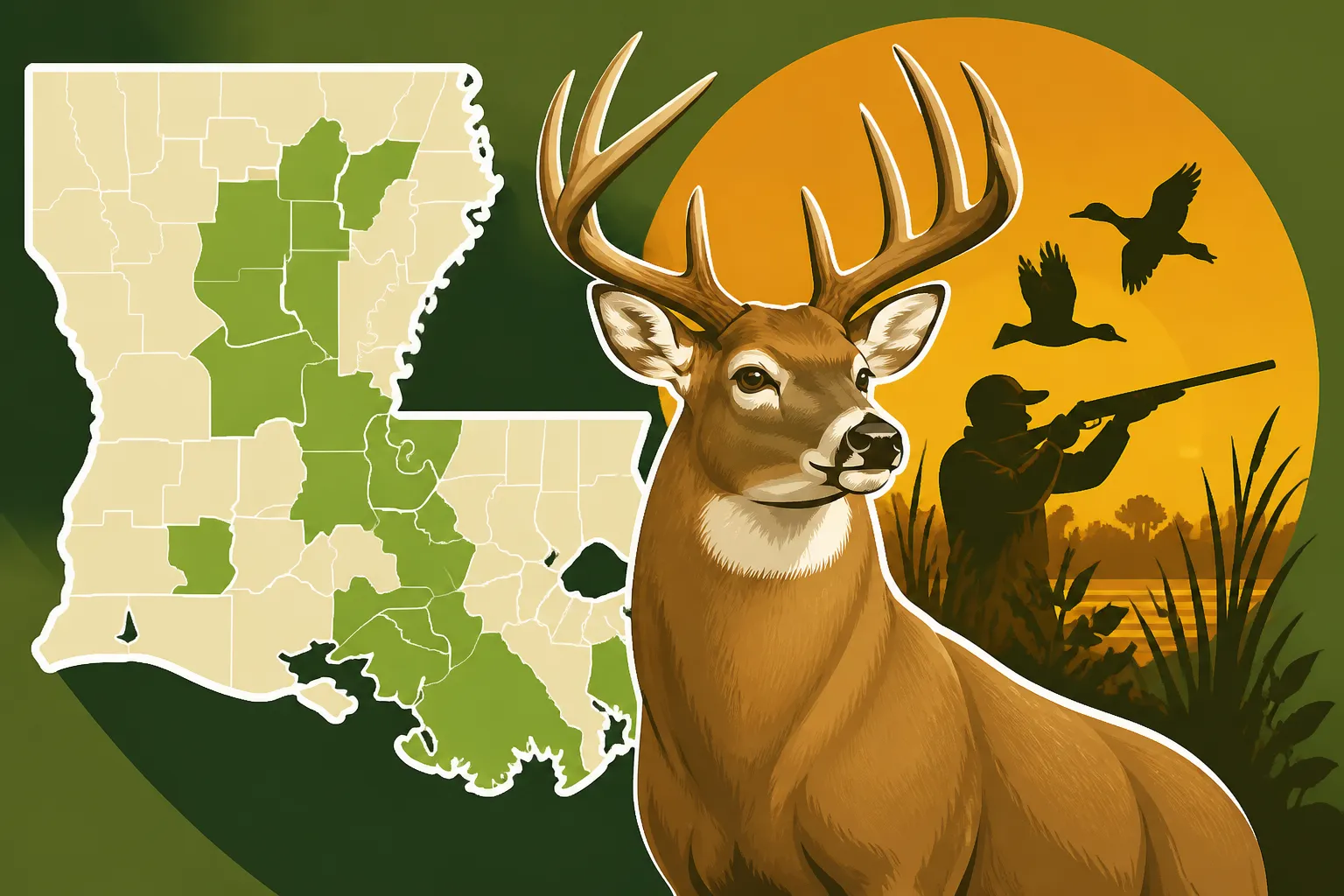
Louisiana is divided into ten deer areas, each with its own season dates and regulations, but within these larger zones, specific parishes stand out as consistent producers of truly remarkable whitetails. These are the places where the habitat, management, and lack of consistent pressure align to create ideal conditions for big bucks.
The Florida Parishes: Northshore Giants
When hunters talk about big bucks in Louisiana, the Florida Parishes often come up in the conversation, and for good reason. Parishes like East Feliciana, West Feliciana, and to a lesser extent, Tangipahoa and Washington, are consistently noted for producing heavy-bodied deer with impressive racks. The rolling hills of this region, a stark contrast to the flat delta lands, are rich in fertile soil that supports vibrant hardwood bottoms and mixed pine-hardwood timber.
These areas benefit from a long history of private land ownership, often by timber companies or individual landowners who have embraced progressive deer management strategies. This commitment to QDM has allowed a significant number of bucks to reach older age classes. The varied topography provides excellent cover, with numerous creek drains, hollows, and dense thickets where mature bucks can hide and feel secure. Additionally, widespread agricultural practices, particularly smaller food plots and interspersed row crops, supplement the natural forage, providing critical nutrition. If you're looking for Why the Florida Parishes Grow Big Bucks, it's a combination of rich soils, diverse habitat, and dedicated management that allows these Northshore giants to flourish. Using mapping tools like GoHunt in this region can help identify those crucial habitat transitions and hidden pockets that often hold older deer.
The Northeast River Bottoms: Tensas and Beyond
No discussion of Louisiana's big buck parishes would be complete without highlighting the legendary Northeast River Bottoms. This region, encompassing parishes like Tensas, Madison, Concordia, and parts of Morehouse, sits squarely in the Mississippi River Alluvial Plain. The soils here are some of the most fertile on earth, deposited over millennia by the river itself. This incredible fertility fuels massive agricultural production—think endless fields of corn, soybeans, and winter wheat—which provides an unrivaled food source for whitetails.
Coupled with these vast agricultural tracts are expansive blocks of bottomland hardwood timber, often managed for both timber production and wildlife. These hardwood forests provide excellent cover, especially during the fall and winter when crops are harvested. The Tensas River National Wildlife Refuge, for example, is famous for its trophy potential, proving what can happen when deer have unlimited food, secure cover, and relatively low pressure in certain areas. Hunters eager to learn more about Hunting Tensas Parish River Bottoms often find that this area truly lives up to its reputation. Many serious trophy hunters scour forum posts on platforms like GoHunt, seeking tips and success stories specific to this fertile delta region. The sheer amount of available food ensures that bucks have the nutrition to maximize their antler growth, year after year.
The Atchafalaya Basin and Central Delta: Swamp Monsters
For the adventurous hunter, the sprawling Atchafalaya Basin and the adjacent central delta parishes like St. Martin, Iberville, and Assumption offer a unique and often rewarding challenge. This isn't your typical farm-country deer hunt; this is deep, wild swamp hunting, and it takes a special kind of dedication. However, the rewards can be truly immense. The Basin is a natural sanctuary, a labyrinth of cypress-tupelo swamps, bayous, and sloughs that provides an almost impenetrable fortress for mature deer.
The sheer difficulty of access means that much of the Basin sees far less hunting pressure than more accessible areas. Bucks here can grow old, wise, and massive, often with dark, heavy racks, simply because they have the space and cover to do so without constant human interference. Hunting the Basin requires specialized tactics, often involving boats, canoes, and a willingness to get wet and muddy. But those who master Hunting Atchafalaya Basin Swamp Deer know that the potential for a true swamp monster is always there. While satellite imagery on GoHunt can provide an overview, actually navigating and understanding the subtle elevation changes and travel corridors in the Basin requires on-the-ground experience or a skilled guide. The deer here are survivors, adapted to their watery world, and tagging one is an achievement to be proud of.
Strategies for Chasing Louisiana's Biggest Bucks
Successfully harvesting a big buck in Louisiana isn't about luck alone; it's a deliberate process that combines extensive scouting, strategic planning, and unwavering patience. It demands a different approach than hunting for a freezer full of venison, though a big buck certainly provides plenty of that too!
Scouting and Research: Knowledge is Power
The pursuit of a big buck starts long before opening day. Successful trophy hunters are year-round scouts, constantly gathering information and observing deer movement. This means pouring over aerial maps and topographic charts, utilizing modern hunting apps, and dedicating time to boots-on-the-ground exploration. For areas like the Florida Parishes, identifying pinch points between timber blocks and agricultural fields, or finding hidden creek bottoms that offer both food and cover, is crucial. For the Northeast River Bottoms, understanding crop rotations and identifying unpressured hardwood islands within vast ag fields can be the key. Even in dense areas like the Atchafalaya Basin, a keen eye for subtle terrain changes and historical high ground can lead to productive stands.
Don't just look for deer sign; try to understand the pattern of movement. When you're Reading Aerial Photos for Central Louisiana Deer, look for edges, funnels, and areas that offer multiple benefits to a deer. Talking to locals, land managers, and other experienced hunters can also provide invaluable insights. Many hunters use sophisticated mapping apps, and GoHunt provides excellent property data and satellite imagery that can help identify potential hotspots, dense cover, and crucial travel corridors, even when you're scouting from home. This foundational knowledge is what separates the hopeful from the consistently successful.
Patience and Persistence: The Long Game
Chasing big bucks is not for the faint of heart or the impatient. These animals are masters of survival, often only making mistakes under specific conditions or during the peak of the rut. It means committing to a strategy, even when it feels like nothing is happening. You might need to pass on numerous smaller bucks, knowing that your target buck is still out there. This can be one of the hardest parts of trophy hunting, especially when you've invested significant time and effort.
Often, big bucks don't just appear; they require you to put in the hours, to sit through slow hunts, and to adapt to changing conditions like weather fronts or hunting pressure. Learning to analyze Hunting Pressure on Louisiana Public Land is vital, knowing when to move deeper into less accessible areas, or when to try a completely different approach. Sometimes, it means dedicating an entire season, or even several, to understanding a specific piece of property and a particular deer. The reward of finally tagging that mature animal, knowing all the effort that went into it, makes the long game worth every minute.
Private vs. Public Land: Weighing Your Options
Louisiana offers diverse hunting opportunities, but when it comes to consistently finding big bucks, the choice between private and public land often comes down to balancing access, management, and effort. Private land, especially those with dedicated quality deer management programs, often offers the highest potential for trophy bucks. These properties typically have controlled harvest rates, ample food plots, and reduced pressure, creating an ideal environment. However, access to such lands usually comes at a premium, whether through lease fees, club memberships, or careful cultivation of landowner relationships. For those without immediate access, learning Getting Private Land Permission in Louisiana can unlock new opportunities.
On the other hand, public lands like Wildlife Management Areas (WMAs) and National Forests offer open access but often come with higher hunter densities and varying levels of management. While public land can be more challenging, it's certainly not impossible to find big bucks. It simply requires more effort in Finding Ground Others Walk Past – areas that are difficult to reach, further from main roads, or in particularly dense cover. Some of the biggest bucks are taken off public ground each year by tenacious hunters willing to put in the work. Each hunter must weigh their resources, time, and desired experience to decide which avenue best suits their pursuit of a Louisiana giant.
Louisiana Big Buck Hotspot Parishes: A Snapshot
To give you a quick overview of some of the parishes frequently mentioned for their big buck potential, here's a comparative table. Keep in mind that specific success can vary year-to-year and tract-to-tract, but these regions generally offer strong opportunities for trophy whitetails.
| Parish Region | Key Characteristics | Primary Habitat | Hunter Pressure | Big Buck Potential |
|---|---|---|---|---|
| Florida Parishes | Rolling hills, fertile soil, private land management | Mixed hardwoods, pine plantations, agriculture | Moderate-Low | High |
| Northeast River Bottoms | Alluvial soils, vast agriculture, large timber blocks | Hardwood bottomland, agriculture | Moderate | High |
| Atchafalaya Basin | Dense swamp, bayous, difficult access | Cypress-tupelo swamp, bottomland hardwoods | Low-Moderate | Very High |
| Central Delta | Riverine forests, fertile soils, agriculture | Bottomland hardwoods, agriculture | Moderate | High |
Ultimately, Louisiana offers incredible diversity in its deer hunting, and with the right knowledge, strategy, and perseverance, that dream of a big buck can certainly become a reality. Understanding the unique attributes of these top parishes is a great first step on that exciting journey. For a deeper dive into statewide regulations and zones, check out our guide to Louisiana's Ten Deer Hunting Areas Explained. You'll find that while some areas are clearly better for antler growth, every parish in Louisiana holds the potential for memorable hunts. And don't forget to report your harvest; knowing your Louisiana Deer Harvest Records helps LDWF manage the herd for future generations of big bucks.
Disclaimer
This article is for general informational purposes only and does not constitute professional advice. Laws, prices and regulations vary by location and change over time. Consult a qualified professional for guidance on your specific situation.