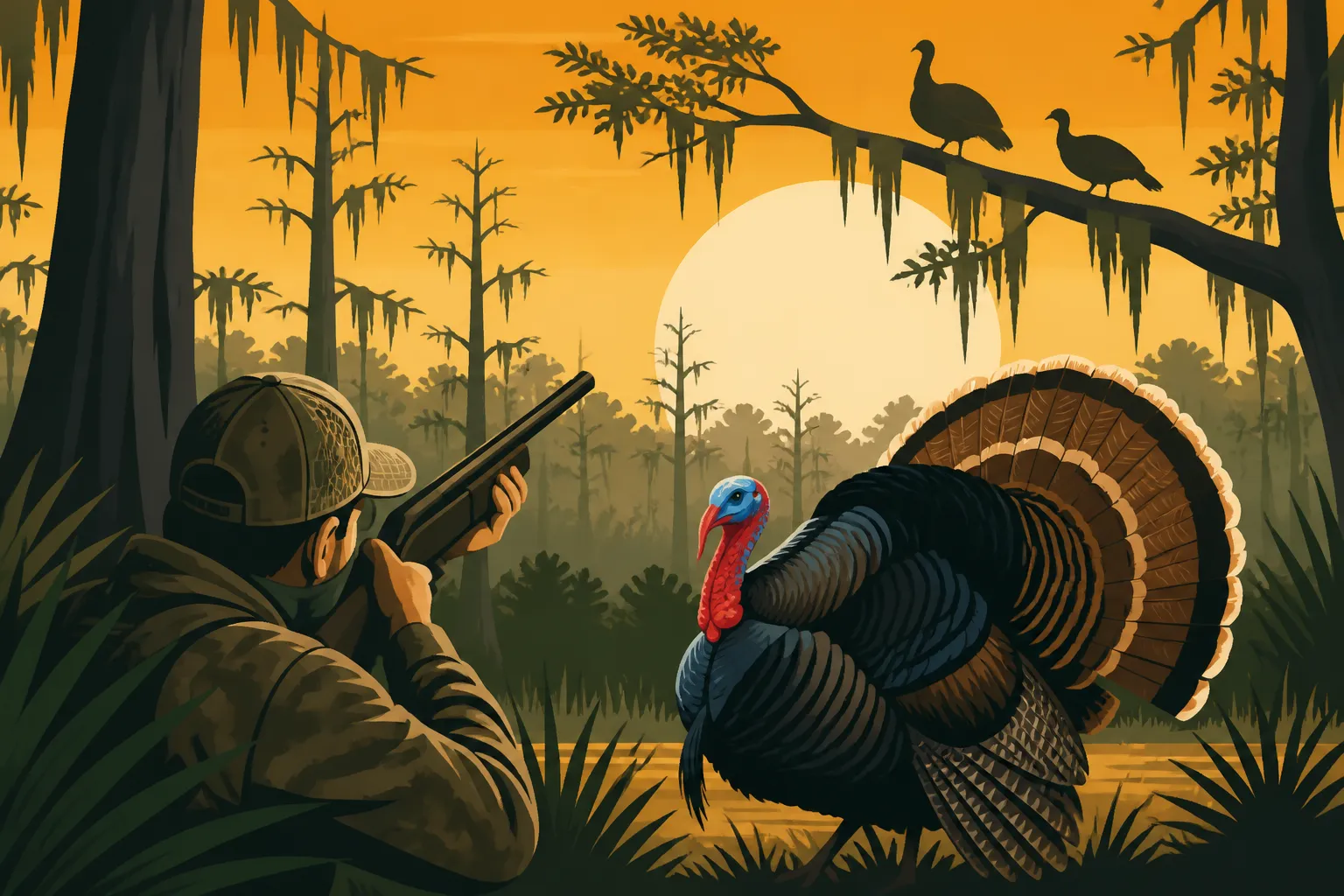
Roost Hunting Louisiana Gobblers
There’s nothing quite like the sound of a Louisiana gobbler hammering out a deep, resonant shock gobble from his roost just before dawn. But if you’ve spent countless mornings trying to pinpoint that sound, only to have the bird pitch down and disappear in the thick bottomland or dense piney woods, you know the frustration. This guide is all about tackling that exact problem, helping you understand how to effectively scout for, approach, and call those roosted gobblers to ensure they land within range and your hunt starts strong.
Understanding the Louisiana Gobbler's Roost Behavior
Knowing why a gobbler chooses a certain tree or area to roost is half the battle. They're not just picking any old branch; there's a method to their madness, driven by safety, comfort, and routine. In Louisiana, with our diverse landscapes ranging from vast cypress-tupelo swamps to rolling pine hills and agricultural field edges, these factors can vary significantly.
Why Gobblers Roost Where They Do
Gobblers are inherently vulnerable on the ground, especially at night. Their roosting choice is primarily a defensive one. They seek out tall, sturdy trees that offer clear lines of sight or sound underneath, making it harder for ground predators like coyotes, bobcats, or even feral hogs to sneak up unnoticed. Often, these are the tallest trees in an area, providing an elevated perch that allows them to survey their surroundings. Think mature hardwoods along a creek, a towering cypress in a swamp, or a massive pine on a ridge.
They also prefer trees that have strong, horizontal limbs for comfortable perching. Imagine trying to sleep on a flimsy, sloping branch – a gobbler wants security. These trees often provide a bit of cover from the elements, too, offering some protection from rain or a biting wind. Furthermore, a gobbler might choose a roost tree based on its proximity to food sources or strutting zones he frequents during the day. If he knows there's a good green field or a receptive hen hangout nearby, he's more likely to roost close to it, ready to hit the ground running at first light. Sometimes, they'll pick the same tree or a cluster of trees night after night, establishing a predictable pattern that we, as hunters, can exploit.
Seasonal and Weather Influences on Roosting
Just like us, turkeys are creatures of habit, but their habits can definitely be swayed by the calendar and the skies. Early in the spring turkey season, when the weather might still be a bit cooler and more unpredictable, gobblers often stick to more sheltered roosting spots. They might favor dense stands of timber or areas with a thicker canopy that offers protection from cold fronts or a sudden downpour. As the season progresses and the weather warms, especially when Louisiana gobblers go quiet in late April, their roosting patterns can become more flexible. They might start using more isolated trees on field edges or in smaller timber blocks, confident in the milder conditions.
Wind is another huge factor. A gobbler will almost always roost on the leeward side of a ridge or a timber block if there’s a strong breeze. They want to be able to hear approaching sounds, and a howling wind can make that nearly impossible. Heavy rain or severe storms can also push them into denser cover, or even cause them to skip gobbling from the roost entirely, making them harder to locate. On clear, calm nights, however, they might feel more secure on a high, exposed limb, allowing their calls to carry further across the still air, which is exactly what we want to hear.
Early Morning vs. Evening Roosting Habits
Understanding the difference between morning and evening roosting habits is critical for effective roost hunting. In the evening, gobblers are looking for a safe place to settle down for the night. They might feed their way towards a known roost area, doing a bit of casual gobbling as the sun dips below the horizon, almost as if checking in with other birds. They typically fly up into a tree anywhere from 30 minutes to an hour before dark, often with a few final, soft clucks or yelps. This is your prime opportunity to listen for those "fly-up" sounds and pinpoint their exact tree without disturbing them. You’re trying to gather intel for the next morning.
Come morning, the routine is different. They’re eager to get on the ground, find hens, and begin their daily strut. They'll start gobbling from the limb as first light breaks, often increasing in intensity as the sun rises. This is when they're most vocal and often most vulnerable if you've set up correctly. They'll pitch down from the roost when they feel safe, sometimes directly to a waiting hen (or your decoy!), or they might fly down to an open field to strut. The key is to be in position, hidden, and ready to call effectively before they make that decision to fly down.
Scouting for Roost Sites: The Key to Success
You can't effectively hunt a roosted gobbler if you don't know where he's roosting. This is where dedicated scouting, both in person and with modern tools, becomes absolutely indispensable. It's about putting in the groundwork before the season ever opens and confirming those spots closer to opening day.
Locating Potential Roost Trees and Areas
Pre-season scouting is paramount. Long before you ever pick up your shotgun, you should be out walking the areas you plan to hunt. Look for the characteristics we just discussed: the tallest trees, those with sturdy horizontal limbs, especially near water sources like creeks, rivers, or sloughs, or along ridge tops. In piney woods, look for mature stands with open understories. In bottomland, identify those ancient cypress or oaks that dominate the canopy. Don't forget to look for historical sign too, such as droppings underneath potential roost trees or feathers. Sometimes, just walking the habitat and identifying prime areas that look like "turkey country" is the best first step.
The Louisiana Department of Wildlife and Fisheries (LDWF) offers some incredible resources, including maps that can help you identify different timber types on public lands. Think about areas where different habitat types meet, like where a dense pine plantation borders a hardwood drain, or where a field meets a woodline. These "edge" habitats are often favored by turkeys for travel and roosting. Remember, a gobbler might use several different roost sites throughout a season, but often there are preferred "neighborhoods" they stick to. You're trying to find those neighborhoods and the specific trees within them.
Using Technology for Pre-Season Scouting
In today's hunting world, technology can give you a significant leg up. Applications like GoHunt are invaluable for pre-season scouting. You can use their satellite imagery to identify prime roosting habitat without ever setting foot on the property. Look for those dark green spots indicating mature timber, especially along natural travel corridors like creeks or ridges. The elevation mapping can also help you pinpoint high points that gobblers might favor for security. You can drop pins on potential roost trees, measure distances to potential setup locations, and even map out quiet entry and exit routes—all from the comfort of your home.
This digital scouting saves you countless hours of walking and helps you prioritize your in-field efforts. Imagine identifying five potential roost areas on GoHunt, then only having to physically scout those five, rather than blindly wandering. This strategy is particularly effective when scouting Louisiana public land before season, where vast tracts of land can be overwhelming. Don't just rely on the map for the big picture; zoom in, look for individual tree crowns that stand out, and even consider how the sun will rise in relation to potential setup spots.
Listening for the Roost: The Owl Hoot and Crow Call Method
Once you've narrowed down your potential roosting areas, the next step is to actually locate birds. This is where the time-honored tradition of listening for roosted gobblers comes into play. The best times are dusk and dawn. In the evening, drive or walk slowly through your target areas, stopping frequently to listen. Use a locator call, like an owl hooter or a crow call. The sharp, piercing sound of these calls often triggers a shock gobble from a bird on the roost, revealing his location without alerting him to your presence as a "turkey."
Listen carefully not just for the gobble, but for the direction and how close it sounds. Make a mental note, or better yet, mark it on your GoHunt app or physical map. Do this for several evenings leading up to your hunt. Early mornings are even better. Get into your chosen area before light breaks, ideally an hour or more before sunrise. Again, use those locator calls as the sky begins to lighten. The first gobble of the morning from the roost is pure magic, and it's your confirmation that a bird is in play. Avoid over-calling with turkey sounds when he's on the roost; a locator call is much less intrusive and less likely to put him on edge.
Approaching the Roost: Stealth and Strategy
Once you’ve got a gobbler pinpointed on the roost, the next few steps are critical. One wrong move, one misplaced foot, and that bird could be silently slipping off to another zip code before you even see him. This phase of the hunt requires absolute discipline and a deep understanding of the gobbler’s acute senses.
Silent Entry and Setting Up Before Daylight
This is arguably the most nerve-wracking part of roost hunting. You need to get as close as possible to that roosted bird, ideally within 100-150 yards, without making a sound or being seen. This means planning your entry route meticulously. Use the GoHunt app to identify terrain features, thick cover, or natural ditches that can conceal your approach. Avoid open fields or clearings until you absolutely have to cross them, and if you do, do so under the cover of complete darkness. Any light from a headlamp should be minimal and pointed at your feet, never illuminating the surrounding woods.
Move slowly, deliberately, and quietly. Every twig snap, every rustle of leaves, is amplified in the pre-dawn quiet. Wear soft clothing that won't snag or make noise. If you're carrying a pack, ensure nothing is clanking or banging. Once you're in the general vicinity of the roost, ease into your final setup location. The goal is to be completely still, hidden, and ready to hunt long before the first hint of light paints the eastern sky. Remember, turkeys have incredible eyesight, even in low light, and their hearing is exceptional. Don't underestimate their ability to detect subtle disturbances.
Choosing the Right Setup Location
Your setup location is a chess move, and it needs to be perfectly executed. You need to choose a spot that offers good concealment, allows for a clear shot, and, most importantly, influences the gobbler to come to you after he flies down. Think about what a gobbler wants: safety and hens. You want to set up in a way that provides both. Look for natural backrests like large trees, stumps, or thick brush that break up your silhouette. This is where mastering the art of Setting Up Against a Big Oak or other substantial cover becomes crucial.
Position yourself so that the gobbler, when he flies down, will have to pass within shooting range to get to where he thinks the "hen" is. Often, this means setting up slightly uphill from the roost if possible, or along a subtle rise that creates a visual barrier. You want to encourage him to come over that rise, bringing him into range unexpectedly. Consider the terrain carefully; avoid setting up in a ditch or a low spot where your calls might be muffled, or where water might collect. Always prioritize being in a position where you can cleanly raise your gun and make a shot without excess movement, especially when he's closing the distance.
Decoy Placement for Roosted Birds
Decoys can be a game-changer when roost hunting, especially when employed with finesse. For a roosted bird, a single hen decoy or a jake/hen combo can be incredibly effective. The key is to place them in a spot where they are visible to the gobbler when he flies down, but not so far away that he hangs up. Typically, 20-30 yards from your position is ideal. This puts the gobbler in range when he comes to investigate.
Consider how the gobbler will approach. If he's likely to pitch down into an open field, place your decoys where they're prominent. If he's flying into a more timbered area, ensure they're visible through the trees. Decoy placement for pressured Louisiana birds might mean slightly altering your strategy, perhaps using fewer decoys or placing them in a slightly less obvious spot to avoid spooking wary birds. Position the decoy(s) facing away from your likely shot angle; this often encourages the gobbler to circle the decoy, presenting a broadside shot. Ensure there are no branches or obstructions that could block your shot. A good rule of thumb is to place the decoys at a distance that, if the gobbler stops just beyond them, he’s still within your effective range.
Calling Strategies for Roosted Gobblers
Once you're set up and the world starts to lighten, it's time to talk turkey. Your calling strategy for a roosted bird is delicate. You want to entice him, but not overdo it. The goal is to make him believe a receptive hen is waiting, ready for him to fly down and join her.
The Soft Tree Yelp and Fly-Down Cackle
As the first hint of gray light appears and you start hearing those initial tree gobbles, resist the urge to immediately hit him with aggressive calling. Start with soft, subtle tree yelps. These are quiet, contented sounds, mimicking a hen still on the roost. This tells the gobbler, "Hey, there's a hen right here, and she's ready to start her day." Don't call much, just a few soft yelps every 5-10 minutes, letting him know you're there. You want to make him want to pitch down near you.
Once he's really hammering, and especially when you hear the unmistakable sound of wings beating and birds flying down around him (or even if he's the only one), that's when you can introduce a fly-down cackle. This is a series of rapid, excited yelps and clucks, mimicking a hen flying off the roost. This often seals the deal, making the gobbler think, "She just flew down, and she's right there!" Pair this with some subtle wing flaps (using your hat or even a wing from a previously harvested bird if you have one) for added realism. The sounds of Calling a Louisiana Gobbler Off the Roost should be natural and not overly aggressive.
Mimicking the Flock: Building Excitement
Sometimes, a gobbler might have hens already with him on the roost, or he's surrounded by other birds. In these scenarios, you're not just trying to call a gobbler, you're trying to pull him away from his established flock. This requires a slightly more assertive approach. After your initial soft tree yelps, if he's not committing, you might need to mimic the sounds of a small, excited flock.
This involves varied hen sounds: some clucks, purrs, and soft yelps, perhaps even mimicking two different hens having a "conversation." This creates a sense of competition and urgency. You want to make him believe that your flock is more enticing, more ready for action, than the one he's with. Don't be afraid to add in some subtle scratching sounds on the leaves after he's flown down, suggesting hens are feeding contentedly. The key is to build excitement and make it sound like a party he doesn't want to miss, without sounding fake or overly aggressive. Listen to the real birds around you and try to match their cadence and volume.
Dealing with Hung-Up Birds
Ah, the "hung-up" gobbler. Every turkey hunter knows this frustration. He's gobbling, he's close, but he just won't come into range. He might be standing at 70 yards, strutting his heart out, but that last 20-30 yards seems like an invisible force field. This usually happens because he expects the hen to come to him. Your setup location or decoy placement might be a factor, or perhaps he's just a very wary bird.
When this happens, patience is your best friend. Resist the urge to call too aggressively or to move. Often, less is more. Try going completely silent for 10-15 minutes. Let the suspense build. Sometimes, the lack of a response makes him curious enough to take those final steps. If silence doesn't work, try a few very soft, almost pleading purrs or clucks, just enough to remind him you're there. If he's truly stubborn and you have ample cover, you might consider a slight, slow movement away from him, making him think the "hen" is leaving. This can sometimes flip a switch and bring him running. However, this is a high-risk, high-reward move, best reserved for birds you feel are otherwise unkillable.
Post-Fly-Down Tactics and Adaptations
Even with the best planning, a roost hunt doesn't always go exactly as scripted. Gobblers have a mind of their own, and sometimes they pitch down differently than anticipated. Knowing how to adapt after the initial fly-down is crucial for salvaging a hunt and turning a potential bust into a success.
What to Do When He Pitches Down Far Away
It's happened to all of us. You've done everything right: scouted, set up silently, called subtly… and then the gobbler pitches down 150 yards away, or worse, completely out of sight in the opposite direction. Don't despair! This isn't the end of the hunt; it's just the end of the "roost hunt" phase. The first thing you need to do is assess the situation. Did he fly down with hens? If so, your job just got a lot harder, as those real hens are usually more enticing. Did he land in an open field or deep in the timber?
If he lands far but you can still hear him, your best bet is to become mobile. This might mean initiating some Run-and-Gun Turkey Tactics on Public Land. Quickly and quietly pack up your gear, ensuring you don't spook any other birds in the process. Use terrain features and thick cover to close the distance. Try to get ahead of him or position yourself along a likely travel route, then set up and try calling again. If he landed with hens, you might need to try a tactic known as "running and gunning" to eventually cut him off from his ladies or wait for the hens to disperse later in the morning.
Transitioning to Run-and-Gun or Still-Hunting
When the roost hunt fizzles out, transitioning tactics is key. If the gobbler has moved off, or if you simply couldn't get a response, don't just sit there lamenting. Switch gears. Run-and-gun hunting involves moving actively through the woods, stopping frequently to call, listen, and then moving again. This is particularly effective in areas where turkeys are spread out or where you suspect they might be feeding or strutting in different locations. Use locator calls to try and strike another bird.
Still-hunting, on the other hand, is a much slower, more deliberate approach. It involves moving through the woods almost imperceptibly, taking a few steps, then pausing for several minutes to scan, listen, and observe. This is great for thicker cover or when you suspect a bird is nearby but isn't responding to calls. You're trying to visually locate the bird before he sees you. Both tactics require patience and keen observation, and they're often the best way to fill a tag after the early morning roosting show concludes. This kind of adaptation can be crucial when hunting the long either-sex window in Areas 5, 6 and 9, where birds can be highly pressured later in the season.
Common Mistakes and How to Avoid Them
Even seasoned hunters make mistakes, especially when the adrenaline is pumping. One of the most common errors is getting too close to the roosted bird. While you want to be within easy calling distance, creeping directly under his tree is a recipe for disaster. Give yourself some breathing room, typically 80-120 yards. Another frequent mistake is making too much noise during your approach. Every step needs to be planned, every rustle minimized.
Overcalling is another trap. While it's tempting to blast out aggressive yelps at a gobbling bird, often a more subtle approach works best, especially with the initial tree yelps. Remember, you want to entice him, not alarm him. Improper setup is also critical; not having a clear shooting lane or being silhouetted against the skyline can quickly blow a hunt. Always set up against a tree or thick brush that's wider than your shoulders, providing solid concealment. Lastly, moving too soon after he flies down is a major no-no. Give him time to land and survey his surroundings. He'll be looking for the "hen" he heard. Any movement at that moment will likely send him packing.
By understanding how turkeys choose their nightly perches, meticulously scouting both digitally and in person, executing a stealthy approach, using smart calling tactics, and being ready to adapt, you'll dramatically increase your odds of punching a tag on a Louisiana gobbler right off the roost.
| Roost Hunting Stage | Key Actions | Common Mistakes | Success Tips |
|---|---|---|---|
| Evening Scouting | Use locator calls (owl/crow). Pinpoint roost tree. Plan entry route. | Over-calling with turkey sounds. Not confirming exact tree. | Be patient; listen for faint "fly-up" sounds. Use GoHunt for terrain. |
| Pre-Dawn Approach | Move slowly, quietly. Use minimal light. Get within 80-120 yards. | Rushing, making noise. Using bright headlamp. Setting up too close. | Plan primary & secondary routes. Wear soft clothing. Arrive early. |
| Setup & Decoys | Choose concealed spot with clear lanes. Decoys 20-30 yds out. | Silhouetting yourself. Decoys too far or too close. | Use large backrest. Position decoys for broadside shot. Ensure visibility. |
| Calling | Start with soft tree yelps. Add fly-down cackle post-flight. Vary hen sounds. | Overcalling from the roost. Calling too aggressively. | Mimic excited flock, not just one hen. Use wing flaps for realism. |
| Post-Fly-Down | Be patient after he lands. Adapt to run-and-gun if needed. | Moving too soon. Giving up too quickly. | Wait for him to look for the "hen." Be ready to relocate quickly & quietly. |
Disclaimer
Hunting is an inherently dangerous activity. Always prioritize safety, understand and follow all Louisiana Department of Wildlife and Fisheries (LDWF) regulations, and obtain proper licenses and permits before heading afield. This guide provides informational content for educational purposes only and is not a substitute for professional advice or hands-on training. Be aware of your surroundings and the presence of other hunters, especially on public lands.